Sicyopterus lagocephalus, the red-tailed goby or blue stream goby, is a species of goby native to islands of the Indian Ocean from the Comoros to the Mascarene Islands to the Pacific Ocean where it reaches French Polynesia and can be found as far north as Japan. It is an amphidromous species: adults can be found in swift-flowing streams with rocky beds but the eggs hatch at sea and the larval stage remains in marine waters, migrating to freshwaters when they reach the postlarval stage. This species can reach a total length of 13 cm (5 in). In some places it is an important species for local consumption with the post-larvae being caught as they mass in estuaries.

Glossogobius giuris, the tank goby, is a species of goby native to fresh, marine and brackish waters from the Red Sea and East Africa through South Asia and the Indian Ocean to China, Australia and the islands of the Pacific Ocean. This species can also be found in the aquarium trade. It is also known as the bar-eyed goby, flat-headed goby and the Gangetic tank goby.
Risor ruber, the Tusked goby, is a species of goby native to reefs of the western Atlantic Ocean from southern Florida to the Bahamas and south to northern Brazil. This species associates with barrel sponges, sometimes living within the sponge. This species can reach a length of 2.5 centimetres (0.98 in) TL. It is currently the only known member of its genus.

Hector's goby is a species of goby native to the Indian Ocean to the islands of Micronesia in the western Pacific Ocean. It can be found on sheltered coral reefs at depths of from 3 to 30 metres. This species reaches a length of 8.5 centimetres (3.3 in) SL. It can also be found in the aquarium trade. The specific name honours Gordon Hector who was Chief Secretary to the Government of the Seychelles, in gratitude for his help to Smith's work in the Seychelles.
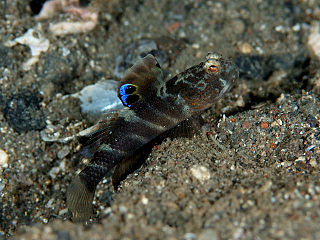
Mahidolia mystacina, the flagfin prawn goby, flagfin shrimpgoby or smiling goby, is a species of goby native to the Indian Ocean and the Pacific Ocean from Delagoa Bay, Mozambique to the Society Islands and from southern Japan to Samoa and northern Australia. This species occurs in marine and brackish waters, being found in coastal bays, estuaries and reef bases where the bottom is silty or muddy at depths of from 5 to 25 metres. This species is a commensal with a species of alpheid shrimp, using its burrow as its home. This species can reach a length of 8 centimetres (3.1 in) TL. This species can also be found in the aquarium trade. It is currently the only known member of its genus.

Oxyurichthys microlepis, the maned goby, is a species of goby native to tropical marine and brackish waters along the coasts of the Indian Ocean from Africa to the western Pacific Ocean where it occurs in estuaries and inshore waters to depths of about 75 metres (246 ft). It occurs in the Mekong Delta and is suspected to use the tidal flow up the river to reach as far inland as Cambodia. This species can reach a length of 13.5 centimetres (5.3 in) TL. It is of minor importance to local commercial fisheries and can also be found in the aquarium trade.

Priolepis semidoliata, the half-barred goby, is a species of goby native to the Indo-Pacific region.
Elacatinus horsti, the yellowline goby, is a species of goby native to the western Atlantic Ocean and the Caribbean Sea.
Elacatinus chancei, the shortstripe goby, is a species of ray-finned fish in the family Gobiidae. It lives inside or on the surface of a sponge and occurs in tropical waters in the west central Atlantic Ocean, the Bahamas, the Antilles, and Venezuela.

The Isthmus goby is a species of goby native to marine and brackish waters of the Indian Ocean and the western Pacific Ocean where it can be found at depths of from 3 to 15 metres. This species lives on substrates consisting of a mix of sand and rubble. This species grows to a length of 10.2 centimetres (4.0 in) SL. This species is the only known member of its genus.
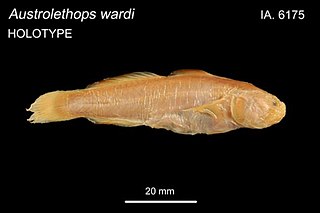
The small-eyed goby is a species of goby native to tropical reefs of the Indian Ocean through the western Pacific Ocean where it inhabits areas of coral rubble. As its common name suggests, this species has particularly small eyes. This species grows to a length of 6 centimetres (2.4 in) TL. This species is the only known member of its genus. The small-eyed goby is specialised to feed on seagrass and they share a burrows with mud lobsters of the genus Thalassina. The specific name honours Charles Melbourne Ward (1903-1966), the Australian actor, naturalist and collector of specimens who collected the type specimen.
Barbuligobius boehlkei, the Cryptic bearded goby, is a species of goby native to the Indian Ocean and the western Pacific Ocean where it can be found on sand-rubble substrates at depths of from 1 to 15 metres. This species grows to a length of 2 centimetres (0.79 in) SL. This species is the only known member of its genus. Its specific name honours James E. Böhlke (1930-1982) of the Academy of Natural Sciences of Philadelphia.
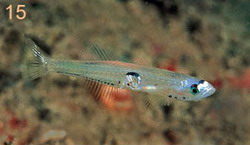
Crystallogobius linearis, the crystal goby, is a species of goby native to the Atlantic coasts of Europe and the Mediterranean Sea where it can be found at depths of from 1 to 400 metres. Males of this species grow to a length of 4.7 centimetres (1.9 in) SL while females only reach 3.9 centimetres (1.5 in) SL. This species is the only known member of its genus. The name Crystallogobius comes from the Latin words cristallum, meaning "crystal", and gobius, meaning gudgeon.

Valenciennea helsdingenii is a species of goby from the Indo-Pacific. It is commonly known as the twostripe goby, black-lined sleeper goby, or railway sleeper goby. It can grow up to a length of 25 cm (9.8 in) and is distinguishable by two prominent orange to black lines running longitudinally through its body.
Ginsburgellus novemlineatus, the Nineline goby, is a species of goby native to tropical reefs of the western Atlantic Ocean and the Caribbean Sea. It is frequently found associated with the sea urchin Echinometra lucunter, living underneath the urchin. This species grows to a length of 2.5 centimetres (0.98 in) TL. This species can also be found in the aquarium trade. This species is the only known member of its genus, the name of which honours the ichthyologist Isaac Ginsburg (1886-1975) of the U.S. National Museum who had an interest in gobies.
The comb goby is a species of goby native to marine and brackish waters of the Indian Ocean and the western Pacific Ocean. This species occurs mostly on muddy substrates near mangrove forests. This species grows to a length of 18 centimetres (7.1 in) TL. This species is of minor importance to local commercial fisheries and can also be found in the aquarium trade. This species is the only known member of its genus. Paratrypauchen microcephalus has been recorded from areas which have soft, muddy bottoms, in estuaries and around the mouths of rivers near mangroves where they inhabit deep burrows in the mud. It is not known if they excavate the burrows themselves. This species feeds on benthic invertebrates such as crustaceans.
The peppered goby is a species of goby native to the waters around the Bahamas and Curaçao where it is mostly found inhabiting sponges, showing a particular affinity for Spheciospongia vesparia. This species is the only known member of its genus.

Phyllogobius platycephalops, the Slender spongegoby, is a species of goby native to the western Indian Ocean and the western Pacific Ocean where it occurs on reefs at depths of from 2 to 18 metres. This species is a commensal on sponges of the genus Phyllospongia. This species grows to a length of 5 centimetres (2.0 in) SL. This species is the only known member of its genus.
Trypauchenopsis intermedia, the bearded eel goby, is a species of goby native to fresh waters from the Atlantic coast of South Africa to the Pacific island of Guam. This species grows to a length of 9.5 centimetres (3.7 in) TL. This species is the only known member of its genus.

Pleurosicya mossambica, also known as the toothy goby or the Mozambique ghost goby, is a small species of goby native to the tropical Indo-West Pacific region. It was first described by South African ichthyologist J.L.B. Smith in 1959. Like many other gobies, it forms commensal relationships with several other marine invertebrates, including soft corals and sponges.