Related Research Articles
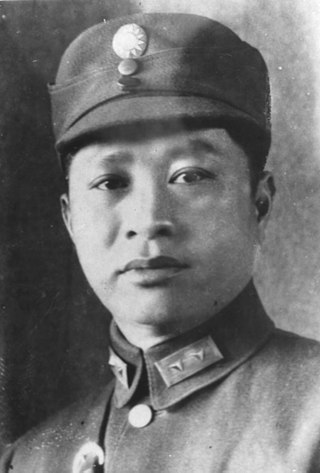
Ye Ting, born in Huiyang, Guangdong, was a Chinese military leader who played a key role in the Northern Expedition to reunify China after the 1911 Revolution. After serving with the Kuomintang, Ye later joined the Chinese Communist Party (CCP).
Donghu was a tribal confederation of "Hu" (胡) nomadic people that was first recorded from the 7th century BCE and was taken over by the Xiongnu in 150 BCE. They lived in northern Hebei, southeastern Inner Mongolia and the western part of Liaoning, Jilin and Heilongjiang along the Yan Mountains and Greater Khingan Range.
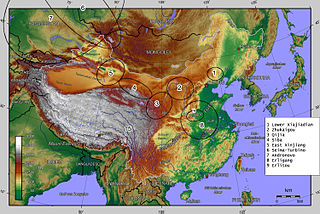
The Lower Xiajiadian culture is an archaeological culture in Northeast China, found mainly in southeastern Inner Mongolia, northern Hebei, and western Liaoning, China. Subsistence was based on millet farming supplemented with animal husbandry and hunting. Archaeological sites have yielded the remains of pigs, dogs, sheep, and cattle. The culture built permanent settlements and achieved relatively high population densities. The population levels reached by the Lower Xiajiadian culture in the Chifeng region would not be matched until the Liao Dynasty. The culture was preceded by the Hongshan culture, through the transitional Xiaoheyan culture. The type site is represented by the lower layer at Xiajiadian in Chifeng, Inner Mongolia.

The Upper Xiajiadian culture was a Bronze Age archaeological culture in Northeast China derived from the Eurasian steppe bronze tradition. It is associated with the Donghu of Chinese history.
The Tagar culture was a Bronze Age Saka archeological culture which flourished between the 8th and 1st centuries BC in South Siberia. The culture was named after an island in the Yenisei River opposite Minusinsk. The civilization was one of the largest centres of bronze-smelting in ancient Eurasia.

Yang Erche Namu is a Chinese writer and singer of Mosuo ethnicity.
Deng Wei Hon FRPS was a Chinese portrait photographer who was a professor at Tsinghua University, China. He was known for his photographic projects such as the Chinese Cultural Celebrity Portrait project, and the World Celebrities project.

Guifang was an ancient ethnonym for a northern people that fought against the Shang Dynasty. Chinese historical tradition used various names, at different periods, for northern tribes such as Guifang, Rong, Di, Xunyu, Xianyun, or Xiongnu peoples. This Chinese exonym combines gui and fang, a suffix referring to "non-Shang or enemy countries that existed in and beyond the borders of the Shang polity."
Luobohe Miao, also known as Hmjo or A-Hmyo, is a Miao language of China.
Tang Haoming, also known as Deng Yunsheng, is a Chinese novelist. He is best known for writing biographical novels of Zeng Guofan, Zhang Zhidong, and Yang Du. He is now the vice president of Hunan Writers Association.

Yang Le was a Chinese mathematician. He was a member of the Chinese Academy of Sciences.
The Soong Ching-ling Children’s Literature Prize 宋庆龄儿童文学奖(pinyin: Song Qingling ertong wenxue jiang) is a prize for children’s literature in China. It is sponsored by the Soong Ching-ling Foundation, and is awarded every two years, with a different genre specified each time. It is one of the four main prizes for children's literature in China.
Yang Shiming or Shih-Ming Yang was a Chinese thermodynamicist, who was a pioneer in heat transfer in mainland China.
Qian Lingxi, also known as Tsien Ling-hi, was a Chinese civil engineer and physicist. An authority on engineering structural mechanics and computational mechanics, he served as president of the Dalian University of Technology (DUT) and was a founding member of the Chinese Academy of Sciences (CAS). DUT's Lingxi Library, opened in 2009, is named after him.
She or Shehua is an unclassified Sinitic language spoken by the She people of Southeastern China. It is also called Shanha, San-hak (山哈) or Shanhahua (山哈话). She speakers are located mainly in Fujian and Zhejiang provinces of Southeastern China, with smaller numbers of speakers in a few locations of Jiangxi, Guangdong and Anhui provinces.
Yang Tianshi is a Chinese historian who is a professor at the Graduate School of the Chinese Academy of Social Sciences. He is a member of the Chinese Academy of Social Sciences and the Central Research Institute of Culture and History. He has been hailed as first person from the Chinese mainland to study Chiang Kai-shek.
The Sauromatian culture was an Iron Age culture of horse nomads in the area of the lower Volga River to the southern Ural Mountain, in southern Russia, dated to the 6th to 4th centuries BCE. Archaeologically, the Sauromatian period itself is sometimes also called the "Blumenfeld period", and is followed by a transitional Late Sauromatian-Early Sarmatian period, also called the "Prokhorov period".

The Samus culture is an Early Bronze Age archaeological culture, around 2000 BC. It was widespread in Tomsk-Narym Basin Southern Western Siberia, on the middle Irtysh and in the upper reaches of the Ob and showed close ties to the neighboring Krotov culture.
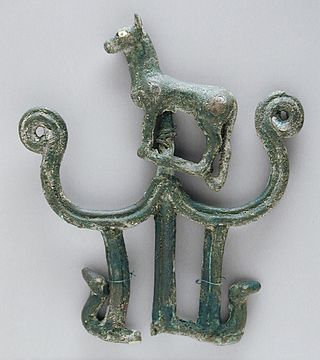
A rein hook, or rein holder is a device used in chariotry. It is designed to hold the reins in place when the driver is away, or his hands are used for something else than driving. It is used to free the rider's hands. It is held in place by a "charioteer's belt".

The Maoqinggou culture is an archaeological culture of Inner Mongolia, to the east of the Ordos culture area, centered around the Maoqinggou cemetery. It is an important site for the understanding of China's northern grasslands in the early Iron Age. The site has four phases, from the Spring and Autumn period to the late Warring States period, including a period of early Xiongnu occupation.
References
- 1 2 Cao Hongbo 蔡鸿博, ed. (10 March 2020). "致敬最美的她——文博界的女学者们" [Paying respects to those who are most beautiful: Female scholars of cultural heritage and museum studies]. Wangyi. Retrieved 19 March 2021.
- 1 2 "心无旁骛踏实地,守得云开见月明——杨建华教授访谈" [Keep your feet on the ground with no distractions, after rain there's always a rainbow: An interview with Professor Yang Jianhua]. Chinese Archaeology (in Chinese). 12 January 2017. Retrieved 11 November 2022.
- ↑ Shao Huiqiu; Yang Jianhua (2019). "执着与坚守:杨建华教授访谈录" [Perserverance and persistance: transcript of Professor Yang Jianhua's interview]. Cultural Relics in Southern China (in Chinese) (1): 23–43.