
Under the Whyte notation for the classification of steam locomotives, 0-4-0 represents one of the simplest possible types, that with two axles and four coupled wheels, all of which are driven. The wheels on the earliest four-coupled locomotives were connected by a single gear wheel, but from 1825 the wheels were usually connected with coupling rods to form a single driven set.
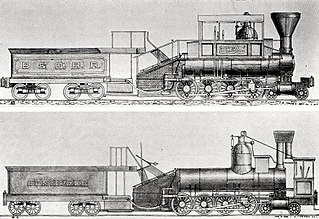
Under the Whyte notation for the classification of steam locomotives, 4-8-0 represents the wheel arrangement of four leading wheels on two axles, usually in a leading truck or bogie, eight powered and coupled driving wheels on four axles and no trailing wheels. In North America and in some other countries the type was usually known as the Twelve-wheeler.

Under the Whyte notation for the classification of steam locomotives, a 2-6-4 locomotive has two leading wheels, six coupled driving wheels and four trailing wheels.
The following lists events that happened during 1907 in South Africa.

The Bristol and Exeter Railway Fairfield was an experimental broad gauge self-propelled steam carriage. In later use the carriage portion was removed and it was used as a small shunting locomotive.
Railmotor is a term used in the United Kingdom and elsewhere for a railway lightweight railcar, usually consisting of a railway carriage with a steam traction unit, or a diesel or petrol engine, integrated into it.
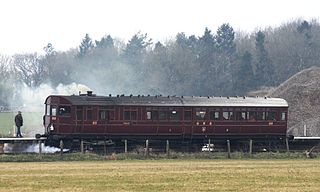
The steam rail motors (SRM) were self-propelled carriages operated by the Great Western Railway in England and Wales from 1903 to 1935. They incorporated a steam locomotive within the body of the carriage.

Under the Whyte notation for the classification of steam locomotives, 0-6-0+0-6-0 represents the wheel arrangement of an articulated locomotive with two separate swivelling engine units, each unit with no leading wheels, six powered and coupled driving wheels on three axles and no trailing wheels. The arrangement is effectively two 0-6-0 locomotives operating back-to-back and was used on Garratt, Double Fairlie, Meyer and Kitson-Meyer articulated locomotives. A similar arrangement exists for Mallet steam locomotives on which only the front engine unit swivels, but these are referred to as 0-6-6-0.
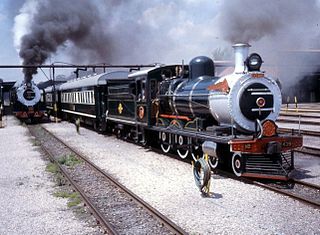
The South African Railways Class 6 4-6-0 of 1893 was a steam locomotive from the pre-Union era in the Cape of Good Hope.
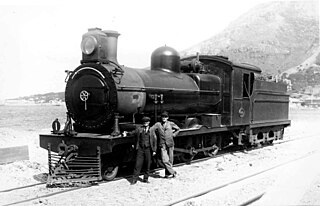
The South African Railways Class 6A 4-6-0 of 1896 was a steam locomotive from the pre-Union era in the Cape of Good Hope.

The South African Railways Class 6B 4-6-0 of 1897 was a steam locomotive from the pre-Union era in the Cape of Good Hope.
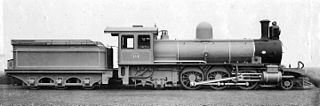
The South African Railways Class 6Z 2-6-4 of 1901 was a steam locomotive from the pre-Union era in the Cape of Good Hope.

A steam motor is a form of steam engine used for light locomotives and light self-propelled motor cars used on railways. The origins of steam motor cars for railways go back to at least the 1850s, if not earlier, as experimental economizations for railways or railroads with marginal budgets. These first examples, at least in North America, appear to have been fitted with light reciprocating engines, and either direct or geared drives, or geared-endless chain drives. Most incorporated a passenger carrying coach attached to the engine and its boiler. Boiler types varied in these earlier examples, with vertical boilers dominant in the first decade and then with very small diameter horizontal boilers. Other examples of steam motor cars incorporated an express-baggage or luggage type car body, with coupling apparatus provided to allow the steam motor car to draw a light passenger coach.

The NZASM 19 Tonner 0-4-2T of 1891 was a South African steam locomotive from the pre-Union era in Transvaal.
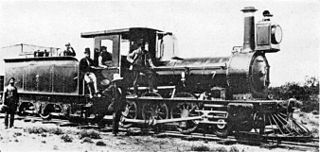
The Cape Government Railways 1st Class 2-6-0 of 1876 by Beyer, Peacock and Avonside was a South African steam locomotive from the pre-Union era in the Cape of Good Hope.
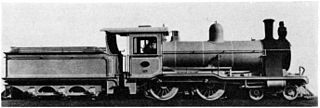
The Cape Government Railways 3rd Class 4-4-0 of 1903 was a South African steam locomotive from the pre-Union era in the Cape of Good Hope.

The CSAR Railmotor of 1907 was a South African steam railmotor locomotive from the pre-Union era in Transvaal Colony.

The Cape Government Railways Railmotor of 1906 was a South African steam railmotor locomotive from the pre-Union era in the Cape of Good Hope.
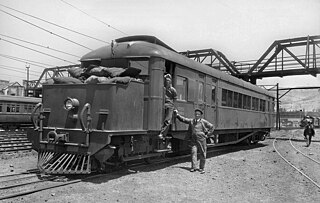
The South African Railways Clayton Railmotor of 1929 was a steam railmotor.

South African steam locomotive tenders were classified by means of type letters and sometimes numbers, while locomotive specifications included a list of permissible tenders which could be used with each engine class.


