13th Illinois Volunteer Infantry Regiment

Last updated
13th Regiment Illinois Volunteer Infantry

First at Vicksburg.jpg

Pictured are the Confederate Lines, Vicksburg, Mississippi, May 19, 1863. In this assault against bitter resistance the 1st Battalion, 13th Infantry, lost forty-three percent of its men, but of the attacking force, it alone fought its color up the steep slope to the top. General Sherman called its performance "unequalled in the Army" and authorized the 13th Infantry to inscribe "First at Vicksburg" on its color. From U.S. Army Center of Military History painting in "US Army in Action" series.
Active April 21, 1861, to June 18, 1864
CountryFlag of the United States (1863-1865).svg  United States
Allegiance

Flag of Illinois.svg  Illinois

Flag of the United States (1863-1865).svg  United States
Branch Infantry Flag of the United States (1863-1865).svg Union Army
Engagements

American Civil War

The 13th Regiment Illinois Volunteer Infantry, nicknamed "Fremont's Grey Hounds," was an infantry regiment that served in the Union Army during the American Civil War. The Thirteenth was one of the regiments organized under the act known as the Ten Regiment Bill. [1]

Infantry military service branch that specializes in combat by individuals on foot

Infantry is the branch of an army that engages in military combat on foot, distinguished from cavalry, artillery, and tank forces. Also known as foot soldiers, infantry traditionally relies on moving by foot between combats as well, but may also use mounts, military vehicles, or other transport. Infantry make up a large portion of all armed forces in most nations, and typically bear the largest brunt in warfare, as measured by casualties, deprivation, or physical and psychological stress.

Regiment Military unit

A regiment is a military unit. Their role and size varies markedly, depending on the country and the arm of service.

Union Army Land force that fought for the Union during the American Civil War

During the American Civil War, the Union Army referred to the United States Army, the land force that fought to preserve the Union of the collective states. Also known as the Federal Army, it proved essential to the preservation of the United States of America as a working, viable republic.

Contents

Service

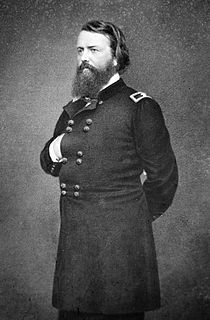
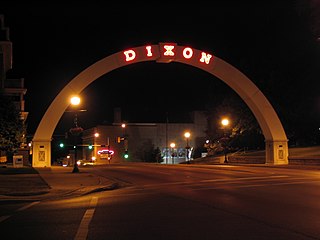
The 13th Illinois Infantry was mustered into state service by Captain John Pope, at Camp Dement, Dixon, Illinois, on April 21, 1861, and summoned into Federal service on May 24, 1861, for a three-year term. The Thirteenth was the first Regiment organized from the Second Congressional District of Northern Illinois. [1] [2]

John Pope (military officer) Union United States Army general

John Pope was a career United States Army officer and Union general in the American Civil War. He had a brief stint in the Western Theater, but he is best known for his defeat at the Second Battle of Bull Run in the East.

Dixon, Illinois City in Illinois, United States

Dixon is a city and the county seat of Lee County, Illinois, United States. The population was 15,733 as of the 2010 census, down from 15,941 in 2000. The city is named after founder John Dixon, who operated a rope ferry service across Rock River, which runs through the city. The Illinois General Assembly designated Dixon as "Petunia Capital of Illinois" in 1999 and "The Catfish Capital of Illinois" in 2009.

In June, the regiment was ordered to Caseyville, Illinois, 10 miles east of St. Louis, and by July 5, had arrived at Rolla, Missouri, where it remained until the spring of 1862. While stationed at Rolla, the regiment was deployed to guard the supply trains to and from General Lyon’s army, from guerrilla bands in that part of the state. The Thirteenth was also part of General Fremont’s force that went to Springfield, Missouri, in the fall of 1861. [2] In 1862 the regiment joined General Curtis’ army at Pea Ridge, Missouri, 250 miles southwest of Rolla, in his march from Pea Ridge to Helena, Arkansas, on the Mississippi River. [1]

Caseyville, Illinois Village in Illinois, United States

Caseyville is a village in St. Clair County, Illinois, United States. The population was 4,245 at the 2010 census, a decline from 4,310 in 2000.

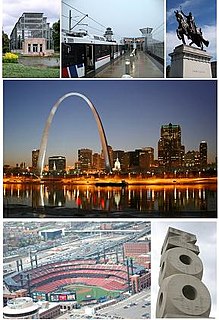
St. Louis Independent city in the United States

St. Louis is an independent city and major inland port in the U.S. state of Missouri. It is situated along the western bank of the Mississippi River, which marks Missouri's border with Illinois. The city had an estimated 2017 population of 308,626 and is the cultural and economic center of the St. Louis metropolitan area, which is the largest metropolitan area in Missouri, the second-largest in Illinois, and the 22nd-largest in the United States.

Rolla, Missouri City in Missouri, United States

Rolla is a city in and the county seat of Phelps County, Missouri, United States. The population in the 2010 United States Census was 19,559. Rolla is located approximately midway between St. Louis and Springfield along I-44. The Rolla, Mo Micropolitan Statistical area consists of Phelps County, Missouri.

The regiment was part of General Sherman’s army in his attack on Chickasaw Bayou, and on the first day of battle at the Bayou, Colonel Wyman was killed. [1] The Thirteenth was also present at the capture of Arkansas Post, and was successful in a raid in Greenville, Mississippi. [2]

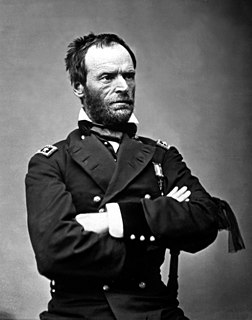
William Tecumseh Sherman US Army general, businessman, educator, and author

William Tecumseh Sherman was an American soldier, businessman, educator, and author. He served as a general in the Union Army during the American Civil War (1861–65), for which he received recognition for his outstanding command of military strategy as well as criticism for the harshness of the scorched earth policies he implemented in conducting total war against the Confederate States.

Battle of Chickasaw Bayou

The Battle of Chickasaw Bayou, also called the Battle of Walnut Hills, fought December 26–29, 1862, was the opening engagement of the Vicksburg Campaign during the American Civil War. Confederate forces under Lt. Gen. John C. Pemberton repulsed an advance by Union Maj. Gen. William T. Sherman that was intended to lead to the capture of Vicksburg, Mississippi.

Arkansas Post human settlement in United States of America

The Arkansas Post was the first European settlement in the lower Mississippi River Valley and present-day Arkansas when Henri de Tonti established it in 1686 as a French trading post on the banks of the lower Arkansas River. The French and Spanish traded with the Quapaw for years, and the post was of strategic value to the French, Spanish, and Americans. It was designated as the first capital of the Arkansas Territory in 1819, but lost that status to Little Rock in 1821. During the years of fur trading, Arkansas Post was protected by a series of forts. The forts and associated settlements were located at three known sites and possibly a fourth, as the waterfront area was prone to erosion and flooding.

The regiment was mustered out on June 18, 1864.

Total strength and casualties

The regiment suffered 6 officers and 61 enlisted men who were killed in action or who died of their wounds and 5 officers and 123 enlisted men who died of disease, for a total of 192 fatalities. [3]

Infantry field and staff

See also

Related Research Articles

John S. Phelps Union Army officer

John Smith Phelps was a politician, soldier during the American Civil War, and the 23rd Governor of Missouri.

The 34th Indiana Veteran Volunteer Infantry Regiment, nicknamed The Morton Rifles, was an Infantry Regiment that served in the Union Army during the American Civil War. It had the distinction of fighting in the last land action of the war, the Battle of Palmito Ranch, Texas May 12–13, 1865, and also of suffering the last soldier killed during the war, Private John J. Williams.

The 15th Regiment of the Illinois Volunteer Cavalry was a volunteer cavalry regiment that served in the Union Army during the American Civil War.

The 9th Iowa Infantry Regiment was an infantry regiment that served in the Union Army during the American Civil War.

The 30th Regiment Illinois Volunteer Infantry was an infantry regiment that served in the Union Army during the American Civil War.
The 19th Regiment Illinois Volunteer Infantry was an infantry regiment that served in the Union Army during the American Civil War. Three companies formerly with Col. Elmer Ellsworth's Zouave Cadets wore a zouave uniform consisting of a dark blue zouave jacket with red trimmings, red pants, leather gaiters, a sky blue shirt, red sash, and a red French styled kepi with a dark blue band. The jacket cuffs were trimmed in yellow-orange and red. Brass buttons went down both fronts of the jacket. They were organized into four separate companies on May 4, 1861, in Chicago. It was consolidated and mustered into Federal service as the 19th Illinois Volunteer Infantry on June 17, 1861. It was mustered out at Chicago on July 9, 1864.

The 23rd Regiment Illinois Volunteer Infantry, known as the "First Irish" or "Irish 'Brigade'", was an infantry regiment that served in the Union Army during the American Civil War.

The 24th Regiment Illinois Volunteer Infantry, also known as the 1st Hecker Jaeger Regiment, was an infantry regiment that served in the Union Army during the American Civil War. It was made up almost exclusively of German, Hungarian, Czech and Slovak immigrants. It was the first unit mobilised for the war in Chicago, and was composed of many Forty-Eighters, veterans of the revolutions of 1848 in Germany and the Austrian Empire.

The 25th Regiment Illinois Volunteer Infantry was an infantry regiment that served in the Union Army during the American Civil War.

The 37th Regiment Illinois Volunteer Infantry, nicknamed the "Fremont Rifles" and "Illinois Greyhounds", was an infantry regiment that served in the Union Army during the American Civil War.

The 47th Regiment Illinois Volunteer Infantry was an infantry regiment that served in the Union Army during the American Civil War.

59th Illinois Infantry Regiment

.

The 2nd Missouri Volunteer Infantry was an infantry regiment that served in the Union Army during the American Civil War. The regiment was organized by Colonel Peter J. Osterhaus, a veteran of the respected 2nd Missouri Volunteer Infantry. The majority of the soldiers in the 12th were ethnic Germans. This intermixed German-American unit also had a large portion of its ranks filled by volunteers from Illinois.

The 7th Kentucky Volunteer Infantry Regiment was an infantry regiment that served in the Union Army during the American Civil War.

1st Kansas Volunteer Infantry Regiment

The 1st Kansas Volunteer Infantry Regiment was an infantry regiment that served in the Union Army during the American Civil War. On August 10, 1861, at the Battle of Wilson's Creek, Missouri, the regiment suffered 106 soldiers killed in action or mortally wounded, one of the highest numbers of fatalities suffered by any Union infantry regiment in a single engagement during the American Civil War.

The 2nd Missouri Volunteer Infantry was an infantry regiment that served in the Union Army during the American Civil War.

The 58th Ohio Volunteer Infantry was an infantry regiment in the Union Army during the American Civil War.

The 77th Ohio Volunteer Infantry was an infantry regiment in the Union Army during the American Civil War.

The Second Missouri Volunteer Cavalry, also known officially as Merrill's Horse, was a cavalry regiment that served in the Union Army during the American Civil War. The regiment was one of only a handful of Missouri regiments to be officially "named" as well as numbered.

The 17th Missouri Volunteer Infantry was an infantry regiment that served in the Union Army during the American Civil War.

References