
The Odonata are an order of flying insects that includes the dragonflies and damselflies. Like most other flying insects, they evolved in the early Mesozoic era. Their prototypes, the giant dragonflies of the Carboniferous, 325 mya, are no longer placed in the Odonata but included in the Protodonata or Meganisoptera.

Mayflies are aquatic insects belonging to the order Ephemeroptera. This order is part of an ancient group of insects termed the Palaeoptera, which also contains dragonflies and damselflies. Over 3,000 species of mayfly are known worldwide, grouped into over 400 genera in 42 families.
The following are lists of insects of Great Britain. There are more than 20,000 insects of Great Britain, this page provides lists by order.

The blue-tailed damselfly or common bluetail is a damselfly, belonging to the family Coenagrionidae.
The most recent understanding of the evolution of insects is based on studies of the following branches of science: molecular biology, insect morphology, paleontology, insect taxonomy, evolution, embryology, bioinformatics and scientific computing. It is estimated that the class of insects originated on Earth about 480 million years ago, in the Ordovician, at about the same time terrestrial plants appeared. Insects may have evolved from a group of crustaceans. The first insects were landbound, but about 400 million years ago in the Devonian period one lineage of insects evolved flight, the first animals to do so. The oldest insect fossil has been proposed to be Rhyniognatha hirsti, estimated to be 400 million years old, but the insect identity of the fossil has been contested. Global climate conditions changed several times during the history of Earth, and along with it the diversity of insects. The Pterygotes underwent a major radiation in the Carboniferous while the Endopterygota underwent another major radiation in the Permian.

Insect wings are adult outgrowths of the insect exoskeleton that enable insects to fly. They are found on the second and third thoracic segments, and the two pairs are often referred to as the forewings and hindwings, respectively, though a few insects lack hindwings, even rudiments. The wings are strengthened by a number of longitudinal veins, which often have cross-connections that form closed "cells" in the membrane. The patterns resulting from the fusion and cross-connection of the wing veins are often diagnostic for different evolutionary lineages and can be used for identification to the family or even genus level in many orders of insects.

Baetidae is a family of mayflies with about 1000 described species in 110 genera distributed worldwide. These are among the smallest of mayflies, adults rarely exceeding 10 mm in length excluding the two long slender tails and sometimes much smaller, and members of the family are often referred to as small mayflies or small minnow mayflies. Most species have long oval forewings with very few cross veins but the hindwings are usually very small or even absent. The males often have very large eyes, shaped like turrets above the head.
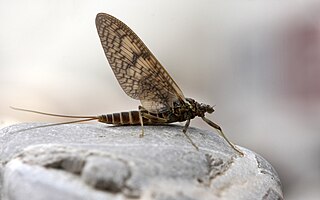
The Heptageniidae are a family of mayflies with over 500 described species mainly distributed in the Holarctic, Oriental, and Afrotropical regions, and also present in the Central American Tropics and extreme northern South America. These are generally rather small mayflies with three long tails. The wings are usually clear with prominent venation although species with variegated wings are known. As in most mayflies, the males have large compound eyes, but not divided into upper and lower parts.
Dry fly fishing is an angling technique in which the lure is an artificial fly which floats on the surface of the water and does not sink below the surface. Developed originally for trout fly fishing, it is sometimes regarded as the supreme fishing sport, owing to its difficulty in both manual dexterity and understanding of the fish in its environment.

An artificial fly or fly lure is a type of fishing lure, usually used in the sport of fly fishing. In general, artificial flies are an imitation of natural food sources that fly fishers present to their target species of fish while fly fishing. Artificial flies are constructed by fly tying, in which furs, feathers, thread or any of very many other materials are tied onto a fish hook. Artificial flies may be constructed to represent all manner of potential freshwater and saltwater fish prey to include aquatic and terrestrial insects, crustaceans, worms, baitfish, vegetation, flesh, spawn, small reptiles, amphibians, mammals and birds, etc. Effective artificial fly patterns are said to be killing flies because of their ability to put fish in the creel for the fly fisher. There are thousands of artificial fly patterns, many of them with descriptive and often idiosyncratic names.

Baetis is a genus of mayflies of the family Baetidae, known as the blue-winged olive to anglers. There are at least 150 described species in Baetis. They are distributed worldwide, with the most variety in North America and northern Europe.
Fallceon is a genus of blue-winged olives in the family of mayflies called Baetidae. There are about 19 described species in Fallceon.

The shadow darner is a species of dragonfly in the family Aeshnidae. It is found in almost all of Canada and most states in the United States.

Sympetrum madidum, the red-veined meadowhawk, is a species of dragonfly in the family Libellulidae.
Rhithrogena germanica is a European species of mayfly, and is "probably the most famous of all British mayflies", because of its use in fly fishing. It is known in the British Isles as the March brown mayfly, a name which is used in the United States for a different species, Rhithrogena morrisoni. It emerges as a subimago at the end of winter, and can be distinguished from similar species by a dark spot on the femur of each leg.
Cloeon dipterum is a species of mayfly with a Holarctic distribution. It is the most common mayfly in ponds in the British Isles and the only ovoviviparous mayfly in Europe. Males differ from females in having turbinate eyes.

The Adams is a traditional dry fly primarily used for trout. It is considered a general imitation of an adult mayfly, flying caddis or midge. It was designed by Leonard Halladay from Mayfield, Michigan in 1922, at the request of his friend Charles Adams. The Adams has been considered one of the most popular, versatile, effective and best selling dry flies since its creation.

Ephemera vulgata is a species of mayfly in the genus Ephemera. This mayfly breeds in stationary water in slow rivers and in ponds, the nymphs developing in the mud.
Acerpenna macdunnoughi is a species of small minnow mayfly in the family Baetidae. It is found in North America.
Acerpenna pygmaea, the tiny blue-winged olive, is a species of small minnow mayfly in the family Baetidae. It is found in all of Canada and the continental United States.


