
A cherry is the fruit of many plants of the genus Prunus, and is a fleshy drupe.
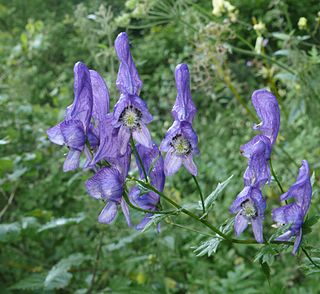
Aconitum, also known as aconite, monkshood, wolfsbane, leopard's bane, devil's helmet, or blue rocket, is a genus of over 250 species of flowering plants belonging to the family Ranunculaceae. These herbaceous perennial plants are chiefly native to the mountainous parts of the Northern Hemisphere in North America, Europe, and Asia; growing in the moisture-retentive but well-draining soils of mountain meadows.

Primula is a genus of herbaceous flowering plants in the family Primulaceae. They include the primrose, a familiar wildflower of banks and verges. Other common species are P. auricula (auricula), P. veris (cowslip), and P. elatior (oxlip). These species and many others are valued for their ornamental flowers. They have been extensively cultivated and hybridised. Primula are native to the temperate Northern Hemisphere, south into tropical mountains in Ethiopia, Indonesia, and New Guinea, and in temperate southern South America. Almost half of the known species are from the Himalayas.

Forsythia, is a genus of flowering plants in the olive family Oleaceae. There are about 11 species, mostly native to eastern Asia, but one native to southeastern Europe. Forsythia – also one of the plant's common names – is named after William Forsyth.

Delphinium is a genus of about 300 species of annual and perennial flowering plants in the family Ranunculaceae, native throughout the Northern Hemisphere and also on the high mountains of tropical Africa. The genus was erected by Carl Linnaeus.

Dasiphora fruticosa is a species of hardy deciduous flowering shrub in the family Rosaceae, native to the cool temperate and subarctic regions of the northern hemisphere, often growing at high altitudes in mountains. Dasiphora fruticosa is still widely referenced in the horticultural literature under its synonym Potentilla fruticosa. Common names include shrubby cinquefoil, golden hardhack, bush cinquefoil, shrubby five-finger, widdy, and kuril tea.

Hydrangea macrophylla is a species of flowering plant in the family Hydrangeaceae, native to China. It is a deciduous shrub growing to 2 m (7 ft) tall by 2.5 m (8 ft) broad with large heads of pink or blue flowers in summer and autumn. Common names include bigleaf hydrangea, French hydrangea, lacecap hydrangea, mophead hydrangea, and hortensia. It is widely cultivated in many parts of the world in many climates. It is not to be confused with H. aspera 'Macrophylla'.

Abutilon pictum, syn. Abutilon striatum (disputed), is a species of flowering plant in the family Malvaceae. It is native to southern Brazil, Argentina, Paraguay and Uruguay. The plant has become naturalised in Central America, and is used in horticulture. Common names include redvein abutilon, red vein Indian mallow, redvein flowering maple, Chinese-lantern and red vein Chinese lanterns.

Camellia japonica, known as common camellia, or Japanese camellia, is a species of Camellia, a flowering plant genus in the family Theaceae. There are thousands of cultivars of C. japonica in cultivation, with many colors and forms of flowers. Despite its common name, it is native to China, not Japan. The cultivation of Camellia japonica also started in China. Its widespread cultivation can be traced back to the Song Dynasty, when 15 varieties of Camellia japonica were recorded in literature. It was later introduced to Japan. It grows in forests, at altitudes of around 300–1,100 metres (980–3,600 ft).

Lavandula angustifolia, formerly L. officinalis, is a flowering plant in the family Lamiaceae, native to the Mediterranean. Its common names include lavender, true lavender and English lavender ; also garden lavender, common lavender and narrow-leaved lavender.

Papaver nudicaule, the Iceland poppy, is a boreal flowering plant. Native to subpolar regions of Asia and North America, and the mountains of Central Asia as well as temperate China, Iceland poppies are hardy but short-lived perennials, often grown as biennials. They yield large, papery, bowl-shaped, lightly fragrant flowers supported by hairy, 1 foot (30 cm) curved stems among feathery blue-green foliage 1-6 inches long. They were first described by botanists in 1759. The wild species blooms in white or yellow, and is hardy from USDA Zones 3a-10b.

Euonymus alatus, known variously as winged spindle, winged euonymus, or burning bush, is a species of flowering plant in the family Celastraceae, native to central and northern China, Japan, and Korea.
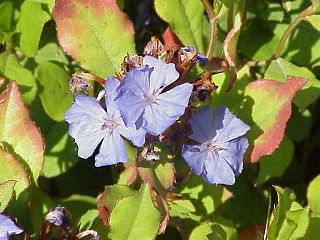
Ceratostigma (;), or leadwort, plumbago, is a genus of eight species of flowering plants in the family Plumbaginaceae, native to warm temperate to tropical regions of Africa and Asia. Common names are shared with the genus Plumbago.

Aconitum carmichaelii is a species of flowering plant of the genus Aconitum, family Ranunculaceae. It is native to East Asia and eastern Russia. It is commonly known as Chinese aconite, Carmichael's monkshood or Chinese wolfsbane. In Mandarin Chinese, it is known as fùzǐ and as wūtóu ; while in Japanese it is named torikabuto.

Euonymus fortunei, the spindle, Fortune's spindle, winter creeper or wintercreeper, is a species of flowering plant in the family Celastraceae, native to east Asia, including China, Korea, the Philippines and Japan. E. fortunei is highly invasive and damaging in the United States, causing the death of trees and forest in urban areas.

Aconitum napellus, monkshood, aconite, Venus' chariot or wolfsbane, is a species of highly toxic flowering plants in the genus Aconitum of the family Ranunculaceae, native and endemic to western and central Europe. It is an herbaceous perennial plant growing to 1 m tall, with hairless stems and leaves. The leaves are rounded, 5–10 cm (2.0–3.9 in) diameter, palmately divided into five to seven deeply lobed segments. The flowers are dark purple to bluish-purple, narrow oblong helmet-shaped, 1–2 cm (0.39–0.79 in) tall. Plants native to Asia and North America formerly listed as A. napellus are now regarded as separate species. The plant is extremely poisonous in both ingestion and body contact.

Lobelia erinus is a species of flowering plant in the bellflower family Campanulaceae, native to southern Africa.

Aster alpinus, the alpine aster or blue alpine daisy, is a species of flowering plant in the family Asteraceae, native to the mountains of Europe, with a subspecies native to Canada and the United States. This herbaceous perennial has purple, pink, or blue flowers in summer.
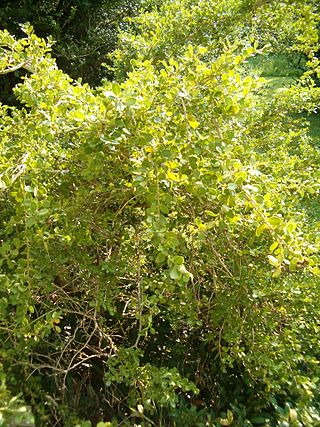
Buxus microphylla, the Japanese box or littleleaf box, is a species of flowering plant in the box family found in Japan and Taiwan. It is a dwarf evergreen shrub or small tree growing to 1 m (3.3 ft) tall and wide.

Elaeagnus macrophylla, the broad-leaved oleaster, is a species of flowering plant native to eastern Asia.


