Related Research Articles
Orokolo is a Trans–New Guinea language spoken in Ihu Rural LLG, Gulf Province, Papua New Guinea by about 50,000 people (2010). Alternate names are Bailala, Haira, Kaipi, Kairu-Kaura, Muro, Muru, Vailala, and West Elema. It is spoken in various villages, including Vailala.
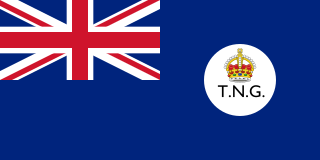
The Territory of New Guinea was an Australian-administered United Nations trust territory on the island of New Guinea from 1914 until 1975. In 1949, the Territory and the Territory of Papua were established in an administrative union by the name of the Territory of Papua and New Guinea. That administrative union was renamed as Papua New Guinea in 1971. Notwithstanding that it was part of an administrative union, the Territory of New Guinea at all times retained a distinct legal status and identity until the advent of the Independent State of Papua New Guinea.
Amaimon is a Papuan language spoken by 1,781 people in Madang Province, Papua New Guinea. It is spoken in Amaimon, Transgogol Rural LLG.
The Northern Adelbert or Pihom–Isumrud languages are a family of two dozen languages in the Madang stock of New Guinea. The occupy the coastal northern Adelbert Range of mountains, vs. the Southern Adelbert languages, another branch of Madang.
Watiwa is a Rai Coast language of Papua New Guinea.
The Kowan languages are a small family of languages spoken in the Adelbert Range area of Madang Province, Papua New Guinea, and first identified by Malcolm Ross.
Menyamya District is a district of the Morobe Province of Papua New Guinea. Its capital is Menyamya. The population of the district was 87,209 at the 2011 census.
Kaki Ae, or Tate, is a language with about 500 speakers, half the ethnic population, near Kerema, in Papua New Guinea. It was previously known by the foreign designation Raeta Tati.
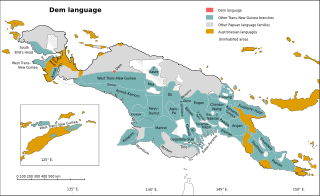
Dem is a divergent Papuan language of West New Guinea. Although Palmer (2018) leaves it unclassified, it was tentatively included in the Trans–New Guinea family in the classification of Malcolm Ross (2005), and Timothy Usher ties it most closely to Amung.
Waskia is a Papuan language of Papua New Guinea. It is spoken on half of Karkar Island, and a small part of the shore on the mainland, by 20,000 people; language use is vigorous. The Waskia share their island with speakers of Takia, an Oceanic language which has been restructured under the influence of Waskia, which is the inter-community language. Waskia has been documented extensively by Malcolm Ross and is being further researched by Andrew Pick.
Siroi (Suroi) is a Rai Coast language spoken in Madang Province, Papua New Guinea, and a local trade language. It is spoken in Kumisanger village, Astrolabe Bay Rural LLG, Madang Province.
Lilau is a Papuan language of Papua New Guinea, closely related to Monumbo. It is spoken in Lilau ward, Almami Rural LLG, Bogia District, Madang Province.
Tairuma, also known as Uaripi after its location, is a Trans–New Guinea language spoken in Uaripi in Central Kerema Rural LLG, Gulf Province, Papua New Guinea.
Aisi, or Musak, is a Papuan language of Madang Province, Papua New Guinea.
Tainae is an Angan language of Gulf Province, Papua New Guinea. Famba (7.506365°S 145.811363°E, Paiguna, and Pio of Kotidanga Rural LLG are the main villages.
Danaru is a Rai Coast language of Papua New Guinea. It is spoken in the single village of Danaru in Usino Rural LLG, Madang Province, Papua New Guinea.
Sam, or Songum, is a Madang language spoken in Madang Province, Papua New Guinea.
Mari, or Hop, is a minor Austronesian language of Madang Province, Papua New Guinea. It is spoken in the four villages of Bumbu, Bubirumpun, Musuam, and Sangkiang in Usino Rural LLG of the Ramu valley.
Almami Rural LLG is a local-level government (LLG) of Madang Province, Papua New Guinea.
Yamben (Yaben) is a Trans–New Guinea language of Madang Province, Papua New Guinea. It was first documented by Andrew Pick in the 2010s and classified by Pick (2019) as a probable primary branch of Madang, though its precise classification is still pending further research. Although surrounded by Croisilles languages, Yamben is not one of them.
References
- 1 2 Korak at Ethnologue (25th ed., 2022)

- ↑ United Nations in Papua New Guinea (2018). "Papua New Guinea Village Coordinates Lookup". Humanitarian Data Exchange. 1.31.9.
