Related Research Articles
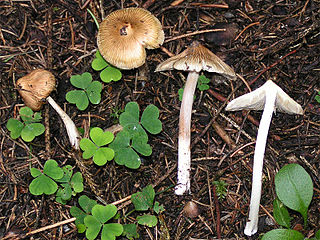
Inocybe is a large genus of mushroom-forming fungi with over 1400 species, including all forms and variations. Members of Inocybe are mycorrhizal, and some evidence shows that the high degree of speciation in the genus is due to adaptation to different trees and perhaps even local environments.
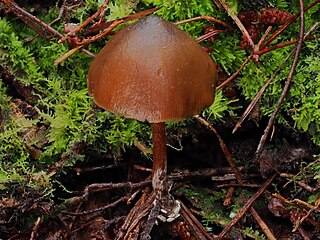
Psilocybe aucklandiae is a species of agaric fungus in the family Hymenogastraceae. The species is known from the Auckland Region of New Zealand, where it grows from clay soils in exotic pine plantations and native forests. It is phylogenetically similar to or almost the same as Psilocybe zapotecorum from Mexico and South America. As a blueing member of the genus Psilocybe it contains the psychoactive compounds psilocin and psilocybin.

Psilocybe subaeruginosa is a species of agaric fungus in the family Hymenogastraceae described in 1927 and known from Australia and New Zealand. As a blueing member of the genus Psilocybe it contains the psychoactive compounds psilocin and psilocybin.
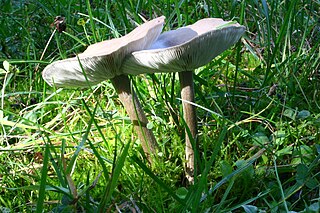
Melanoleuca is a poorly known genus of saprotrophic mushrooms traditionally classified in the family Tricholomataceae. Most are small to medium sized, white, brown, ocher or gray with a cylindrical to subcylindrical stipe and white to pale yellowish gills. The basidiospores are ellipsoid and ornamented with amyloid warts. Melanoleuca is considered a difficult group to study due to their macroscopic similarities among species and the need of a thorough microscopic analysis to separate species. DNA studies have determined that this genus is closely related to Amanita and Pluteus and that it does not belong to the family Tricholomataceae.

Gymnopilus liquiritiae is a mushroom in the family Hymenogastraceae. The mushroom is widely distributed and grows in dense clusters on dead conifer wood. It has a rusty orange spore print, a bitter taste, and does not contain the hallucinogen psilocybin. One of its key distinguishing features is the lack of partial veil.
Psilocybe liniformans var. americana, is a psilocybin mushroom in the family Hymenogastraceae. It is in the section Semilanceatae of Psilocybe and has psilocybin as its main active compound.

Gymnopilus braendlei is a species of agaric fungus in the family Hymenogastraceae that contains the hallucinogens psilocybin and psilocin. It was originally described by mycologist Charles Horton Peck as Flammula braendlei, from specimens found in the District of Columbia in 1902.
Psilocybe plutonia is a small psilocybin mushroom of the family Hymenogastraceae, believed to contain psilocybin and psilocin. It was first documented from Cuba. An older synonym is Agaricus plutonia.
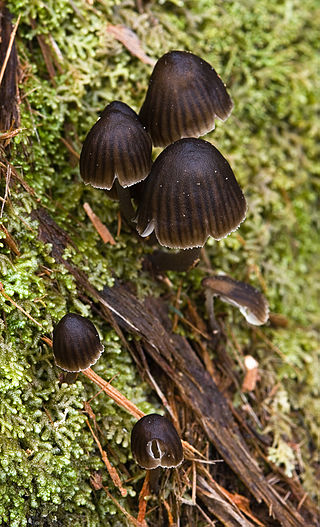
Mycena nargan, commonly known as the Nargan's bonnet, is a species of fungus in the family Mycenaceae, and the sole member of the section Nargan in the genus Mycena. Reported as a new species in 1995, it is known predominantly from Southern Australia. The saprobic fungus produces mushrooms that grow on well-decayed wood, often on the underside of wood lying in litter. The dark chestnut-coloured caps are covered with white, easily removed scales, and reach diameters of up to 2 cm (0.8 in) wide. The pale, slender stems are up to 5 cm (2.0 in) long and have white scales at the base. On the underside of the cap, the cream-coloured gills are widely spaced and bluntly attached to the stem. The edibility of the mushroom is unknown.

Amanita daucipes is a species of fungus in the family Amanitaceae of the mushroom order Agaricales. Found exclusively in North America, the mushroom may be recognized in the field by the medium to large white caps with pale orange tints, and the dense covering of pale orange or reddish-brown powdery conical warts on the cap surface. The mushroom also has a characteristic large bulb at the base of its stem with a blunt short rooting base, whose shape is suggestive of the common names carrot-footed lepidella, carrot-foot amanita, or turnip-foot amanita. The mushroom has a strong odor that has been described variously as "sweet and nauseous", or compared to an old ham bone, or soap. Edibility is unknown for the species, but consumption is generally not recommended due its position in the Amanita subgroup Lepidella, which contains some poisonous members.

Psilocybe aztecorum is a species of psilocybin mushroom in the family Hymenogastraceae. Known from Arizona, Colorado, central Mexico, India and Costa Rica, the fungus grows on decomposing woody debris and is found in mountainous areas at elevations of 2,000 to 4,000 m, typically in meadows or open, grassy conifer forests. The mushrooms have convex to bell-shaped caps 1.5–2 cm (0.6–0.8 in) in diameter, atop slender cylindrical stems that are up to 7.5 cm (3.0 in) long. The color of the caps changes with variations in hydration, ranging from dark chestnut brown to straw yellow or whitish when dry. The base of the stem is densely covered with conspicuous white rhizomorphs, a characteristic uncommon amongst Psilocybe species.
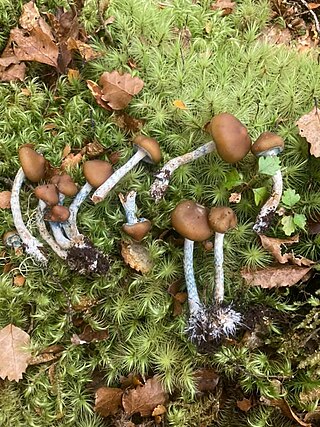
Psilocybe makarorae is a species of psilocybin mushroom in the family Hymenogastraceae. Officially described as new to science in 1995, it is known only from New Zealand, where it grows on rotting wood and twigs of southern beeches. The fruit body (mushroom) has a brownish cap with lighter coloured margins, measuring up to 3.5 cm (1.4 in) wide. The cap shape is either conical, bell-shaped, or flat depending on the age of the mushroom, and it features a prominent umbo. Although the whitish stem does not form a true ring, it retains remnants of the partial veil that covers and protects the gills of young fruit bodies. P. makarorae mushrooms can be distinguished from the similar North American species Psilocybe caerulipes by microscopic characteristics such as the presence of cystidia on the gill faces (pleurocystidia), and cheilocystidia with more elongated necks. Based on the bluing reaction to injury, P. makarorae is presumed to contain the psychedelic compounds psilocybin and psilocin.

Psilocybe yungensis is a species of psychedelic mushroom in the family Hymenogastraceae. In North America, it is found in northeast, central and southeastern Mexico. In South America, it has been recorded from Bolivia, Colombia, and Ecuador. It is also known from the Caribbean island Martinique, and China. The mushroom grows in clusters or groups on rotting wood. The fruit bodies have conical to bell-shaped reddish- to orangish-brown caps that are up to 2.5 cm (1.0 in) in diameter, set atop slender stems 3 to 5 cm long. The mushrooms stain blue when bruised, indicative of the presence of the compound psilocybin. Psilocybe yungensis is used by Mazatec Indians in the Mexican State of Oaxaca for entheogenic purposes.

Mycena fuscoaurantiaca is a species of mushroom in the family Mycenaceae. First reported as a new species in 2007, the diminutive mushroom is only found in Kanagawa, Japan, where it grows on dead fallen twigs in lowland forests dominated by hornbeam (Carpinus) and Chinese evergreen oak trees. The mushroom has a brownish-orange conical cap that has grooves extending to the center, and reaches up to 11 mm (0.43 in) in diameter. Its slender stem is colored similarly to the cap, and long—up to 60 mm (2.4 in) tall. Microscopic characteristics include the weakly amyloid spores, the smooth, swollen cheilocystidia and pleurocystidia with long rounded tips, the diverticulate hyphae of the cap cuticle, and the absence of clamp connections.
Mycena mustea is a species of mushroom in the family Mycenaceae. First described as a new species in 2007, the fungus is known only from Kanagawa, Japan, where it grows on dead fallen twigs in lowland forests. The mushroom's dull violet to grayish-violet cap, initially covered with a fine whitish powder, becomes smooth as it matures, and eventually reaches a diameter of up to 10 mm (0.39 in). The stem is slender, up to 90 mm (3.5 in) long, and is covered with stiff white hairs at the base. Underneath the cap are distantly spaced pale brownish gills that are narrowly attached to the stem. Microscopic characteristics of the mushroom include the weakly amyloid spores, the club-shaped cheilocystidia featuring one or more short knob-like protuberances, the absence of pleurocystidia, the diverticulate cap cuticle hyphae, and the absence of clamp connections.
Mycena nidificata is a species of fungus in the family Mycenaceae of the Agaricales. First collected in 2000 and reported as a new species in 2007, it is known only from Kanagawa, Japan, where it grows on the floor of oak forests. The dark brown irregularly wrinkled cap measures up to 25 mm (1.0 in) in diameter. The cap is supported by a thin stem up to 50 mm (2.0 in) long, which is covered at the base by a whitish hairlike growth, and attached to white, cord-like rhizomorphs—aggregations of mycelium that resemble plant roots. The underside of the cap features thin, distantly spaced grayish gills that have distinct veins running between them. At a microscopic level, distinguishing characteristics include the inamyloid spores, the club-shaped cheilocystidia with finger-like appendages, the diverticulate cells in the outer layer of cap and stem, and the presence of clamp connections.
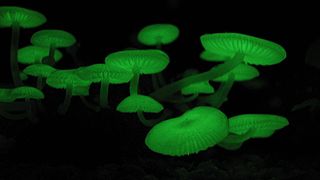
Mycena chlorophos is a species of agaric fungus in the family Mycenaceae. First described in 1860, the fungus is found in subtropical Asia, including India, Japan, Taiwan, Polynesia, Indonesia, and Sri Lanka, in Australia, and Brazil. Fruit bodies (mushrooms) have pale brownish-grey sticky caps up to 30 mm (1.2 in) in diameter atop stems 6–30 mm (0.2–1.2 in) long and up to a millimeter thick. The mushrooms are bioluminescent and emit a pale green light. Fruiting occurs in forests on fallen woody debris such as dead twigs, branches, and logs. The fungus can be made to grow and fruit in laboratory conditions, and the growth conditions affecting bioluminescence have been investigated.

Lepiota babruzalka is an agaric mushroom of the genus Lepiota in the order Agaricales. Described as new to science in 2009, it is found in Kerala State, India, where it grows on the ground in litterfall around bamboo stems. Fruit bodies have caps that measure up to 1.3 cm (0.5 in) in diameter, and are covered with reddish-brown scales. The cap is supported by a long and slender stem up to 4.5 cm (1.8 in) long and 1.5 millimetres (0.1 in) thick. One of the distinguishing microscopic features of the species is the variably shaped cystidia found on the edges of the gills.
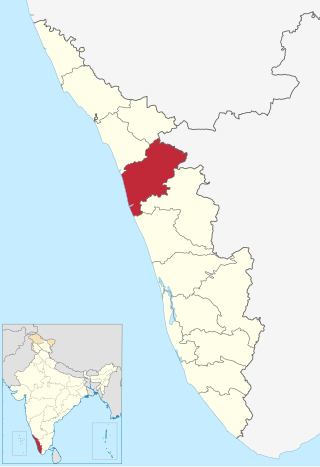
Lepiota harithaka is an agaric mushroom of the genus Lepiota in the order Agaricales. It was described as new to science in 2009. Found in Kerala State, India, fruit bodies of the fungus grow on the ground among bamboo roots.

Psilocybe angulospora is a species of agaric fungus in the family Hymenogastraceae. The species was described from Taiwan in 2015 and is also present in New Zealand, where it is considered introduced. As a blueing member of the genus Psilocybe it contains the psychoactive compounds psilocin and psilocybin.
References
- 1 2 3 Yang ZL, Matheny PB, Ge Z-W, Slot JC, Hibbett DS (2005). "New Asian species of the genus Anamika (euagarics, hebelomatoid clade) based on morphology and ribosomal DNA sequences" (PDF). Mycological Research. 109 (11): 1259–1267. doi:10.1017/S0953756205003758. PMID 16279419. Archived from the original (PDF) on 2016-03-04. Retrieved 2015-10-18.
- ↑ Kirk PM, Cannon PF, Minter DW, Stalpers JA (2008). Dictionary of the Fungi (10th ed.). Wallingford, UK: CABI. p. 28. ISBN 978-0-85199-826-8.
- 1 2 3 Mohanan C. (2011). Macrofungi of Kerala. Kerala, India: Kerala Forest Research Institute. p. 597. ISBN 978-81-85041-73-5.
 | This Hymenogastraceae-related article is a stub. You can help Wikipedia by expanding it. |