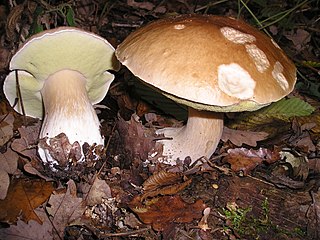
The Boletaceae are a family of mushroom-forming fungi, primarily characterised by small pores on the spore-bearing hymenial surface, instead of gills as are found in most agarics. Nearly as widely distributed as the agarics, the family is renowned for hosting some prime edible species highly sought after by mushroom hunters worldwide, such as the cep or king bolete . A number of rare or threatened species are also present in the family, that have become the focus of increasing conservation concerns. As a whole, the typical members of the family are commonly known as boletes.

Xerocomus is a genus of poroid fungi related to Boletus. Many mycologists did not originally recognize the distinction between the two genera and placed Xerocomus taxa in genus Boletus. However, several molecular phylogenetic studies have demonstrated that Xerocomus is a heterogeneous genus of polyphyletic origin, which has resulted in further division of Xerocomus into Xerocomellus and Hemileccinum. The members of the genus Xerocomellus are more closely related to Boletus than true Xerocomus is, which is relatively distantly related to Boletus and more closely related to Phylloporus. Other former Xerocomus species have since been moved to Aureoboletus, Imleria, Hortiboletus and Rheubarbariboletus.
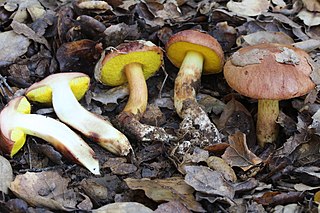
Aureoboletus is a genus of bolete fungi in the family Boletaceae. It was circumscribed by Czech mycologist Zdeněk Pouzar in 1957. A taxonomic monograph was published in 2010 by Wolfgang Klofac.

Boletellus is a genus of fungi in the family Boletaceae. The genus has a widespread distribution, especially in subtropical regions, and contains about 50 species. The genus was first described by American mycologist William Alphonso Murrill in 1909. The genus name means "small Boletus".

Fistulinella is a genus of bolete fungi in the family Boletaceae. The genus has a pantropical distribution, and contains 15 species. Fistulinella was circumscribed by German mycologist Paul Christoph Hennings in 1901.

Boletellus obscurecoccineus, known as the rhubarb bolete, is a species of fungus in the family Boletaceae, found in Australia, New Guinea, Java, Borneo, Japan, Korea, and Taiwan. It is a distinctive and colourful bolete of the forest floor.
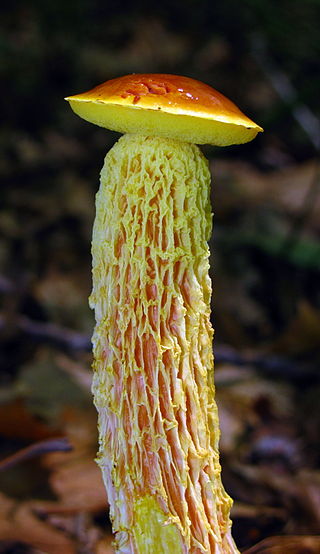
Heimioporus is a genus of fungi in the family Boletaceae. The genus is widely distributed in tropical and subtropical regions, and contains about 15 species.

Aureoboletus mirabilis, commonly known as the admirable bolete, the bragger's bolete, and the velvet top, is an edible species of fungus in the Boletaceae mushroom family. The fruit body has several characteristics with which it may be identified: a dark reddish-brown cap; yellow to greenish-yellow pores on the undersurface of the cap; and a reddish-brown stem with long narrow reticulations. Aureoboletus mirabilis is found in coniferous forests along the Pacific Coast of North America, and in Asia. Unusual for boletes, A. mirabilis sometimes appears to fruit on the wood or woody debris of Hemlock, suggesting a saprobic lifestyle. Despite occasional appearances to the contrary, Aureoboletus mirabilis is mycorrhizal, and forms close mutualistic associations with hemlock roots.
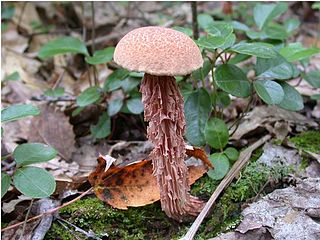
Aureoboletus russellii, commonly known as Russell's bolete, is a species of bolete fungus in the family Boletaceae. An edible species, it is found in Asia and eastern North America, where it grows in a mycorrhizal association with oak, hemlock, and pine trees. Fruit bodies of the fungus are characterized by their coarsely shaggy stem. The yellow-brown to reddish-brown caps are initially velvety, but become cracked into patches with age.

Boletellus dissiliens is a species of fungus in the family Boletaceae. Found in Singapore, it was originally described as Boletus dissiliens by E.J.H. Corner in 1972, and transferred to Boletellus in 1981.

Boletus reticuloceps is a species of fungus in the family Boletaceae. The species was first described scientifically in 1993 as Aureoboletus reticuloceps, and later transferred to the genus Boletus in 2005. The fruit bodies have a dry cap, that is yellowish-brown, deeply wrinkled and reticulated, and covered with fibrils that form minute brown scales. Its stem is finely reticulated. The hymenophore is white when young, but becomes yellow in maturity. The flesh does not change color when bruised or injured. Its spores are olive-brown to brown. The species is found in Asia; the type collection was made in Sichuan, China, growing in forest made largely of Abies fargesii. Similar species include Aureoboletus thibetanus, Boletus castanopsidis, and B. mottiae.
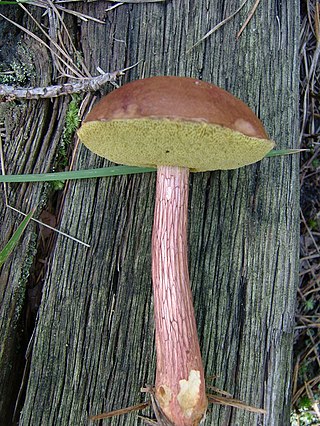
Aureoboletus projectellus is a species of bolete fungus in the family Boletaceae. Found in North America, and recently in Europe, it grows in a mycorrhizal association with pine trees.

Xerocomellus is a genus of fungi in the family Boletaceae. The genus, as it was described in 2008, contained 12 species. However X. rubellus and X. engelii were transferred to the new genus Hortiboletus and X. armeniacus was transferred to the new genus Rheubarbariboletus in 2015. Molecular analysis supports the distinction of Xerocomellus species from Boletus and Xerocomus, within which these species were formerly contained. Xerocomellus in fact is only distantly related to Xerocomus and is most closely related to Tylopilus, Boletus sensu stricto, Porphyrellus, Strobilomyces, and Xanthoconium.

The Boletineae are a suborder of the fungal order Boletales. Families in the Boletineae include the Boletaceae and the Paxillaceae.
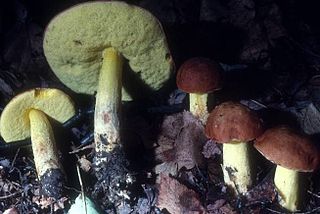
Hemileccinum subglabripes is a fungus of the family Boletaceae native to North America. It was first described by Charles Horton Peck in 1887 as Boletus subglabripes. In 2015 it was transferred to Hemileccinum based on DNA evidence.

Hemileccinum is a genus of fungi in the family Boletaceae. It was erected in 2008 by Josef Šutara to contain two species united by a number of shared morphological features: H. depilatum and the type H. impolitum. In 2014, Wu et al. found it to be distinct from other bolete genera in a molecular phylogenetic study and found it to be most closely related to Corneroboletus. In 2015, H. subglabripes was transferred to Hemileccinum from Boletus based on DNA evidence, while subsequent studies further confirmed the monophyly of the genus.
Tylopilus funerarius is a bolete fungus in the family Boletaceae. Found in Singapore, it was described as new to science in 1909 by English mycologist George Edward Massee. He described it as a "sombre, uninviting species, characterised by brownish-black velvety pileus and brown tube and pores", and considered it similar in appearance to Boletus chrysenteron. The species was transferred to the genus Tylopilus in 1981.

Mu Zang was a Chinese mycologist. He was known for his research on the Boletales of China, and the ecology and biogeography of fungi in southwestern China. He described more than 140 new species and circumscribed three genera, published more than 150 research papers, was chief editor or co-editor for twelve books, and wrote two monographs on the Boletaceae of China. His final book, "Dictionary of the Families and Genera of Chinese Cryptogamic (Spore) Plants" was co-authored with his wife, Professor Xinjiang Li.

Aureoboletus moravicus, commonly known as the tawny bolete, is a species of bolete fungus in the family Boletaceae that is found in Europe. Originally described as Boletus moravicus by Václav Vacek in 1946, it was transferred to the genus Aureoboletus by Wolfgang Klofac in 2010. It is an uncommon bolete of unknown edibility that appears as a vulnerable species on some European Red Lists, and is considered critically endangered in the Czech Republic. Preferred habitats include parklands, near oak trees.
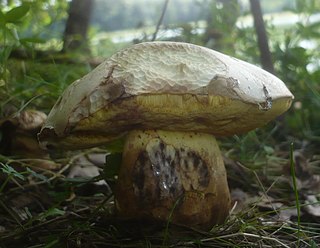
Caloboletus kluzakii is a bolete fungus native to Europe. Until 2014, it was known as Boletus kluzakii. Recent changes in the phylogenetic framework of the family Boletaceae prompted the transfer of this species, along with several other related boletes, including Caloboletus calopus, to the genus Caloboletus. It was described scientifically in 2006 by Josef Šutara and Pavel Špinar, from specimens collected in the Czech Republic. The fungus had earlier been published with the name Boletus fallax by Czech mycologist Zdeněk Kluzák in 1988, but this was invalid, as that name had been used previously by E.J.H. Corner for a Malaysian bolete. The epithet honours Kluzák's contributions in describing the species.

