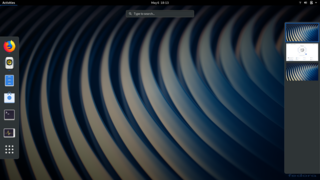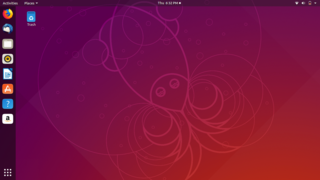
A Linux distribution is an operating system made from a software collection, which is based upon the Linux kernel and, often, a package management system. Linux users usually obtain their operating system by downloading one of the Linux distributions, which are available for a wide variety of systems ranging from embedded devices and personal computers to powerful supercomputers.
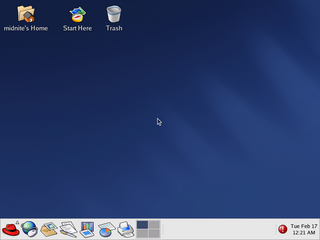
Red Hat Linux, created by the company Red Hat, was a widely used Linux distribution until its discontinuation in 2004.

Slackware is a Linux distribution created by Patrick Volkerding in 1993. Originally based on Softlanding Linux System, Slackware has been the basis for many other Linux distributions, most notably the first versions of SUSE Linux distributions, and is the oldest distribution that is still maintained.
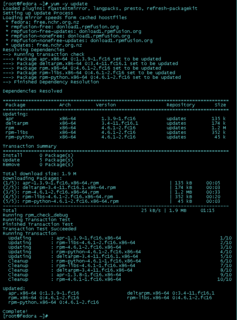
The Yellowdog Updater, Modified (YUM) is a free and open-source command-line package-management utility for computers running the Linux operating system using the RPM Package Manager. Though YUM has a command-line interface, several other tools provide graphical user interfaces to YUM functionality.

Red Hat Enterprise Linux is a Linux distribution developed by Red Hat and targeted toward the commercial market. Red Hat Enterprise Linux is released in server versions for x86-64, Power ISA, ARM64, and IBM Z, and a desktop version for x86-64. All of Red Hat's official support and training, together with the Red Hat Certification Program, focuses on the Red Hat Enterprise Linux platform. Red Hat Enterprise Linux is often abbreviated to RHEL.
Arch Linux is a Linux distribution for computers based on x86-64 architectures.

CentOS is a Linux distribution that provides a free, enterprise-class, community-supported computing platform functionally compatible with its upstream source, Red Hat Enterprise Linux (RHEL). In January 2014, CentOS announced the official joining with Red Hat while staying independent from RHEL, under a new CentOS governing board.
phpLDAPadmin is a web app for administering Lightweight Directory Access Protocol (LDAP) servers. It's written in the PHP programming language, and is licensed under the GNU General Public License. The application is available in 14 languages and supports UTF-8 encoded directory strings.
Planet CCRMA is a collection of Red Hat packages to help set up and optimize a Red Hat-based workstation for audio work.
Technical variations of Linux distributions include support for different hardware devices and systems or software package configurations. Organizational differences may be motivated by historical reasons. Other criteria include security, including how quickly security upgrades are available; ease of package management; and number of packages available.
BioLinux is a term used in a variety of projects involved in making access to bioinformatics software on a Linux platform easier using one or more of the following methods:
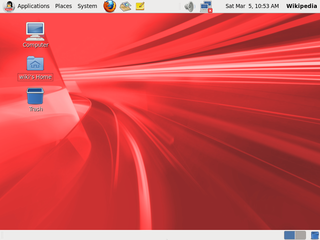
Oracle Linux is a Linux distribution packaged and freely distributed by Oracle, available partially under the GNU General Public License since late 2006. It is compiled from Red Hat Enterprise Linux (RHEL) source code, replacing Red Hat branding with Oracle's. It is also used by Oracle Cloud and Oracle Engineered Systems such as Oracle Exadata and others.
Software distributions, of which Linux distributions form a sizable proportion, are commonly referred to as distros, with rolling release distributions commonly referred to as rolling distros. When used as an adjective, instead of a noun, rolling release is often shortened to rolling, when referring to distributions, software, or development models.
IcedTea is a build and integration project for OpenJDK launched by Red Hat in June 2007. IcedTea-Web is a free software implementation of Java Web Start and the Java web browser plugin. IcedTea-Sound is a collection of plugins for the Java sound subsystem, including the PulseAudio provider which used to be included with IcedTea. The Free Software Foundation recommends that all Java programmers use IcedTea as their development environment.

RPM Package Manager (RPM) is a free and open-source package management system. The name RPM refers to .rpm file format and the package manager program itself. RPM was intended primarily for Linux distributions; the file format is the baseline package format of the Linux Standard Base.

Russian Fedora Remix is a remix of the Fedora Linux distribution adapted for Russia. However, it is neither a copy of the original Fedora nor a new GNU/Linux distribution. The project aims to ensure that Fedora fully satisfies the needs of Russian users with many additional features provided out of the box.
Fedora is a popular Linux distribution developed by the community-supported Fedora Project and is sponsored by Red Hat. Fedora attempts to maintain a six-month release schedule, offering new versions in May and November, although some releases have experienced minor delays.
firewalld is a firewall management tool for Linux operating systems. It provides firewall features by acting as a front-end for the Linux kernel's netfilter framework via the iptables command, acting as an alternative to the iptables service. The name firewalld adheres to the Unix convention of naming system daemons by appending the letter “d”.