
Mandriva Linux is a discontinued Linux distribution developed by Mandriva S.A.
In cryptography, SHA-1 is a cryptographic hash function which takes an input and produces a 160-bit (20-byte) hash value known as a message digest – typically rendered as a hexadecimal number, 40 digits long. It was designed by the United States National Security Agency, and is a U.S. Federal Information Processing Standard.

KNOPPIX is an operating system based on Debian designed to be run directly from a CD / DVD or a USB flash drive, one of the first of its kind for any operating system. Knoppix was developed by, and named after, Linux consultant Klaus Knopper. When starting a program, it is loaded from the removable medium and decompressed into a RAM drive. The decompression is transparent and on-the-fly.

GNU GRUB is a boot loader package from the GNU Project. GRUB is the reference implementation of the Free Software Foundation's Multiboot Specification, which provides a user the choice to boot one of multiple operating systems installed on a computer or select a specific kernel configuration available on a particular operating system's partitions.

K3b is a CD and DVD authoring application by KDE for Unix-like computer operating systems. It provides a graphical user interface to perform most CD/DVD burning tasks like creating an Audio CD from a set of audio files or copying a CD/DVD, as well as more advanced tasks such as burning eMoviX CD/DVDs. It can also perform direct disc-to-disc copies. The program has many default settings which can be customized by more experienced users. The actual disc recording in K3b is done by the command line utilities cdrecord or cdrkit, cdrdao, and growisofs. As of version 1.0, K3b features a built-in DVD ripper.

Ghost is a disk cloning and backup tool originally developed by Murray Haszard in 1995 for Binary Research. The technology was acquired in 1998 by Symantec.
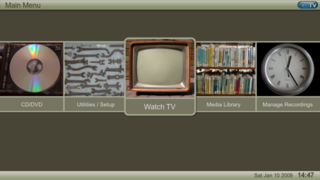
MythTV is a free and open-source home entertainment application with a simplified "10-foot user interface" design for the living room TV. It turns a computer with the necessary hardware into a network streaming digital video recorder, a digital multimedia home entertainment system, or home theater personal computer. It can be considered a free and open-source alternative to TiVo or Windows Media Center. It runs on various operating systems, primarily Linux, macOS, and FreeBSD.
CentOS is a Linux distribution that provides a free, community-supported computing platform functionally compatible with its upstream source, Red Hat Enterprise Linux (RHEL). In January 2014, CentOS announced the official joining with Red Hat while staying independent from RHEL, under a new CentOS governing board.
Technical variations of Linux distributions include support for different hardware devices and systems or software package configurations. Organisational differences may be motivated by historical reasons. Other criteria include security, including how quickly security upgrades are available; ease of package management; and number of packages available.
SHA-2 is a set of cryptographic hash functions designed by the United States National Security Agency (NSA) and first published in 2001. They are built using the Merkle–Damgård structure, from a one-way compression function itself built using the Davies–Meyer structure from a (classified) specialized block cipher.

DVD recordable and DVD rewritable are optical disc recording technologies. Both terms describe DVD optical discs that can be written to by a DVD recorder, whereas only 'rewritable' discs are able to erase and rewrite data. Data is written ('burned') to the disc by a laser, rather than the data being 'pressed' onto the disc during manufacture, like a DVD-ROM. Pressing is used in mass production, primarily for the distribution of home video.
Amiga software is computer software engineered to run on the Amiga personal computer. Amiga software covers many applications, including productivity, digital art, games, commercial, freeware and hobbyist products. The market was active in the late 1980s and early 1990s but then dwindled. Most Amiga products were originally created directly for the Amiga computer, and were not ported from other platforms.

Korora was a remix of the Fedora Linux distribution. Originally Kororaa was a binary installation method for Gentoo Linux which aimed for easy installation of a Gentoo system by using install scripts instead of manual configuration. The name derives from the Māori word kororā – the little penguin.

TestDisk is a free and open-source data recovery utility. It is primarily designed to help recover lost data storage partitions and/or make non-booting disks bootable again when these symptoms are caused by faulty software, certain types of viruses or human error . TestDisk can be used to collect detailed information about a corrupted drive, which can then be sent to a technician for further analysis.
sha1sum is a computer program that calculates and verifies SHA-1 hashes. It is commonly used to verify the integrity of files. It is installed by default in most Unix-like operating systems. Variants include shasum, sha224sum, sha256sum, sha384sum and sha512sum, which use a specific SHA-2 hash function, and sha3sum. Versions for Microsoft Windows also exist, and the ActivePerl distribution includes a perl implementation of shasum. On FreeBSD and OpenBSD the utilities are called md5, sha1, sha256, sha512. These versions offer slightly different options and features. Additionally, FreeBSD offers the "SKEIN" family of message digests.
Parallels Desktop for Mac, by Parallels, is software providing hardware virtualization for Macintosh computers with Intel processors.

DVD is a digital optical disc storage format invented and developed in 1995 and released in late 1996. The medium can store any kind of digital data and is widely used for software and other computer files as well as video programs watched using DVD players. DVDs offer higher storage capacity than compact discs while having the same dimensions.
This article is a comparison of notable software applications that can access or manipulate disk image files. It compares their disk image handling features.

AcetoneISO is a free and open-source virtual drive software to mount and manage image files. Its goals are to be simple, intuitive and stable. Written in Qt, this software is meant for all those people looking for a "Daemon Tools for Linux". However, AcetoneISO does not emulate any copy protection while mounting.


