| "Australiana" | ||||
|---|---|---|---|---|
| Single by Austen Tayshus | ||||
| A-side | "Australiana" | |||
| B-side | "The Comedy Commando" | |||
| Released | June 1983 | |||
| Format | 12″ | |||
| Recorded | The Loony Bin and The Comedy Store | |||
| Genre | Comedy | |||
| Length | 4:23 | |||
| Label | Regular Records | |||
| Songwriter(s) | Billy Birmingham, Austen Tayshus | |||
| Producer(s) | Billy Birmingham, Paul Goodwin | |||
| Austen Tayshus singles chronology | ||||
| ||||
"Australiana" is a spoken-word comedy single by Austen Tayshus, written by Billy Birmingham and recorded live at The Comedy Store, Sydney, in 1983. It was only available on 12″. It is Australia's best-selling single ever [1] and was the No. 1 single in Australia in 1983 for eight weeks, seven of them consecutive. [2]
Spoken word is a performance art that is word-based. It is an oral art that focuses on the aesthetics of word play such as intonation and voice inflection. It is a "catchall" term that includes any kind of poetry recited aloud, including poetry readings, poetry slams, jazz poetry, and hip hop, and can include comedy routines and prose monologues. Although spoken word can include any kind of poetry read aloud, it is different from written poetry in that how it sounds is often one of the main components. Unlike written poetry it has less to do with physical on the page aesthetics and more to do with phonaesthetics, or the aesthetics of sound.
Austen Tayshus is the stage name of Jewish Australian comedian Alexander Jacob Gutman. He is best known for the 1983 comedy single "Australiana", a spoken word piece written by comedian Billy Birmingham, which is filled with Australian puns; it is Australia's best-selling single ever.
Billy Birmingham is an Australian humourist and sometime sports journalist, most noted for his parodies of Australian cricket commentary in recordings under The Twelfth Man name.
The single was banned in Victoria for a week, due to the B-side "The Comedy Commando". This led to a gap between the record's first number one placing (15 August) and its seven-week run at the number one spot (5 September – 17 October).
Victoria is a state in south-eastern Australia. Victoria is Australia's smallest mainland state and its second-most populous state overall, thus making it the most densely populated state overall. Most of its population lives concentrated in the area surrounding Port Phillip Bay, which includes the metropolitan area of its state capital and largest city, Melbourne, Australia's second-largest city. Victoria is bordered by Bass Strait and Tasmania to the south, New South Wales to the north, the Tasman Sea to the east, and South Australia to the west.
The single was rereleased on CD in 2003 (EMI 7243 5 52755 0 9), containing the A-side and the video for the A-side, but not the original B-side. [3]
The sketch is built on extensive sets of equivocations that form puns relating to Australian place names and icons, for example:
In logic, equivocation is an informal fallacy resulting from the use of a particular word/expression in multiple senses throughout an argument leading to a false conclusion. Abbott and Costello's "Who's on first?" routine is a well known example of equivocation.
The pun, also called paronomasia, is a form of word play that exploits multiple meanings of a term, or of similar-sounding words, for an intended humorous or rhetorical effect. These ambiguities can arise from the intentional use of homophonic, homographic, metonymic, or figurative language. A pun differs from a malapropism in that a malapropism is an incorrect variation on a correct expression, while a pun involves expressions with multiple interpretations. Puns may be regarded as in-jokes and/or idiomatic constructions, especially as their usage and meaning are usually specific to a particular language and/or its culture.
My mate, Boomer, rang. Will Walla be there? Vegie might come. Let's go, Anna. Only if Din goes. Nulla bores me. Speak ill of Warra. Ayers rocks in. Alice springs into action. Thanks, Warra, ta. Has Eucum been in? Wait until Gum leaves. On the lawn, Ceston. Marie knows. Leave Jack around a party. Adel laid it on me. Do you wanna game of euchre, Lyptus? Can Wom bat? Can Tenta field? Dar wins every time. Is Bass straight? Swim in the River, Ina. I've got no cosi, Oscar. Without a thread, Bo. Perish the thought. No cooler bar maid. Where can Marsu pee, Al? You reek of Stockade. Cook a burra. A pair of queens land in. Crack on to Wumba. Try to mount Isa. Trying to plat her puss. Flash your wanger at her. What'll 'ey care? Seen a cock or two. Pack Bill a bong. Will a didgery do? Where's the Tally-ho, Bart? Great, Barry—a reefer. Blew Mountains away. Lord! How? Hey! Man! How much can a Koala bear? Lead you astray, Liana.
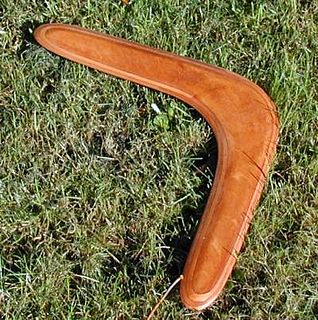
A boomerang is a thrown tool, typically constructed as a flat airfoil, that is designed to spin about an axis perpendicular to the direction of its flight. A returning boomerang is designed to return to the thrower. It is well known as a weapon used by Indigenous Australians for hunting.
A wallaby is a small- or mid-sized macropod native to Australia and New Guinea, with introduced populations in New Zealand, UK and other countries. They belong to the same taxonomic family as kangaroos and sometimes the same genus, but kangaroos are specifically categorised into the six largest species of the family. The term wallaby is an informal designation generally used for any macropod that is smaller than a kangaroo or wallaroo that has not been designated otherwise.
Vegemite is a thick, black Australian food spread made from leftover brewers' yeast extract with various vegetable and spice additives. It was developed by Cyril Percy Callister in Melbourne, Victoria in 1922. The Vegemite brand was owned by Mondelez International until January 2017, when it was acquired by the Australian Bega Cheese group in a US$460,000,000 agreement for full Australian ownership after Bega would buy most of Mondelez International's Australia and New Zealand grocery and cheese business.
Vinyl (RRT 606)
CD single (5527550)
| Chart (1983) | Position |
|---|---|
| Australian (Kent Music Report) [4] | 1 |
| Chart (1983) | Position |
|---|---|
| Australian (Kent Music Report) [5] | 1 |

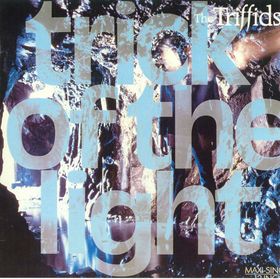
Trick of the Light is a single released in January 1988 by Australian group The Triffids from their album Calenture. The single appeared in 7", 10", 12" and CD single versions. It was produced by Gil Norton and written by David McComb. The B-Side "Love the Fever" was co-written by David McComb and Adam Peters and was produced by Peters. It was recorded in August 1986.
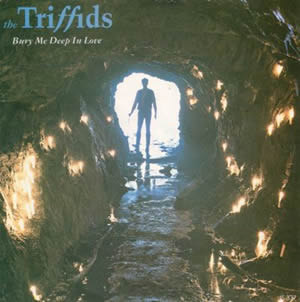
Bury Me Deep in Love is a single released by Australian folk rock group The Triffids from their album Calenture. It appeared in October 1987 and reached No. 48 on the Australian Kent Music Report Singles Chart. It was produced by Gil Norton and written by David McComb, the group's lead singer and guitarist. The B-sides "Baby Can I Walk You Home" and "Region Unknown" were produced by Victor Van Vugt and The Triffids. The single was released as 7", 12" & CD single versions.
"Last Romance" is a song by Australian singer songwriter Mark Holden. It was released as the third and final single from Holden's second studio album, Let Me Love You (1976). The song was a commercial success peaking at number 11 on the Kent Music Report.
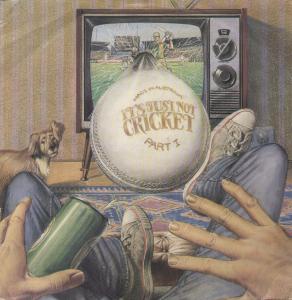
"It's Just Not Cricket" is the debut single of The Twelfth Man, a series of comedy productions by skilled impersonator Billy Birmingham. The single topping the charts for three weeks in June 1984, and was the second highest selling single in Australia in 1984 behind "Dancing in the Dark" by Bruce Springsteen.

Wired World of Sports is the debut album released by The Twelfth Man. Released in 1987, it reached number one on the Kent Music Report in February 1988.

"Wedding Ring" is a song written by Stevie Wright and George Young. It was originally recorded by the Australian rock group the Easybeats in 1965, whose version reached #6 on the Australian charts.

"April Sun in Cuba" is a song recorded by New Zealand group Dragon, released in October 1977. It is the first single to be released from Dragon's fourth studio album Running Free. "April Sun in Cuba" first charted on 7 November 1977, peaking at number 2 on the Kent Music Report Singles Chart and staying on the chart for 22 weeks. It also reached number 9 on the New Zealand singles chart.
"Reach Out for the One Who Loves You" is a song by Australian singer songwriter Mark Holden. It was released as the lead single from Holden's third studio album, Encounter (1977). The song peaked at number 17 on the Kent Music Report.

"A Beat for You" is a song by Australian pop group Pseudo Echo. The song was released in April 1984 as the second single from their debut studio album, Autumnal Park (1984). The song peaked at number 12 on the Australian Kent Music Report.

"Don't Go" is a song by Australian pop group Pseudo Echo. The song was released in October 1985 as the lead single from their second studio album, Love an Adventure (1985). The song became the band's second top five single peaked at number 4 on the Australian Kent Music Report.

"Love an Adventure" is a song by Australian pop group Pseudo Echo. The song was released in January 1986 as the second single from their second studio album, Love an Adventure (1985). The song became the band's third Australian top ten single peaked at number 6 on the Australian Kent Music Report.

"Try" is a song by Australian pop group Pseudo Echo. The song was released in September 1986 as the fourth and final single from the Australian release of their second studio album, Love an Adventure (1985). The song peaked at number 60 on the Australian Kent Music Report.

"Waiting for You" is a song by New Zealand singer and songwriter Sharon O'Neill. The song was released in June 1981 as the lead single from her forthcoming third studio album, Maybe (1981). O'Neill performed the song live on the Countdown on 2 August 1981. The song peaked at number 50 in Australia.
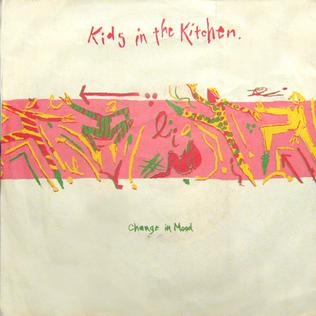
"Change in Mood" is the debut single from Australian pop/new wave group Kids in the Kitchen. The song was released in October 1983 as the lead single from their debut studio album, Shine (1985). The song peaked at number 10 on the Australian Kent Music Report.
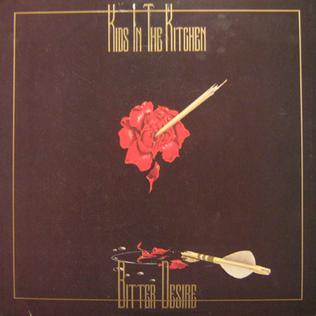
"Bitter Desire" is a song by Australian pop/new wave group Kids in the Kitchen. The song was released in April 1984 as the second single from their debut studio album Shine (1985). The song peaked at number 17 on the Australian Kent Music Report.

"Something That You Said" is a song by Australian pop/new wave group Kids in the Kitchen. The song was released in April 1985 as the third single from their debut studio album Shine (1985). The song peaked at number 19 on the Australian Kent Music Report.

"Current Stand" is a song by Australian pop/new wave group Kids in the Kitchen. The song was released in August 1985 as the fifth single from their debut album, Shine (1985). The song peaked at number 12 on the Australian Kent Music Report.
"Stares and Whispers" is a song by the Australian Renée Geyer Band. The song was released in April 1977 as the lead single from Geyer's fourth studio album So Lucky (1977). It became Geyer's first top 20 single, peaking at number 17 on the Kent Music Report.
"You Know That I Love You" is an pop song written and produced by Terry Britten and recorded by Australian pop singer Christie Allen. The song was released in September 1978 as Allen's debut single and lead single from Allen's debut studio album, Magic Rhythm (1979). The song peaked at number 67 on the Kent Music Report in Australia.
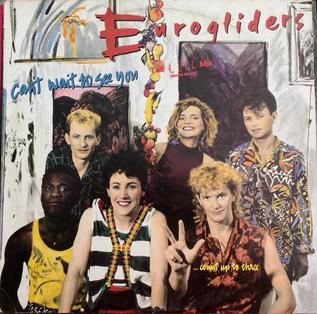
"Can't Wait to See You" is a song by Eurogliders, released in November 1985 as the third single from their third studio album, Absolutely! (1985). The song peaked at number 8 on the Australian Kent Music Report, becoming the band's third top ten single.