
The subphylum Chelicerata constitutes one of the major subdivisions of the phylum Arthropoda. It contains the sea spiders, arachnids, and several extinct lineages, such as the eurypterids and chasmataspidids.

Eurypterids, often informally called sea scorpions, are a group of extinct arthropods that form the order Eurypterida. The earliest known eurypterids date to the Darriwilian stage of the Ordovician period 467.3 million years ago. The group is likely to have appeared first either during the Early Ordovician or Late Cambrian period. With approximately 250 species, the Eurypterida is the most diverse Paleozoic chelicerate order. Following their appearance during the Ordovician, eurypterids became major components of marine faunas during the Silurian, from which the majority of eurypterid species have been described. The Silurian genus Eurypterus accounts for more than 90% of all known eurypterid specimens. Though the group continued to diversify during the subsequent Devonian period, the eurypterids were heavily affected by the Late Devonian extinction event. They declined in numbers and diversity until becoming extinct during the Permian–Triassic extinction event 251.9 million years ago.

Xiphosura is an order of arthropods related to arachnids. They are sometimes called horseshoe crabs. They first appeared in the Hirnantian. Currently, there are only four living species. Xiphosura contains one suborder, Xiphosurida, and several stem-genera.

Mesolimulus is an extinct genus of arthropod. The best known examples are found in Solnhofen limestone near Solnhofen, Bavaria, Germany. Originally assigned to the living genus Limulus, they are related to and look virtually identical to the modern horseshoe crab. Other species assigned to Mesolimulus have been recorded from Spain, Siberia and (questionably) from Lebanon.

Chasmataspidids, sometime referred to as chasmataspids, are a group of extinct chelicerate arthropods that form the order Chasmataspidida. Chasmataspidids are probably related to horseshoe crabs (Xiphosura) and/or sea scorpions (Eurypterida), with more recent studies suggest that they form a clade (Dekatriata) with Eurypterida and Arachnida. Chasmataspidids are known sporadically in the fossil record through to the mid-Devonian, with possible evidence suggesting that they were also present during the late Cambrian. Chasmataspidids are most easily recognised by having an opisthosoma divided into a wide forepart (preabdomen) and a narrow hindpart (postabdomen) each comprising 4 and 9 segments respectively. There is some debate about whether they form a natural group.

Jaekelopterus is a genus of predatory eurypterid, a group of extinct aquatic arthropods. Fossils of Jaekelopterus have been discovered in deposits of Early Devonian age, from the Pragian and Emsian stages. There are two known species: the type species J. rhenaniae from brackish to fresh water strata in the Rhineland, and J. howelli from estuarine strata in Wyoming. The generic name combines the name of German paleontologist Otto Jaekel, who described the type species, and the Greek word πτερόν (pteron) meaning "wing".

Willwerathia is a genus of synziphosurine, a paraphyletic group of horseshoe crab-like fossil chelicerate arthropods. Willwerathia known only by one species, Willwerathia laticeps, discovered in deposits of the Devonian period from the Rhenish Slate Mountains of Germany.

Bembicosoma is a genus of synziphosurine, a paraphyletic group of fossil chelicerate arthropods. Bembicosoma was regarded as part of the clade Planaterga. Fossils of the single and type species, B. pomphicus, have been discovered in deposits of the Silurian period in the Pentland Hills, Scotland. Bembicosoma had been tentatively assigned as an eurypterid before its synziphosurine affinities revealed.
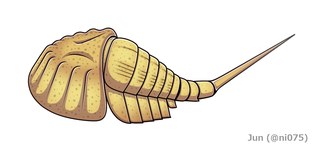
Bunodes is a genus of synziphosurine, a paraphyletic group of fossil chelicerate arthropods. Bunodes was regarded as part of the clade Planaterga. Fossils of the single and type species, B. lunula, have been discovered in deposits of the Silurian period in Ludlow, England. Bunodes is the type genus of the family Bunodidae, the other genera of the same family being Limuloides.

Cyamocephalus is a genus of synziphosurine, a paraphyletic group of fossil chelicerate arthropods. Cyamocephalus was regarded as part of the clade Planaterga. Fossils of the single and type species, C. loganensis, have been discovered in deposits of the Silurian period in Lesmahagow, Scotland. Cyamocephalus is one of the two members of the family Pseudoniscidae, the other being Pseudoniscus. Cyamocephalus differ from Pseudoniscus by the fused tergites of 6th and 7th opisthosomal segments.

Legrandella is a genus of synziphosurine, a paraphyletic group of fossil chelicerate arthropods. Legrandella was regarded as part of the clade Prosomapoda. Fossils of the single and type species, L. lombardii, have been discovered in deposits of the Devonian period in Cochabamba, Bolivia.

Limuloides is a genus of synziphosurine, a paraphyletic group of fossil chelicerate arthropods. Limuloides was regarded as part of the clade Planaterga. Fossils of the genus have been discovered in deposits of the Silurian period in the United Kingdom and potentially in the United States. Limuloides is one of the two genera of the family Bunodidae, the other being the type genus Bunodes. Limuloides characterized by a carapace with radiated ridges and serrated lateral regions, as well as an opisthosoma with rows of nodes. Limuloides was once though to have lateral compound eyes on its carapace, but later investigation did not find any evidence of it.

Pasternakevia is a genus of synziphosurine, a paraphyletic group of fossil chelicerate arthropods. Pasternakevia was regarded as part of the clade Planaterga. Fossils of the single and type species, P. podolica, have been discovered in deposits of the Silurian period in Podolia, Ukraine.

Pseudoniscus is a genus of synziphosurine, a paraphyletic group of fossil chelicerate arthropods. Pseudoniscus was regarded as part of the clade Planaterga. Fossils of the genus have been discovered in deposits of the Silurian period in the United Kingdom, the United States and Estonia. Pseudoniscus is one of the two members of the family Pseudoniscidae, the other being Cyamocephalus.

Weinbergina is a genus of synziphosurine, a paraphyletic group of fossil chelicerate arthropods. Fossils of the single and type species, W. opitzi, have been discovered in deposits of the Devonian period in the Hunsrück Slate, Germany.

Synziphosurina is a paraphyletic group of chelicerate arthropods previously thought to be basal horseshoe crabs (Xiphosura). It was later identified as a grade compose of various basal euchelicerates, eventually excluded form the monophyletic Xiphosura sensu stricto and only regarded as horseshoe crabs under a broader sense. Synziphosurines survived at least since early Ordovician to early Carboniferous in ages, with most species are known from the in-between Silurian strata.

Houia is a genus of dekatriatan, a clade of chelicerate arthropods. Fossils of the single and type species, H. yueya, have been discovered in deposits of the Early Devonian period in Yunnan, China. The name of the genus is derived from the Chinese character 鲎 (hòu), meaning "horseshoe crab". The species name yueya comes from the Chinese characters 月 and 牙, referring to the crescentic shape of its carapace.

Venustulus is a genus of synziphosurine, a paraphyletic group of fossil chelicerate arthropods. Venustulus was regarded as part of the clade Prosomapoda. Fossils of the single and type species, V. waukeshaensis, have been discovered in deposits of the Silurian period in Wisconsin, in the United States. Venustulus is one of the few synziphosurine genera with fossil showing evidence of appendages.

Camanchia is a genus of synziphosurine, a paraphyletic group of fossil chelicerate arthropods. Camanchia was regarded as part of the clade Prosomapoda. Fossils of the single and type species, C. grovensis, have been discovered in deposits of the Silurian period in Iowa, in the United States. Alongside Venustulus, Camanchia is one of the only Silurian synziphosurine with fossil showing evidence of appendages.

Anderella is a genus of synziphosurine, a paraphyletic group of fossil chelicerate arthropods. Anderella was regarded as part of the clade Prosomapoda. Fossils of the single and type species, A. parva, have been discovered in deposits of the Carboniferous period in Montana, in the United States. Anderella is the first and so far the only Carboniferous synziphosurine being described, making it the youngest member of synziphosurines. Anderella is also one of the few synziphosurine genera with fossil showing evidence of appendages, but the details are obscure due to their poor preservation.


