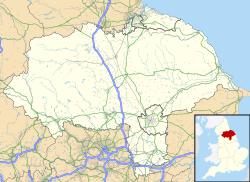
The civil parish also includes the village of Shaw Mills. According to the 2001 census the parish had a population of 521, decreasing to 507 at the 2011 census.[3] The village is about seven miles north of Harrogate.
The civil parish shares a grouped parish council with Warsill. The parish council was originally known as Bishop Thornton and Warsill Parish Council, but in 2019 its name was changed to Bishop Thornton, Shaw Mills and Warsill Parish Council. The name change did not affect the names of the two constituent parishes.[4]
The history of Bishop Thornton is defined by major eras, from its Anglo-Saxon origins to the modern day.[6]
Anglo-Saxon/Norman Period (c. AD 500–1100)
The village was established during the Anglo-Saxon era. Its name derives from the Old English þorn (hawthorn tree) and tūn (enclosure/farmstead). The settlement was small at the time of the Domesday Book in 1086, where it was listed simply as a "settlement" or Thornton, with a recorded population of only a few households. The region was likely impacted by the widespread devastation of the Norman Conquest's "Harrying of the North," but the village persisted.
The Middle Ages (c. 1100–1485)
The most significant event of this era for the village was its acquisition by the church.
Ownership: From 1279 to 1311, the Manor of Thornton belonged to Anthony le Bek, the powerful Prince Bishop of Durham and a high-ranking courtier. This ownership is where the "Bishop" prefix in the village name originates.
Religious Life: The community belonged to the large parish of Ripon Minster (now Ripon Cathedral), but a local "chapel of ease" was built for convenience, with references to it existing as early as 1440.
The Tudor Period (c. 1485–1603)
The Reformation under Henry VIII and the establishment of the Church of England in 1534 had a profound impact. Yorkshire, particularly this area, had strong Catholic leanings. The village remained a centre for Catholicism during this time and after, with religious life continuing even as the state religion changed.
The English Civil War (mid-1600s)
The First English Civil War (1642-1646) primarily focused on the balance of power between Parliament and King Charles I. While the immediate area did not see major battles, the conflict certainly had local consequences. A nearby vicar and several leading local men in another Thornton were recorded as Royalists, fined, and closely watched by Parliamentarians, suggesting a tense political climate in the broader region.
Modern Era
In later centuries, the village evolved through agricultural changes (the enclosure of common land in the 18th century) and industrial activity, such as a local paper mill that ran for much of the 20th century, employing many villagers until its closure in 1976.
You can view the specific Domesday Book entry for the area on Open Domesday to see how the village was officially recorded in 1086.
This page is based on this Wikipedia article Text is available under the CC BY-SA 4.0 license; additional terms may apply. Images, videos and audio are available under their respective licenses.