| Butch Goring | |||
|---|---|---|---|
| Goring with the New York Islanders in the 1980s | |||
| Born | October 22, 1949 | ||
| Height | 5 ft 10 in (178 cm) | ||
| Weight | 165 lb (75 kg; 11 st 11 lb) | ||
| Position | Centre | ||
| Shot | Left | ||
| Played for | Los Angeles Kings New York Islanders Boston Bruins | ||
| National team | |||
| NHL draft | 51st overall, 1969 Los Angeles Kings | ||
| Playing career | 1969–1987 | ||
Robert Thomas "Butch" Goring [1] (born October 22, 1949) is a Canadian former professional ice hockey player and coach. He played 16 seasons in the National Hockey League (NHL) for the Los Angeles Kings, New York Islanders and Boston Bruins. A four-time Stanley Cup winner with the Islanders, he has been cited as a key figure of the Islanders dynasty. [2]
Since retiring as a player he has served as head coach of both the Bruins and Islanders. He currently serves as the Islanders' television color commentator on MSG Network and select games for TNT alongside lead team and #2 TNT play-by-play announcer Brendan Burke. [3] In addition, ice-level reporter Darren Pang joins the pair for select games. [4] [5]
Goring was born on October 22, 1949, in Winnipeg, Manitoba, Canada [6] to parents Bob and Audree. [7] He was raised in St. Boniface, Winnipeg alongside his twin sister and two brothers. Goring is of Scottish and British descent through his parents. His father Bob was a welder for the Canadian National Railway. [8] Growing up, Goring was a fan of the Detroit Red Wings and wore the jersey number 9 in honour of Gordie Howe. [7]
Growing up in Winnipeg, Goring played junior ice hockey with the Winnipeg Rangers and Winnipeg Jets of the Manitoba Junior Hockey League (MJHL). [6] In his rookie season with the Rangers, Goring scored 66 points and received the 1967 Lorne "Windy" Lyndon Memorial trophy as the MJHL's most sportsmanlike player. He also had a one game trial with Canada's National hockey team against the Manitoba Senior League All-Stars. [9] The following season, Goring played on the Hull Nationals in the Quebec Provincial Senior Hockey League with future NHLer Bob Berry. [10] He finished the 1968–69 leading the team in scoring before being recruited to join the WCHL's Winnipeg Jets. While it was rumoured that the Jets offered Goring a car in exchange for his signing, team owner Benny Hatskin denied it. [11] By December, Goring ranked third in league scoring with 33 points and second in goals. [12] He left the team in February 1969 to join the Dauphin Kings of the MJHL due to his unhappiness with the team's operations. [13] After finishing his junior career, Goring was drafted by the Los Angeles Kings in the fifth round (51st overall) of the 1969 NHL amateur draft. [14]
Following the draft, Goring was assigned to the Kings' American Hockey League (AHL) affiliate, the Springfield Kings, for the 1969–70 season. [15] Goring found immediate success in the AHL while playing alongside Mike Corrigan and Randy Miller, and the trio combined to become Springfield's highest scoring line. [16] As a result of his early success, Goring was considered an early candidate for the Rookie of the Year. [17] By the end of November, Goring had scored 13 goals and seven assists through 19 games. [16] Due to the Los Angeles Kings' offensive struggles, Goring and Corrigan were recalled to the NHL level on November 26 [18] and placed on a line with veteran Eddie Shack. [19] While on this line, Goring scored his first NHL goal on November 30 against the Detroit Red Wings. [20] [21] Goring continued to play alongside Shack through the remainer of the season, although Corrigan was eventually replaced by Ross Lonsberry. [14]
Goring returned to the Kings' training camp ahead of the 1970-71 season but struggled to keep up with his teammates. [22] He also arrived at camp eight pounds underweight and complained of feeling lathargic. Following a series of tests, Goring was admitted to Daniel Freeman Memorial Hospital with mononucleosis and mild hepatitis in mid-October. [23] In November, Goring was reassigned to the Springfield Kings and moved in with the team's physician while he rebuilt his strength. [22] Upon returning to Springfield's lineup, Goring led the league in playoff goals, assists and points in helping his team (along with future Hall of Fame goaltender and future Islanders' teammate Billy Smith) win the Calder Cup championship.
The next season Goring was promoted for good to the NHL, and starred for nine seasons for the Los Angeles Kings, developing into one of the most complete players in the league. In the 1975–76 playoff quarterfinal series against the Boston Bruins, Goring scored the overtime game-winning goal in game 2 and game 6. He won both the Bill Masterton Trophy and the Lady Byng Memorial Trophy in 1978, becoming the first player to win both trophies the same year. [24] Prior to the 1978–79 season he was offered a five-year, $1-million contract by the World Hockey Association's Edmonton Oilers; [1] Goring re-signed with the Kings after they countered with an offer of $1.25-million over the same term. [25] [26]
In the 1980 season, Goring was traded in March to the New York Islanders in exchange for Billy Harris and Dave Lewis, and was widely regarded as being the "final piece of the puzzle". [27] [28] That season, he scored 19 points in 21 playoff games to help the Islanders to the first of four consecutive Stanley Cups. The next season (1980–81), he improved upon his previous playoff run, scoring 10 goals and 10 assists in 20 playoff games, and was awarded the Conn Smythe Trophy as the playoff most valuable player, as the Islanders won their second Cup. [24] Goring played 78 games and did not receive a single penalty, but did not win the Lady Byng Trophy that year. [29]
Goring's final NHL season was 1984-85. After his release by the Islanders, he played effectively for half a season with the Boston Bruins, before retiring and becoming the Bruins' head coach for a season and a half. [30] [31] After he was fired as the Bruins' coach in 1986–87, [32] he played briefly for the Nova Scotia Oilers of the AHL before retiring for good. [33] [34]
Goring retired having played 1107 games, with 375 goals and 513 assists for 888 points. He recorded only 102 penalty minutes, the lowest total in NHL history for a player appearing in more than a thousand games. He was a very effective penalty-killer throughout his career as he finished in the top ten for short-handed goals nine seasons in his career amassing a career total of 40 short-handed goals, the fifth most of all-time.
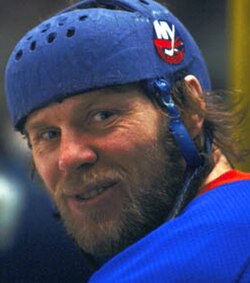
Goring was most recognizable on the ice for the Sven Tumba-endorsed Spaps brand helmet that he had worn since childhood and continued to wear throughout his entire professional career. [35]
Former Islanders' teammate Mike Bossy stated on a 2010 episode of Off the Record with Michael Landsberg that Goring is quite likely the originator of the NHL's tradition of growing a beard in the Stanley Cup playoffs, commonly called a "playoff beard". [36] Other former Islanders, including Dave Lewis and Clark Gillies, point to the tradition starting in the mid-1970s, before Goring's time with the team, [37] although Goring certainly participated in the tradition once he joined the Islanders. [38]
Goring's No. 91 was retired by the Islanders on February 29, 2020, ahead of a game against the Boston Bruins. [39]
| Team | Regular season | Playoffs | ||||||||||||
|---|---|---|---|---|---|---|---|---|---|---|---|---|---|---|
| Season | Team | League | GP | G | A | Pts | PIM | GP | G | A | Pts | PIM | ||
| 1965–66 | Winnipeg Rangers | MJHL | 3 | 0 | 0 | 0 | 0 | 3 | 0 | 1 | 1 | 0 | ||
| 1966–67 | Winnipeg Rangers | MJHL | 51 | 35 | 31 | 66 | 2 | 8 | 2 | 6 | 8 | 0 | ||
| 1967–68 | Hull Nationals | Que-Sr. | 40 | 16 | 41 | 57 | 4 | — | — | — | — | — | ||
| 1967–68 | Winnipeg Jets | MJHL | — | — | — | — | — | 1 | 2 | 1 | 3 | 0 | ||
| 1967–68 | St. Boniface Mohawks | AC | — | — | — | — | — | 12 | 5 | 6 | 11 | 2 | ||
| 1968–69 | Winnipeg Jets | WCHL | 39 | 42 | 33 | 75 | 0 | — | — | — | — | — | ||
| 1968–69 | Dauphin Kings | MC | — | — | — | — | — | 12 | 8 | 8 | 16 | 5 | ||
| 1968–69 | Regina Pats | MC | — | — | — | — | — | 2 | 2 | 3 | 5 | 0 | ||
| 1969–70 | Los Angeles Kings | NHL | 59 | 13 | 23 | 36 | 8 | — | — | — | — | — | ||
| 1969–70 | Springfield Kings | AHL | 19 | 13 | 7 | 20 | 0 | — | — | — | — | — | ||
| 1970–71 | Los Angeles Kings | NHL | 19 | 2 | 5 | 7 | 2 | — | — | — | — | — | ||
| 1970–71 | Springfield Kings | AHL | 40 | 23 | 32 | 55 | 4 | 12 | 11 | 14 | 25 | 0 | ||
| 1971–72 | Los Angeles Kings | NHL | 74 | 21 | 29 | 50 | 2 | — | — | — | — | — | ||
| 1972–73 | Los Angeles Kings | NHL | 67 | 28 | 31 | 59 | 2 | — | — | — | — | — | ||
| 1973–74 | Los Angeles Kings | NHL | 70 | 28 | 33 | 61 | 2 | 5 | 0 | 1 | 1 | 0 | ||
| 1974–75 | Los Angeles Kings | NHL | 60 | 27 | 33 | 60 | 6 | 3 | 0 | 0 | 0 | 0 | ||
| 1975–76 | Los Angeles Kings | NHL | 80 | 33 | 40 | 73 | 8 | 9 | 2 | 3 | 5 | 4 | ||
| 1976–77 | Los Angeles Kings | NHL | 78 | 30 | 55 | 85 | 6 | 9 | 7 | 5 | 12 | 0 | ||
| 1977–78 | Los Angeles Kings | NHL | 80 | 37 | 36 | 73 | 2 | 2 | 0 | 0 | 0 | 2 | ||
| 1978–79 | Los Angeles Kings | NHL | 80 | 36 | 51 | 87 | 16 | 2 | 0 | 0 | 0 | 0 | ||
| 1979–80 | Los Angeles Kings | NHL | 69 | 20 | 48 | 68 | 12 | — | — | — | — | — | ||
| 1979–80 | New York Islanders | NHL | 12 | 6 | 5 | 11 | 2 | 21 | 7 | 12 | 19 | 2 | ||
| 1980–81 | New York Islanders | NHL | 78 | 23 | 37 | 60 | 0 | 18 | 10 | 10 | 20 | 6 | ||
| 1981–82 | New York Islanders | NHL | 67 | 15 | 17 | 32 | 10 | 19 | 6 | 5 | 11 | 12 | ||
| 1982–83 | New York Islanders | NHL | 75 | 19 | 20 | 39 | 8 | 20 | 4 | 8 | 12 | 4 | ||
| 1983–84 | New York Islanders | NHL | 71 | 22 | 24 | 46 | 8 | 21 | 1 | 5 | 6 | 2 | ||
| 1984–85 | New York Islanders | NHL | 29 | 2 | 5 | 7 | 2 | — | — | — | — | — | ||
| 1984–85 | Boston Bruins | NHL | 39 | 13 | 21 | 34 | 6 | 5 | 1 | 1 | 2 | 0 | ||
| 1986–87 | Nova Scotia Oilers | AHL | 10 | 3 | 5 | 8 | 2 | — | — | — | — | — | ||
| NHL totals | 1,107 | 375 | 513 | 888 | 102 | 134 | 38 | 50 | 88 | 32 | ||||
| Year | Team | Event | GP | G | A | Pts | PIM | |
|---|---|---|---|---|---|---|---|---|
| 1981 | Canada | CC | 7 | 3 | 2 | 5 | 4 |
Goring served two stints as an NHL head coach. He coached the Bruins in the 1985–86 season and the early part of the following campaign; [32] he also coached the New York Islanders in the 1999–2000 season [40] [41] [42] and most of the following season – he was fired by the Islanders on March 4, 2001. [43] He also served as the head coach for several minor league teams, including the Spokane Chiefs Capital District Islanders, Las Vegas Thunder, Denver Grizzlies, [40] Utah Grizzlies, and Anchorage Aces, winning two championships. In 2002–2003, after a short stint as head coach of the Frankfurt Lions of the Deutsche Eishockey Liga where he replaced Doug Bradley, he took over the Krefeld Penguins and led them to their first championship since 1952. In 2004–2005, he was the coach of the DEG Metro Stars hockey team in Germany.
| Team | Year | Regular season | Postseason | |||||||||
|---|---|---|---|---|---|---|---|---|---|---|---|---|
| G | W | L | T | OTL | Pts | Finish | W | L | Win% | Result | ||
| BOS | 1985–86 | 80 | 37 | 31 | 12 | — | 86 | 3rd in Adams | 0 | 3 | .000 | Lost in Division Semifinals |
| BOS | 1986–87 | 13 | 5 | 7 | 1 | — | (11) | (fired) | — | — | — | — |
| NYI | 1999–2000 | 82 | 24 | 48 | 9 | 1 | 58 | 5th in Atlantic | — | — | — | Missed playoffs |
| NYI | 2000–01 | 65 | 17 | 40 | 5 | 3 | (52) | (fired) | — | — | — | — |
| Total | 240 | 83 | 126 | 27 | 4 | 193 | 0 | 3 | .000 | 1 playoff appearance | ||