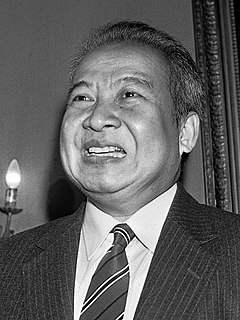
Norodom Sihanouk was a Cambodian royal, politician, composer and filmmaker who was twice the King of Cambodia. He was the son of King Norodom Suramarit and Queen Sisowath Kossamak. In Cambodia, he is also known as Samdech Euv.
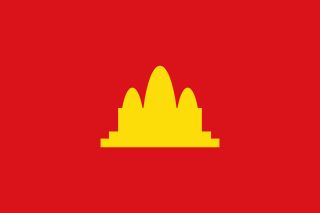
Party of Democratic Kampuchea was a political party in Cambodia, formed as a continuation of the Communist Party of Kampuchea in December 1981. In the mid-1980s, it publicly claimed that its ideology was democratic socialism, having ostensibly renounced communism.

The Cambodian People's Party, founded as the Kampuchean People's Revolutionary Party, is the current ruling political party of Cambodia. It was the sole legal party in the country at the time of the People's Republic of Kampuchea (1979–1989) and during the first two years of the State of Cambodia. Its name was changed during the final years of the State of Cambodia, when the single-party system as well as the Marxist–Leninist ideology were abandoned. Having governed Cambodia since 1979, it is one of the longest-ruling parties in the world. The General Secretary of the party from 1979 to 1981 was Pen Sovan. The KPRP was originally a Marxist–Leninist party, although it took on a more reformist outlook in the mid-1980s under Heng Samrin's leadership. In the 1990s, the KPRP officially dropped its commitment to socialist ideology altogether when it renamed itself the Cambodian People's Party. It is also currently the oldest active party in Cambodia. Since 2018, the party commands all 125 seats in the National Assembly, and 58 of 62 seats in the Senate. Hun Sen, the Prime Minister of Cambodia, has served as the party's President since 2015.

The Cambodian–Vietnamese War, otherwise known in Vietnam as the Counter-offensive on the Southwestern border, was an armed conflict between the Socialist Republic of Vietnam and Democratic Kampuchea. The war began with isolated clashes along the land and maritime boundaries of Vietnam and Kampuchea between 1975 and 1978, occasionally involving division-sized military formations. On 25 December 1978, Vietnam launched a full-scale invasion of Kampuchea and subsequently occupied the country and removed the Communist Party of Kampuchea government from power.

The Khmer People's National Liberation Front was a political front organized in 1979 in opposition to the Vietnamese-installed People's Republic of Kampuchea (PRK) regime in Cambodia. The 200,000 Vietnamese troops supporting the PRK, as well as Khmer Rouge defectors, had ousted the brutal Democratic Kampuchea regime of Pol Pot, and were initially welcomed by the majority of Cambodians as liberators. Some Khmer, though, recalled the two countries' historical rivalry and feared that the Vietnamese would attempt to subjugate the country, and began to oppose their military presence. Members of the KPNLF supported this view.

The Parliament of the Kingdom of Cambodia is the bicameral legislature of the Government of Cambodia, consisting of the Senate and the National Assembly. The Parliament is composed of 187 members, 125 MPs and 62 Senators.

The United Nations Transitional Authority in Cambodia (UNTAC) was a United Nations peacekeeping operation in Cambodia in 1992–93 formed following the 1991 Paris Peace Accords. It was also the first occasion on which the UN had taken over the administration of an independent state, organised and run an election, had its own radio station and jail, and been responsible for promoting and safeguarding human rights at the national level.

The People's Republic of Kampuchea was founded in Cambodia by the Salvation Front, a group of Cambodian communists dissatisfied with the Khmer Rouge after the overthrow of Democratic Kampuchea, Pol Pot's government. Brought about by an invasion from the Socialist Republic of Vietnam, which routed the Khmer Rouge armies, it had Vietnam and the Soviet Union as its main allies.
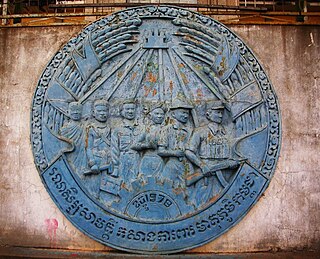
The Kampuchea United Front for National Salvation, often simply referred to as Salvation Front or by its French acronym FUNSK, was the nucleus of a new Cambodian regime that would topple the Khmer Rouge and later establish the People's Republic of Kampuchea (PRK).

Khieu Kanharith is the Cambodian Minister of Information.

The Kampuchean People's Representative Assembly was the official name of the unicameral legislature of Cambodia during the Democratic Kampuchea period. It was established as the official legislature of Kampuchea on January 5, 1976, consisting of 250 members.
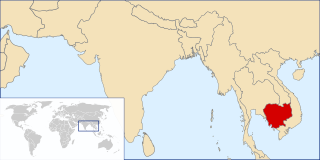
United Nations Security Council resolution 668, adopted unanimously on 20 September 1990, after noting the ongoing political discussions and efforts regarding a just and lasting peaceful situation in Cambodia, the Council endorsed the political framework that would enable the Cambodian people to exercise their right to self-determination through U.N. organised elections.

United Nations Security Council resolution 783, adopted unanimously on 13 October 1992, after recalling resolutions 668 (1990), 717 (1991), 718 (1991), 728 (1992), 745 (1992) and 766 (1992) and noting a report by the Secretary-General Boutros Boutros-Ghali, the Council welcomed the progress the United Nations Transitional Authority in Cambodia (UNTAC) had made in Cambodia in accordance with the Paris Agreements, however it recognised various security and economic concerns facing UNTAC.
United Nations Security Council resolution 810, adopted unanimously on 8 March 1993, after recalling resolutions 668 (1990) and 745 (1992), the Council, after deploring continuing political violence in Cambodia in violation of the Paris Agreements as well as attacks and detention of members of the United Nations Transitional Authority in Cambodia (UNTAC), discussed upcoming elections to the Constituent Assembly, as part of a process of national reconciliation.
United Nations Security Council resolution 835, adopted unanimously on 2 June 1993, after recalling resolutions 668 (1990), 745 (1992), 810 (1993), 826 (1993) and other relevant resolutions, the Council expressed appreciation for the United Nations Transitional Authority in Cambodia (UNTAC) in the aftermath of recent elections in Cambodia.
United Nations Security Council resolution 840, adopted unanimously on 15 June 1993, after recalling resolutions 668 (1990), 745 (1992), 810 (1993), 826 (1993), 835 (1993) and other relevant resolutions, the Council endorsed the results of the 1993 general elections in Cambodia.

General elections were held in Cambodia on 1 May 1981 and marked the establishment of the new, Vietnamese-backed, state of the People's Republic of Kampuchea (PRK). The Kampuchean People's Revolutionary Party was the only party to contest the election, and won all 117 seats. Voter turnout was reported to be 90%.

The Communist Party of Kampuchea, also known as Khmer Communist Party (KCP), was a communist party in Cambodia. Its leader was Pol Pot and its followers were generally known as Khmer Rouge. The party was underground for most of its existence and took power in the country in 1975 and established the state known as Democratic Kampuchea. The party lost power in 1979 with the establishment of the People's Republic of Kampuchea by leftists who were dissatisfied by the Pol Pot regime and by the intervention of Vietnamese military forces after a period of mass killing. The party was officially dissolved in 1981, with the Party of Democratic Kampuchea claiming its legacy.