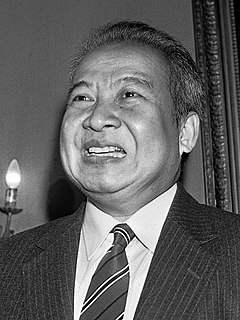
Norodom Sihanouk was a Cambodian royal, politician, composer and filmmaker who was twice the King of Cambodia. He was the son of King Norodom Suramarit and Queen Sisowath Kossamak. In Cambodia, he is also known as Samdech Euv.
After the fall of the Pol Pot regime of Democratic Kampuchea, Cambodia was under Vietnamese occupation and a pro-Hanoi government, the People's Republic of Kampuchea was established. A civil war raged during the 1980s opposing the government's Kampuchean People's Revolutionary Armed Forces against the Coalition Government of Democratic Kampuchea, a government in exile composed of three Cambodian political factions: Prince Norodom Sihanouk's Funcinpec party, the Party of Democratic Kampuchea and the Khmer People's National Liberation Front (KPNLF).
FUNCINPEC, National United Front for an Independent, Neutral, Peaceful and Cooperative Cambodia in English, is a royalist political party in Cambodia. Founded in 1981 by Norodom Sihanouk, it started off as a resistance movement against the People's Republic of Kampuchea (PRK) government. In 1982, it formed a resistance pact, the Coalition Government of Democratic Kampuchea (CGDK), together with the Khmer People's National Liberation Front (KPNLF) and the Khmer Rouge. It was one of the signatory parties of the 1991 Paris Peace Accords, which paved the way for the formation of the United Nations Transitional Authority in Cambodia (UNTAC). In 1992, FUNCINPEC became a political party and participated in the 1993 general elections organised by UNTAC. It won the elections, and formed a coalition government with the Cambodian People's Party (CPP), with which it jointly headed. Norodom Ranariddh, Sihanouk's son who had succeeded him as the party president, became First Prime Minister while Hun Sen, who was from the CPP, became Second Prime Minister.

Kampong Cham is a province (khaet) of Cambodia located on the central lowlands of the Mekong River. It borders the provinces of Kampong Chhnang to the west, Kampong Thom and Kratié to the north, Tbong Khmum to the east, and Prey Veng and Kandal to the south. Kampong Cham was officially divided into two provinces on 31 December 2013 in what was seen by many as a political move by the ruling party. All land west of the Mekong remained Kampong Cham while land east of the river became Tbong Khmum province. Prior to this division, Kampong Cham extended eastward to the international border with Vietnam, was the eleventh largest province in Cambodia, and with a population of 1,680,694, was the most populous province in Cambodia. Its capital and largest city is Kampong Cham.

The Candlelight Party is a personalist liberal party in Cambodia. The party was a member of the Council of Asian Liberals and Democrats, Liberal International, and the Alliance of Democrats.

Norodom Ranariddh is a Cambodian royal politician and law academic. He is the second son of Norodom Sihanouk of Cambodia and a half-brother of the current king, Norodom Sihamoni. Ranariddh is the president of FUNCINPEC, a Cambodian royalist party. He was also the First Prime Minister of Cambodia following the restoration of the monarchy, serving between 1993 and 1997, and subsequently as the President of the National Assembly between 1998 and 2006.
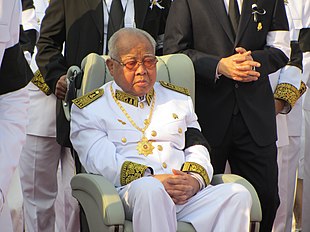
Chea Sim was a Cambodian politician. He was President of the Cambodian People's Party from 1991 to 2015, President of the National Assembly of Cambodia from 1981 to 1998 and President of the Senate from 1999 to 2015. His official title was Samdach Akeak Moha Thomak Pothisal Chea Sim, Protean Protsaphea ney Preah Reacheanachak Kampuchea.

Norodom Chakrapong is a Cambodian royal politician, businessman and former major-general of the Royal Cambodian Armed Forces. He is the fourth son of Norodom Sihanouk of Cambodia and also a half-brother of the current king, Norodom Sihamoni. Chakrapong started his career as a military pilot in 1963. After Sihanouk was overthrown in 1970, Chakrapong spent time under house arrest, then in Beijing as the Head of Protocol of then-Prince Sihanouk, afterwards living overseas before he joined the Funcinpec in 1981 and fought against Vietnamese occupation as a commander of the Armée Nationale Sihanoukiste. In 1991, Chakrapong left Funcinpec to join the Cambodian People's Party (CPP) and served as the Deputy Prime Minister of Cambodia between 1992 and 1993. When the CPP lost the 1993 general elections, Chakrapong led a secession attempt in 1993. In 1994, he was accused of joining a failed coup attempt which led him to be sent into exile. After Chakrapong was pardoned in 1998, he founded a private airline company, Royal Phnom Penh Airways. The airlines later stopped all operations in early 2006.

Cambodia is a one party dominant state with the Cambodian People's Party in power. Cambodia's legislature is chosen through a national election. The general election is held every five years in the fourth Sunday of July. The Parliament of Cambodia has two chambers. The National Assembly of Cambodia has 125 members, each elected for a five-year term by proportional representation. The Senate has 62 members, mostly indirectly elected.
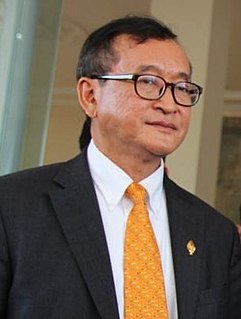
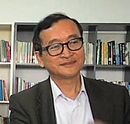
Sam Rainsy is a Cambodian activist and politician who most recently served as the Leader of the Opposition. He is now the president of the Cambodia National Rescue Movement (CNRM), launched in January 2018. He was a Member of Parliament (MP) for Kampong Cham, first from 1998 until 2005, then from 2008 to 2011, and finally from 2014 until 2015; he has been revoked of parliamentary immunity three times. He was previously the MP for Siem Reap from 1993 until 1995 when he was expelled from the Constituent Assembly. A co-founder of the Cambodia National Rescue Party (CNRP), Rainsy was previously a member of the royalist Funcinpec Party and served as the Minister of Economy and Finance during Norodom Ranariddh's administration from 1993 until his sacking in 1994. In June 1995, he was expelled from the National Assembly, and formed the Khmer Nation Party (KNP), which changed its name before the 1998 elections to the Sam Rainsy Party (SRP) to avoid registration issues. From 2000 to 2002 and again from 2012 to 2014, Rainsy was the chairperson of the Council of Asian Liberals and Democrats.

Sar Kheng is a Cambodian politician. One of the highest-ranking members of the ruling Cambodian People's Party, he is the current Minister of the Interior and has served as a Deputy Prime Minister since 1992. He also represents the province of Battambang in the Cambodian Parliament. Kheng has been the Minister of the Interior since 1992. Until March 2006, he shared the position with FUNCINPEC party member You Hockry as co-Ministers of the Interior, but then became sole interior minister in a cabinet reshuffle as FUNCINPEC ended its coalition with the CPP. He is currently the second longest serving government minister of Cambodia after Prime Minister Hun Sen. On June 14, 2015, King Norodom Sihamoni awarded Kheng the honorary title of "Samdech". His official title is "Samdech Kralahom Sar Kheng". Kheng is married to Nhem Sakhan with whom he has three children.
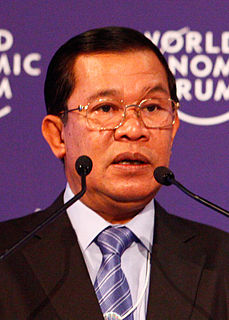
General elections were held in Cambodia on 27 July 2003 to elect members of the National Assembly. The elections were won by the ruling Cambodian People's Party, which won a majority of 73 seats in the 123-seat parliament. However, due to the requirement for a two-thirds majority to elect a Prime Minister, a new government was not formed until July 2004 when a deal was reached with the FUNCINPEC party. Hun Sen was subsequently re-elected the post of Prime Minister.

Mu Sochua is a Cambodian politician and rights activist. She was a Member of Parliament (MP) for Battambang from 2013 to 2017, a seat which she previously held from 1998 to 2003. She was a member and Vice President of the Cambodia National Rescue Party (CNRP) until its dissolve, and previously a member of the Sam Rainsy Party (SRP) prior to its merger with the Human Rights Party. As a member of FUNCINPEC, she also served as Minister of Women and Veterans' Affairs in Hun Sen's coalition government from 1998 to 2004. She is currently one of 118 senior opposition figures serving a five-year ban from politics following a court ruling on 16 November 2017.

The 1997 clashes in Cambodia, also referred to as the 1997 coup in Cambodia, took place in Cambodia in July to September 1997. As a result, co-premier Hun Sen ousted the other co-premier Norodom Ranariddh. Dozens of people were killed during the conflict.

General elections were held in Cambodia between 23 and 28 May 1993. The result was a hung parliament with the FUNCINPEC Party being the largest party with 58 seats. Voter turnout was 89.56%. The elections were conducted by the United Nations Transitional Authority in Cambodia (UNTAC), which also maintained peacekeeping troops in Cambodia throughout the election and the period after it.
General elections were held in Cambodia on 26 July 1998. The result was a victory for the Cambodian People's Party (CPP), which won 64 of the 122 seats, resulting in its leader Hun Sen becoming Prime Minister. Opposition parties sought a recount and claimed there had been irregularities, claims supported by many international observers. Voter turnout was 93.7%.
General elections were held in Cambodia on 28 July 2013. The National Election Committee (NEC) announced that some 9.67 million Cambodians were eligible to cast their ballots to elect the 123-seat National Assembly. Voter turnout was reported to be 69.6%, making it the lowest turnout in history. Polling precincts opened 7:00 a.m. and closed at 3:00 p.m. The Cambodian Minister of Information, Khieu Kanharith announced in preliminary results that the Cambodian People's Party won 68 seats and the opposition Cambodia National Rescue Party won all the remaining 55 seats. This election marked the largest seat loss by the Cambodian People's Party to date, and their lowest share of seats since 1998.

Tboung Khmum, officially Tbong Khmum, is a province (khaet) of Cambodia located on the central lowlands of the Mekong River. It borders the provinces of Kampong Cham to the west, Kratié to the north, Prey Veng to the south, and shares an international border with Vietnam to the east. Its capital and largest city is Suong. The province's name consists of two words in Khmer, tboung and khmum (bee), which together mean "amber".
General elections were held in Cambodia on Sunday, 29 July 2018 to elect members of the sixth National Assembly. Polling stations opened at 07:00 and closed at 15:00. The number of registered voters has decreased for the first time since 1993 and was down 13% from the 2013 general elections.