Charleston seismic zone

Last updated
Charleston seismic zone
Middleton Place/Summerville Seismic Zone
EtymologyThe city of Charleston, South Carolina
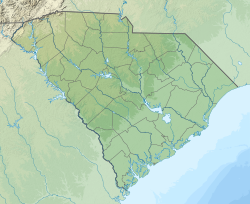
USA South Carolina relief location map.svg
Bullseye1.png
Charleston seismic zone
Location of the Charleston seismic zone
Named by Arthur Tarr
Year defined1981
Coordinates 33°02′16″N80°10′18″W / 33.0379°N 80.1717°W / 33.0379; -80.1717
CountryUnited States
RegionSouth Carolina coastal plain
State South Carolina
Cities Charleston, South Carolina
Characteristics
Top depth8,000 metres (26,247 ft) [1]
Part of South Georgia rift
Length20 km (12.4 miles)
Width10 km (6.2 miles)
Tectonics
Plate North American plate
StatusActive
Earthquakes 1886 Charleston earthquake (6.7-7.8 magnitude) [2]
Age Jurassic

The Charleston seismic zone, also known as the Middleton Place/Summerville seismic zone is a major seismic zone located near the town of Summerville, South Carolina. It is a result of basement faults from the ancient South Georgia rift, which was active during the break up of Pangea (~201 Ma). [3] The Charleston seismic zone has the potential for large and catastrophic earthquakes. On August 31, 1886, a fault under the town of Summerville, South Carolina ruptured and produced an earthquake that had an estimated magnitude of between 6.8 and 7.8 on the Richter Scale. This was one of the largest earthquakes ever recorded in the eastern United States. [2] [4]

Contents

Geography

The Charleston seismic zone is centered near the town of Summerville, South Carolina (~20 miles northeast of Charleston, South Carolina). Summerville lies directly over an ancient rift valley, the South Georgia rift, which was involved in the initial break up of Pangea. [1] The seismic zone is located on the coastal plain of South Carolina; with the Piedmont crystalline surface rocks to the northwest, and the Atlantic Ocean to the east and southeast of the area. [5] The Penholoway, Waccamaw, Socastee, and Wando formations make up the surface lithology of the area. [6] [1] [7]

Geology

The geology of the zone is complicated and involves several major geological processes.

South Georgia rift

The zone dates back to the end of the Triassic period. During that time, the Supercontinent Pangea was rifting apart. Initial rifting created a series of half graben rift valley's; together known as the Newark Supergroup. Some of these rift valleys are: [8]

These rift valleys were associated with the Central Atlantic magmatic province (CAMP); one of the largest volcanic events in Earth's history. [9] Further south, the South Georgia rift was also erupting basalt at the same time as their counterparts to the north in the Newark Supergroup basins. [1]

Earthquake hazard map of the United States from the USGS. The Charleston area is listed as the highest hazard level 2018 Long-term National Seismic Hazard Map.jpg
Earthquake hazard map of the United States from the USGS. The Charleston area is listed as the highest hazard level

After Pangea rifted apart and opened the Atlantic Ocean, the South Georgia rift was left severely fractured. As a result, 4 to 5 different faults intersect around the Summerville, South Carolina area. Two of the most active faults are the Woodstock and Ashley River faults. This complex setup makes the Charleston seismic zone prone to large earthquakes over time. [10] Even though hundreds of millions of years have passed since volcanic activity occurred, the faults can be reactivated. This happens from far-field plate boundary interactions and movement associated with the North American plate. [11]

North American plate

North American Plate tectonic map North American Plate map-fr.png
North American Plate tectonic map

The North American plate is constantly under stress from bordering plate boundaries. On its southern boundary, the North American plate interacts with the South American, and the Caribbean plates. This location is a complex tectonic setting where you have both subduction at the Lesser Antilles Volcanic Arc and a long transform fault (Motagua Fault, the Swan Islands Transform Fault, and the Cayman Trough. [12]

On its southwestern boundary, the North American plate interacts with the Cocos plate. This is marked by a subduction zone Middle America Trench, where the Cocos plate subducts under the North American plate. The boundary then transitions to a complex rifting/strike-slip fault configuration further north (San Andreas fault). [13] North of here, the plate boundary transitions back to subduction (Cascadia subduction zone where the Juan de Fuca plate subducts under the North American plate) before transitioning to another long strike-slip fault (Nootka fault). [14]

At the northern terminus of the Nootka fault, the North American plate boundary turns west along the southern Alaskan coast where a ~4000 kilometer (~2485 mile) subduction zone, (the Aleutian subduction zone) marks the North American plates southern boundary. The Pacific plate is subducting under the North American plate. [15]

At its northern boundary, The North American plate becomes an ultra-slow spreading center known as the Gakkel Ridge. Total spreading rates along this boundary range between 6 and 12.6 mm/yr (0.2 to 0.5 inches/year). [16]

The eastern boundary of the North American plate is the Mid-Atlantic Ridge. This boundary has a direct link to the Charleston seismic zone and the South Georgia rift. The Mid-Atlantic Ridge started as the spreading center that broke up Pangea, and created the South Georgia rift and the Charleston seismic zone as a result. [17] ~201 Ma later, the ridge is still actively making the Atlantic Ocean wider by around ~1.2 to 5.5 cm/yr (.47 to 2.1 inches/year). [18]

Other boundaries

While all plate boundaries surrounding the North American plate play a role in the Charleston seismic zones behavior, there are two plate boundaries that influence earthquake activity most. The divergent plate boundary (Mid-Atlantic Ridge) and the strike-slip (San Andreas fault). Their interaction creates compressional forces along the US east coast. [19] [20]

The Mid-Atlantic ridge creates ridge push which slowly moves the North American plate westward via gravity caused by the cooled basalt sliding down towards the continental margins. This western movement interacts with the San Andreas fault on the US west coast. This rotates the North American plate counterclockwise. As stress building over time, the shear becomes too great and faults ruptures. [20] [19] [21]

Fault structure

Detailed map laying out fault structures below the Charleston/Summerville, South Carolina area. (USGS) Cross section of Charleston Faults.pdf
Detailed map laying out fault structures below the Charleston/Summerville, South Carolina area. (USGS)

Many different faults meet in the Summerville, South Carolina area. Its layout is extremely complicated. It's difficult to pinpoint fault locations and their respective sizes due to the thick layer of sediment that covers the area. In places close to the Charleston seismic zone, sediment layers can be as much as 830 m (2,700 ft) deep. [22]

Two of the major faults that have been implicated in seismic activity are the Woodstock fault and the Ashley River fault. The Woodstock fault is a right-lateral oblique strike-slip fault. It can be further divided into the north and south Woodstock fault. The Woodstock fault is buried by a deep Mesozoic sedimentary layer that ranges in depth from 2,200 - 12,300 m (9,842 - 42,650 ft). [19]

The Ashley River fault in contrast is a reverse fault (compressional fault) in response to a plate tectonic stress fields. [23] Both of these faults intersect near Summerville, South Carolina and are the likely source of large earthquakes (including the 1886 Charleston earthquake).

Earthquakes

The Charleston seismic zone is one of the most seismically active regions in the eastern United States. [24] Faults under the Charleston area build pressure over hundreds to thousands of years until a large rupture occurs. The area experiences 10 to 15 earthquakes per year, with most being minor (less than 3 in magnitude). [25]

1886 Charleston Earthquake

In the evening of August 31, 1886, a large and extremely powerful earthquake occurred near the city of Charleston, South Carolina. The epicenter was located very close to the city of Summerville, in South Carolina. With an estimated magnitude of 7.3, this one one of the largest earthquakes ever recorded along the US east coast. [26]

For my years, the cause of the Charleston earthquake was unknown. It wasn't until the 1980s and 1990s that the source of the earthquake was discovered. A huge problem that early studies faced was the huge sedimentary layer that covered the fault. [27] [28]

In 2020, LiDAR (Light detection and Ranging) was used for the first time to see the structure of faults under Summerville. This study revealed that multiple faults may have ruptured during the 1886 earthquake. The 17 kilometer long Middleton Place lineament along with the 40 kilometer long Deer Park lineament (where the Woodstock fault is found), may have worked in tandum and the combined ruture caused the massive earthquake in 1886. [29]

References

  1. 1 2 3 4 Shah, A. K.; Pratt, T. L.; Horton, J. W. (May 2023). "Rift Basins and Intraplate Earthquakes: New High-Resolution Aeromagnetic Data Provide Insights Into Buried Structures of the Charleston, South Carolina Seismic Zone". Geochemistry, Geophysics, Geosystems. 24 (5) e2022GC010803. Bibcode:2023GGG....2410803S. doi:10.1029/2022GC010803 . Retrieved 5 January 2026.
  2. 1 2 Rasanen, Ryan A.; Maurer, Brett W. (1 January 2023). "Probabilistic seismic source inversion of the 1886 Charleston, South Carolina, earthquake from macro seismic evidence: A major updating". Engineering Geology. 312 106958. Bibcode:2023EngGe.31206958R. doi:10.1016/j.enggeo.2022.106958. ISSN   0013-7952 . Retrieved 22 January 2026.
  3. Pratt, T. L.; Shah, A. K.; Horton, J. W.; Chapman, M. C.; Beale, J. (December 2014). "Recent Fault Activity in the 1886 Charleston, South Carolina Earthquake Epicentral Area and its Relation to Buried Structures". AGU Fall Meeting Abstracts: T12B–07. Bibcode:2014AGUFM.T12B..07P . Retrieved 5 January 2026.
  4. Tuttle, Martitia P.; Hartleb, Ross; Wolf, Lorraine; Mayne, Paul W. (13 July 2019). "Paleoliquefaction Studies and the Evaluation of Seismic Hazard". Geosciences. 9 (7): 311. Bibcode:2019Geosc...9..311T. doi: 10.3390/geosciences9070311 .
  5. "SOUTH CAROLINA GEOLOGY AND SEISMICITY" (PDF). South Carolina Department of Transportation. January 2022. pp. 11-i -11–25. Retrieved 5 January 2026.
  6. "Seismic Profiling of Faults Related to the 1886 Charleston Earthquake: Summerville Survey" (PDF). USGS. United States Geological Survey. 31 December 2022. Retrieved 5 January 2026.
  7. Weems, Robert E.; Lewis, William C. (January 2002). "Structural and tectonic setting of the Charleston, South Carolina, region: Evidence from the Tertiary stratigraphic record". Geological Society of America Bulletin. 114 (1). GSA: 24–42. Bibcode:2002GSAB..114...24W. doi:10.1130/0016-7606(2002)114<0024:SATSOT>2.0.CO;2 . Retrieved 5 January 2026.
  8. OLSEN, PAUL E. (January 1980). "TRIASSIC AND JURASSIC FORMATIONS OF THE NEWARK BASIN" (PDF). Bingham Laboratories, Department of Biology, Yale University. Retrieved 6 January 2026.
  9. Knight, K.B.; Nomade, S.; Renne, P.R.; Marzoli, A.; Bertrand, H.; Youbi, N. (November 2004). "The Central Atlantic Magmatic Province at the Triassic–Jurassic boundary: paleomagnetic and 40Ar/39Ar evidence from Morocco for brief, episodic volcanism". Earth and Planetary Science Letters. 228 (1–2): 143–160. doi:10.1016/j.epsl.2004.09.022 . Retrieved 6 January 2026.
  10. Gangopadhyay, Abhijit; Talwani, Pradeep (2005). "Front Matter". Current Science. 88 (10): 609–16. JSTOR   24110459 . Retrieved 7 January 2026.
  11. Murphy, Benjamin S.; Liu, Lijun; Egbert, Gary D. (16 August 2019). "Insights Into Intraplate Stresses and Geomorphology in the Southeastern United States". Geophysical Research Letters. 46 (15): 8711–8720. Bibcode:2019GeoRL..46.8711M. doi:10.1029/2019GL083755. ISSN   0094-8276 . Retrieved 7 January 2026.
  12. Bally, A. W.; Scotese, C. R.; Ross, M. I. (1989). "North America; Plate-tectonic setting and tectonic elements". The Geology of North America—An Overview: 1–15. doi:10.1130/DNAG-GNA-A.1. ISBN   0-8137-5207-8 . Retrieved 7 January 2026.
  13. McCaffrey, Robert (July 2005). "Block kinematics of the Pacific–North America plate boundary in the southwestern United States from inversion of GPS, seismological, and geologic data". Journal of Geophysical Research: Solid Earth. 110 (B7) 2004JB003307. Bibcode:2005JGRB..110.7401M. doi:10.1029/2004JB003307 . Retrieved 7 January 2026.
  14. Humphreys, Eugene D.; Coblentz, David D. (September 2007). "North American dynamics and western U.S. tectonics". Reviews of Geophysics. 45 (3) 2005RG000181. Bibcode:2007RvGeo..45.3001H. doi:10.1029/2005RG000181 . Retrieved 7 January 2026.
  15. Carver, Gary; Plafker, George (19 March 2013). "Paleoseismicity and Neotectonics of the Aleutian Subduction Zone-An Overview". Geophysical Monograph Series: 43–63. doi:10.1029/179GM03. ISBN   978-1-118-66639-5 . Retrieved 7 January 2026.
  16. Cochran, James R.; Kurras, Gregory J.; Edwards, Margo H.; Coakley, Bernard J. (February 2003). "The Gakkel Ridge: Bathymetry, gravity anomalies, and crustal accretion at extremely slow spreading rates". Journal of Geophysical Research: Solid Earth. 108 (B2) 2002JB001830. Bibcode:2003JGRB..108.2116C. doi:10.1029/2002JB001830 . Retrieved 7 January 2026.
  17. Stubblefield, Aaron G.; Hatcher, Robert D.; Wright Horton, J.; Daniels, David L. (June 2023). "Unzipping supercontinent Pangea: Geologic, potential field data, and buried structures, and a case for sequential Atlantic opening". Tectonophysics. 856 229842. Bibcode:2023Tectp.85629842S. doi:10.1016/j.tecto.2023.229842 . Retrieved 7 January 2026.
  18. Lin, Jian; Morgan, Jason Phipps (3 January 1992). "The spreading rate dependence of three-dimensional mid-ocean ridge gravity structure". Geophysical Research Letters. 19 (1): 13–16. arXiv: 1104.0296 . Bibcode:1992GeoRL..19...13L. doi:10.1029/91GL03041 . Retrieved 7 January 2026.
  19. 1 2 3 Mazzotti, Stephane; Townend, John (April 2010). "State of stress in central and eastern North American seismic zones". Lithosphere. 2 (2): 76–83. Bibcode:2010Lsphe...2...76M. doi:10.1130/L65.1 . Retrieved 7 January 2026.
  20. 1 2 Zoback, Mary Lou; Zoback, Mark D. (1989). "Chapter 24: Tectonic stress field of the continental United States" (PDF). Geological Society of America Memoirs. 172: 523–540. doi:10.1130/MEM172-p523. ISBN   0-8137-1172-X . Retrieved 7 January 2026.
  21. Dura-Gomez, I.; Talwani, P. (1 September 2009). "Finding Faults in the Charleston Area, South Carolina: 1. Seismological Data" (PDF). Seismological Research Letters. 80 (5): 883–900. Bibcode:2009SeiRL..80..883D. doi:10.1785/gssrl.80.5.883 . Retrieved 7 January 2026.
  22. Chapman, M.C.; Martin, J.R.; Olgun, G.; Regmi, B. (12 June 2003). "PREDICTION AND GEOGRAPHICAL INFORMATION SYSTEM (GIS) MAPPING OF GROUND MOTIONS AND SITE RESPONSE IN CHARLESTON, SC AND TWO NEIGHBORING COUNTIES: FIRST PHASE DEVELOPMENT OF A GIS FOR SEISMIC HAZARD EVALUATION" (PDF). USGS. United States Geological Survey. Retrieved 8 January 2026.
  23. Talwani, Pradeep (13 November 2003). "Macroscopic Effects of the 1886 Charleston Earthquake" (PDF). Carolina Geological Society. Retrieved 10 January 2026.
  24. Dodson, Braley (16 May 2022). "What was the strongest earthquake to hit South Carolina?". WBTW. Retrieved 11 January 2026.
  25. Field, Carla (20 June 2017). "Earthquakes in South Carolina are surprisingly common". WYFF. Retrieved 11 January 2026.
  26. Hough, Susan E.; Bilham, Roger (1 June 2024). "The 1886 Charleston, South Carolina, Earthquake: Intensities and Ground Motions". Bulletin of the Seismological Society of America. 114 (3): 1658–1679. Bibcode:2024BuSSA.114.1658H. doi:10.1785/0120230224 . Retrieved 23 January 2026.
  27. KITZNILLER, CARLA (26 May 1983). "Large strain effects of the 1886 South Carolina earthquake" (PDF). United States Geological Survey. Retrieved 23 January 2026.
  28. Talwani, Pradeep (1982). "Internally consistent pattern of seismicity near Charleston, South Carolina". Geology. 10 (12): 654. Bibcode:1982Geo....10..654T. doi:10.1130/0091-7613(1982)10<654:ICPOSN>2.0.CO;2 . Retrieved 23 January 2026.
  29. Marple, Ronald T.; Hurd, Jr., James D. (22 May 2020). "Interpretation of lineaments and faults near Summerville, South Carolina, USA, using LiDAR data: implications for the cause of the 1886 Charleston, South Carolina, earthquake". Atlantic Geology. 56: 073–095. Bibcode:2020AtlG...56...73M. doi:10.4138/atlgeol.2020.003 . Retrieved 23 January 2026.