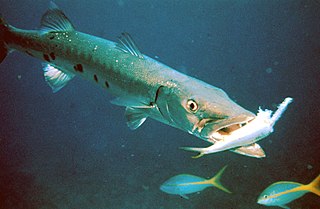
A barracuda is a large, predatory, ray-finned fish known for its fearsome appearance and ferocious behaviour. The barracuda is a saltwater fish of the genus Sphyraena, the only genus in the family Sphyraenidae, which was named by Constantine Samuel Rafinesque in 1815. It is found in tropical and subtropical oceans worldwide ranging from the eastern border of the Atlantic Ocean to the Red Sea, on its western border the Caribbean Sea, and in tropical areas of the Pacific Ocean. Barracudas reside near the top of the water and near coral reefs and sea grasses. Barracudas are targeted by sport-fishing enthusiasts.

The Exocoetidae are a family of marine ray-finned fish in the order Beloniformes, known colloquially as flying fish or flying cod. About 64 species are grouped in seven genera. While they cannot fly in the same way a bird does, flying fish can make powerful, self-propelled leaps out of the water where their long wing-like fins enable gliding for considerable distances above the water's surface. The main reason for this behavior is thought to be to escape from underwater predators, which include swordfish, mackerel, tuna, and marlin, among others, though their periods of flight expose them to attack by avian predators such as frigate birds.

The yellow bullhead is a species of bullhead catfish, a ray-finned fish that lacks scales.

Cheilopogon is a genus of flyingfishes.
The dwarf catshark is a catshark of the family Scyliorhinidae, found only off the coast of Western Australia, at depths between 200 and 400 m. Its length is up to 44 cm.

Scolopendridae is a family of large centipedes.

The California flying fish, Cheilopogon pinnatibarbatus californicus, is a subspecies of Bennett's flying fish. Prior to the 1970s, the California flying fish was known as a distinct species, with the scientific classification Cypselurus californicus. In fact there are 40 distinct classifications of flying fish. It may grow up to 19 inches (48 cm) in length and is the largest member of the flying fish family. It is found in the Eastern Pacific Ocean, from Oregon to Baja California. As with all other flying fish, the California can not actually fly, but it can launch itself into the air, using its specially adapted fins to glide along the surface.
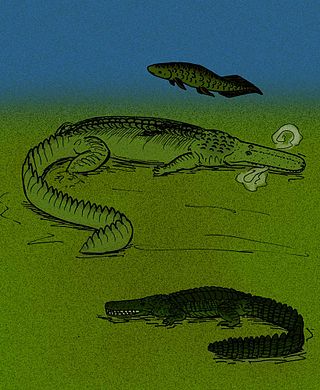
Retodus is an extinct genus of prehistoric lungfish found in Cretaceous-aged freshwater strata of Egypt, Algeria and Niger. The type species, R. tuberculatus, was named in 2006. It was originally named as a species of Ceratodus and Neoceratodus in 1963.

The Atlantic flyingfish is a flying fish in the family Exocoetidae. It was first described by the French zoologist, Achille Valenciennes in a 22-volume work entitled Histoire naturelle des poissons, which was a collaboration with fellow zoologist Georges Cuvier.
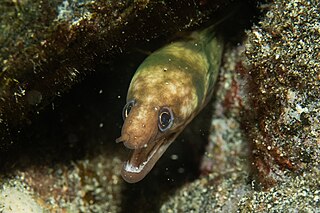
The slendertail moray eel is a moray eel found in coral reefs in the Pacific Ocean. It was first named by Jenkins in 1903, and is also commonly known as the graceful-tailed moray.

The Hawaiian blackhead triplefin, also known as the Hawaiian triplefin in Hawaii, is a species of triplefin blenny in the genus Enneapterygius. It is a tropical blenny found in coral reefs in the Pacific Ocean, from the Hawaiian Islands, French Frigate Shoals, Laysan Island, and Midway Atoll. Blennies in this species swim at a depth range of 1–23 metres, and inhabit dead coral and rock.

The Diplectanidae are a family of monopisthocotylean monogeneans. They are all parasitic on the gills of fish. Diplectanids are small animals, generally around 1 mm in length. As parasites, they can be extremely numerous, up to several thousand on an individual fish.
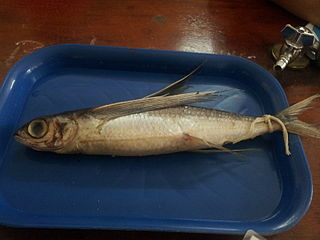
Cheilopogon nigricans, the blacksail flyingfish, also known as African flyingfish, or leaping flyingfish, is a flying fish in the family Exocoetidae. It is an oceanodromous, plankton-eating marine fish which has commercial value.
Oliver Peebles Jenkins was an American physiologist and histologist, mainly associated with Stanford University.
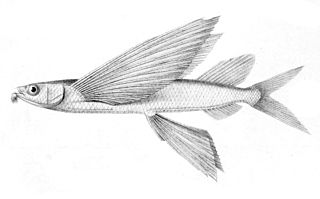
Cheilopogon pinnatibarbatus, Bennett's flying fish, is a species of flying fish which has a circumglobal distribution in tropical and subtropical seas. It is an epiplegaic species which feeds on zooplankton and small fishes and is capable of leaping out of the water and gliding over the surface.
Cheilopogon dorsomacula is a species of fish in the family Exocoetidae.
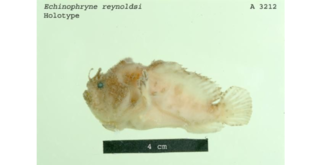
Echinophryne reynoldsi is a species of fish in the family Antennariidae. It was first described in 1984 by Theodore Wells Pietsch III and Rudie Hermann Kuiter.
Hypostomus boulengeri is a species of catfish in the family Loricariidae. It is native to South America. The species reaches 24.5 cm SL and is believed to be a facultative air-breather.


