
The Afroasiatic languages, also known as Hamito-Semitic, or Semito-Hamitic, and sometimes also as Afrasian, Erythraean or Lisramic, are a language family of about 300 languages that are spoken predominantly in the geographic subregions of Western Asia, North Africa, the Horn of Africa, and parts of the Sahara/Sahel. With the exception of its Semitic branch, all branches of the Afroasiatic family are exclusively native to the African continent.

The Ababda are an Arab or Beja tribe in eastern Egypt and Sudan. Historically, most were Bedouins living in the area between the Nile and the Red Sea, with some settling along the trade route linking Korosko with Abu Hamad. Numerous traveler accounts from the nineteenth century report that some Ababda at that time still spoke Beja or a language of their own, hence many secondary sources consider the Ababda to be a Beja subtribe. Most Ababda now speak Arabic and identify as an Arab tribe from the Hijaz. The Ababda have a total population of over 250,000 people.
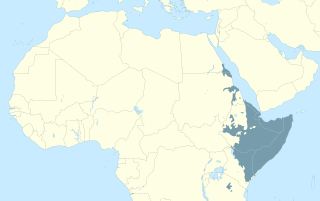
The Cushitic languages are a branch of the Afroasiatic language family. They are spoken primarily in the Horn of Africa, with minorities speaking Cushitic languages to the north in Egypt and the Sudan, and to the south in Kenya and Tanzania. As of 2012, the Cushitic languages with over one million speakers were Oromo, Somali, Beja, Afar, Hadiyya, Kambaata, Saho, and Sidama.
Nubians are an ethnic group indigenous to the region which is now northern Sudan and southern Egypt. They originate from the early inhabitants of the central Nile valley, believed to be one of the earliest cradles of civilization. In the southern valley of Egypt, Nubians differ culturally and ethnically from other Egyptians, although they intermarried with members of other ethnic groups, especially Arabs. They speak Nubian languages as a mother tongue, part of the Northern Eastern Sudanic languages, and Arabic as a second language.

The Beja people are an ethnic group native to the Eastern Desert, inhabiting a coastal area from southeastern Egypt through eastern Sudan and into northwestern Eritrea. They are descended from peoples who have inhabited the area since 4000 BC or earlier, although they were Arabized by Arabs who settled in the region. They are nomadic, and live primarily in the Eastern Desert. They number around 1,900,000 to 2,200,000 people. Most of the Beja speak Arabic, while some speak the Cushitic language of Beja and the Semitic language of Tigre. In Eritrea and southeastern Sudan, many members of the Beni-Amer grouping speak Tigre. Originally, the Beja did not speak Arabic, however the migration of the numerous Arab tribes of Juhaynah, Mudar, Rabi'a, and many more to the Beja areas contributed to the Arabization and Islamization of them, however the Arabs did not fully settle in the Beja areas as they looked for better climate in other areas. The Beja have partially mixed with Arabs through intermarriages over the centuries, and by the 15th century were absorbed into Islam. The process of Arabization led to the Beja adopting the Arabic language, Arab clothing, and Arab kinship organization.

Lower Nubia is the northernmost part of Nubia, roughly contiguous with the modern Lake Nasser, which submerged the historical region in the 1960s with the construction of the Aswan High Dam. Many ancient Lower Nubian monuments, and all its modern population, were relocated as part of the International Campaign to Save the Monuments of Nubia; Qasr Ibrim is the only major archaeological site which was neither relocated nor submerged. The intensive archaeological work conducted prior to the flooding means that the history of the area is much better known than that of Upper Nubia.

The Kerma culture or Kerma kingdom was an early civilization centered in Kerma, Sudan. It flourished from around 2500 BC to 1500 BC in ancient Nubia. The Kerma culture was based in the southern part of Nubia, or "Upper Nubia", and later extended its reach northward into Lower Nubia and the border of Egypt. The polity seems to have been one of a number of Nile Valley states during the Middle Kingdom of Egypt. In the Kingdom of Kerma's latest phase, lasting from about 1700 to 1500 BC, it absorbed the Sudanese kingdom of Sai and became a sizable, populous empire rivaling Egypt. Around 1500 BC, it was absorbed into the New Kingdom of Egypt, but rebellions continued for centuries. By the eleventh century BC, the more-Egyptianized Kingdom of Kush emerged, possibly from Kerma, and regained the region's independence from Egypt.
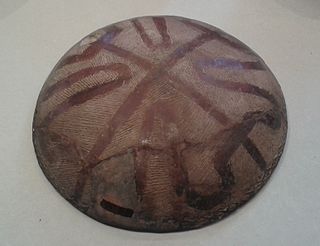
The C-Group culture is an archaeological culture found in Lower Nubia, which dates from ca. 2400 BCE to ca. 1550 BCE. It was named by George A. Reisner. With no central site and no written evidence about what these people called themselves, Reisner assigned the culture a letter. The C-Group arose after Reisner's A-Group and B-Group cultures, and around the time the Old Kingdom was ending in Ancient Egypt.
Lowland East Cushitic is a group of roughly two dozen diverse languages of the Cushitic branch of the Afro-Asiatic family. Its largest representatives are Somali and Oromo.
Konso is a Lowland East Cushitic language spoken in southwest Ethiopia. Native speakers of Konso number about 200,000. Konso is closely related to Dirasha, and serves as a "trade language"—or lingua franca—beyond the area of the Konso people. Blench (2006) considers purported dialects Gato and Turo to be separate languages.
Bussa, or Mossiya, is a Cushitic language spoken in the Dirashe special woreda of the Southern Nations, Nationalities, and People's Region located in southern Ethiopia. The people themselves, numbering 18,000 according to the 2007 census, call their language Mossittaata.
The South Cushitic or Rift languages of Tanzania are a branch of the Cushitic languages. The most numerous is Iraqw, with half a million speakers. These languages are believed to have been originally spoken by Southern Cushitic agro-pastoralists from Ethiopia, who began migrating southward into the Great Rift Valley in the third millennium BC.
Yaaku is an endangered Afroasiatic language spoken in Kenya. It is Cushitic, but its position within that family has been unclear. Bender 2020 [2008] concluded it was Omo–Tana ('Arboroid'). Speakers are all older adults.
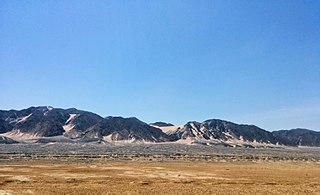
Itbāy or ʿAtbāy is a region of southeastern Egypt and northeastern Sudan. It is characterized by a chain of mountains, the Red Sea Hills, running north–south and parallel with the Red Sea. The hills separate the narrow coastal plain from the Eastern Desert.

The Rendille are a Cushitic-speaking ethnic group inhabiting the northern Eastern Province of Kenya.

The languages of Ethiopia include the official languages of Ethiopia, its national and regional languages, and a large number of minority languages, as well as foreign languages.
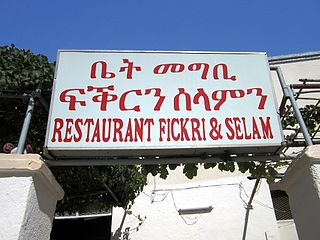
The main languages spoken in Eritrea are Tigrinya, Tigre, Kunama, Bilen, Nara, Saho, Afar, Beja. Tigrinya, Arabic, English language and historically Italian language serve as working languages.
Highland East Cushitic, or Sidamic, is a branch of the Afroasiatic language family spoken in south-central Ethiopia. They are often grouped with Lowland East Cushitic, Dullay, and Yaaku as East Cushitic, but that group is not well defined and is considered dubious.
The Dullay languages belong to the Cushitic subgroup of the Afro-Asiatic language family and are spoken in Ethiopia. Dullay is a dialect continuum consisting of the Gawwada and Tsamai languages. Blench (2006) places most of Bussa in the Konsoid languages, and counts several Gawwada varieties as distinct languages.
The Savanna Pastoral Neolithic is a collection of ancient societies that appeared in the Rift Valley of East Africa and surrounding areas during a time period known as the Pastoral Neolithic. They were South Cushitic speaking pastoralists who tended to bury their dead in cairns, whilst their toolkit was characterized by stone bowls, pestles, grindstones and earthenware pots.
