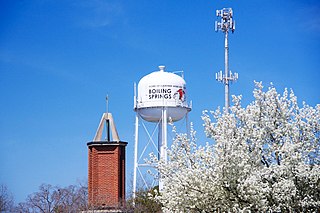
Boiling Springs is a town in Cleveland County, North Carolina, United States and is located in the westernmost part of the Charlotte metropolitan area, located approximately 50 miles away from the city. As of the 2010 census, the town's population was 4,647. It is home to Gardner–Webb University. The town is named after the natural spring found on the university's property, which feeds a small lake.

Shelby is a city in and the county seat of Cleveland County, North Carolina. It lies near the western edge of the Charlotte-Concord, NC-SC Combined Statistical Area. The population was 21,918 at the 2020 census.

Oliver Max Gardner was an American politician who served as the 57th governor of the U.S. state of North Carolina from 1929 to 1933. A member of the Democratic Party, Gardner worked in the administrations of President Franklin Delano Roosevelt and Harry S. Truman.

Cameron A. Morrison was an American politician and the 55th governor of the U.S. state of North Carolina from 1921 to 1925.
Coker University is a private university in Hartsville, South Carolina. It was founded in 1908 and is accredited by the Southern Association of Colleges and Schools. Coker's sports teams, nicknamed the Cobras, compete in NCAA Division II.

Baldwin Wallace University (BW) is a private university in Berea, Ohio. Established in 1845 as Baldwin Institute by Methodist businessman John Baldwin, it merged with nearby German Wallace College in 1913 to become Baldwin-Wallace College.
Campbell University is a private Christian, Liberal Arts university in Buies Creek, North Carolina. Campbell's main campus in Buies Creek is home to its College of Arts & Sciences, College of Pharmacy & Health Sciences, Divinity School, School of Education, Lundy-Fetterman School of Business, and the School of Engineering. Nearby is the Health Sciences Campus, home to the Jerry M. Wallace School of Osteopathic Medicine and the Catherine W. Wood School of Nursing. Campbell also operates a Raleigh Campus in downtown Raleigh, which is home to the Norman Adrian Wiggins School of Law as well as other programs. It maintains additional satellite campuses in Fort Bragg/Pope Air Force Base and at Camp Lejeune in North Carolina, and maintains a degree program at Tunku Abdul Rahman College in Kuala Lumpur, Malaysia, and provides online classes through Adult & Online Education. The university athletics teams are the Fighting Camels; its athletics programs field 20 NCAA Division I teams.

Gardner–Webb University is a private Christian liberal arts university in Boiling Springs, North Carolina. It was founded as Boiling Springs High School in 1905. Gardner-Webb is a classified among "Doctoral/Professional Universities".
The campus of the University of California, Berkeley, and its surrounding community are home to a number of notable buildings by early 20th-century campus architect John Galen Howard, his peer Bernard Maybeck, and their colleague Julia Morgan. Subsequent tenures as supervising architect held by George W. Kelham and Arthur Brown, Jr. saw the addition of several buildings in neoclassical and other revival styles, while the building boom after World War II introduced modernist buildings by architects such as Vernon DeMars, Joseph Esherick, John Carl Warnecke, Gardner Dailey, Anshen & Allen, and Skidmore, Owings and Merrill. Recent decades have seen additions including the postmodernist Haas School of Business by Charles Willard Moore, Soda Hall by Edward Larrabee Barnes, and the East Asian Library by Tod Williams Billie Tsien Architects.
The Alice Freeman Palmer Memorial Institute, better known as Palmer Memorial Institute, was a school for upper-class African Americans. It was founded in 1902 by Dr. Charlotte Hawkins Brown at Sedalia, North Carolina near Greensboro. Palmer Memorial Institute was named after Alice Freeman Palmer, former president of Wellesley College and benefactor of Dr. Brown.
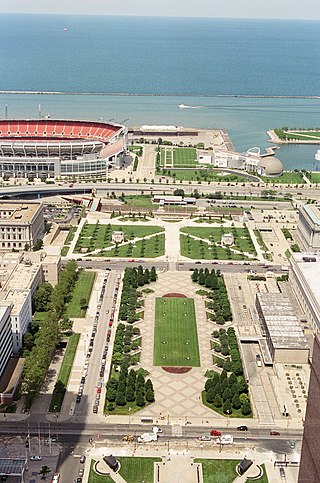
The Cleveland Mall is a landscaped public park in downtown Cleveland, Ohio. One of the most complete examples of City Beautiful design in the United States, the park is a historic site listed on the National Register of Historic Places.
This is an incomplete list of historic properties and districts at United States colleges and universities that are listed on the National Register of Historic Places (NRHP). This includes National Historic Landmarks (NHLs) and other National Register of Historic Places listings. It includes listings at current and former educational institutions.

The Playmakers Theatre, originally Smith Hall, is a historic academic building on the campus of the University of North Carolina at Chapel Hill. Built in 1850, it was designated a National Historic Landmark for its architecture, as an important example of Greek Revival architecture by Alexander Jackson Davis. It is now a secondary venue of the performing company, which is principally located at the Paul Green Theatre in the Joan H. Gillings Center for Dramatic Art.
The University of Arkansas Campus Historic District is a historic district that was listed on the National Register of Historic Places on September 23, 2009. The district covers the historic core of the University of Arkansas campus, including 25 buildings.

Biddle Memorial Hall is a historic building located on the campus of Johnson C. Smith University in Charlotte, Mecklenburg County, North Carolina. It was built in 1883, and is a 3 1/2-story, five bay Romanesque style brick and stone building on a raised basement. It features an elaborate clock tower named Big Johnson, known as the tallest clock tower that plays the Westminster Chimes every 15 minutes to mark the passing of time in the Charlotte Uptown area. Which can be heard a mile away. With a pyramidal slate roof and baritizans at each corner. It was built as the main building for the school established in 1867 by the Presbyterian church for the education of African-American students. It was named in 1923 to honor Mary D. Biddle who donated $1,400 to the school.

Memorial Hall, also known as the General Service Building, is a historic dormitory building located on the campus of Coker University at Hartsville, Darlington County, South Carolina. It was built in two phases in 1913 and 1916. Memorial Hall is a three-story, five-bay, masonry building with Neo-Classical details. The front façade features a three-bay projecting full-height portico supported by four colossal Corinthian order columns. In 1916, the General Service Building was added and consists of three distinct parts: a central projecting block and two dormitory wings. It was built with funds donated by the college's founder, Major James Lide Coker.

Webbley, also known as the O. Max Gardner House, is a historic home located at Shelby, Cleveland County, North Carolina. It was built in 1852, and overbuilt in 1907 in the Colonial Revival style. It is a two-story frame dwelling with a low-pitched hip roof, flat roof deck, and roof balustrade. It has two hip roof rear ells. The front facade features a full-height, flat-roof portico supported by fluted Ionic order columns. The home acquired its named shortly after it was bought by James L. Webb in 1911. Webbley was the home of Governor Oliver Max Gardner (1882–1947) and his wife, Fay Webb-Gardner, from 1911 until his death.

Central Shelby Historic District is a national historic district located at Shelby, Cleveland County, North Carolina. It encompasses 229 contributing buildings in the central business district and surrounding residential areas of Shelby. The district is centered on the Cleveland County Courthouse (1907) and public square, established in 1841. The district includes representative examples of Colonial Revival and Bungalow / American Craftsman architectural styles. The district includes the separately listed courthouse, Masonic Temple Building, and Webbley. Other notable buildings include the Webb House, Wells House, Fulenwider-Ebeltoft House, Dr. S. S. Royster House, Bateman House, Washburn Block, city hall and firehouse (1911), Royster Building (1910), First Baptist Church, Ascension Lutheran Church (1932), and Southern Railway Freight Depot.

Downtown Gastonia Historic District is a national historic district located at Gastonia, Gaston County, North Carolina. It encompasses 77 contributing buildings and 1 contributing object in the central business district of Gastonia. The commercial, civic, institutional, and multi-unit residential buildings were built between the 1890s and 1954, and include notable examples of Colonial Revival and Classical Revival architecture. Located in the district are the separately listed former Gaston County Courthouse, First National Bank Building, Third National Bank Building, and Robinson-Gardner Building. Other notable buildings include the U.S. Post Office (1935), York Medical Building (1938), Kress Department Store, Leibowitz Department Store, Ideal Moving Picture Theater, City Hall, Kirby Building (1922), First Baptist Church (1922), Gaston County War Memorial Hall (1928), and the (former) Gaston County Public Library (1930).

Fay Lamar Webb-Gardner was an American political hostess, businesswoman, and philanthropist. As the wife of Oliver Max Gardner, she served as the Second Lady of North Carolina from 1917 to 1923 and as First Lady of North Carolina from 1929 to 1933. When her husband's political career took them to Washington, D.C., she became known as a prominent society and political hostess and was considered one of the most popular figures in American political circles of the time. Webb-Gardner was active in cultural and civic endeavors and was a member of the American Red Cross, the Woman's Missionary Union, the North Carolina Symphony Society, the National Civic League, and the League of Women Voters, as well as Chairwoman of the North Carolina State Advisory Board of Paroles. A Democrat, she served on the North Carolina Democratic Committee and the Democratic National Committee, and was twice elected as a delegate to the Democratic National Convention.