Echinopsis pelecyrhachis var. lobivioides(Backeb.) Friedrich
Echinopsis polyancistraBackeb.
Echinopsis subdenudataCárdenas
Echinopsis tapecuanaF.Ritter
Lobivia ancistrophora(Speg.) Schlumpb.
Lobivia graulichiiFrič
Lobivia subdenudata(Cárdenas) Schlumpb.
Mesechinopsis ancistrophora(Speg.) Y.Itô
Mesechinopsis hamatacantha(Backeb.) Y.Itô
Mesechinopsis leucorhodantha(Backeb.) Y.Itô
Mesechinopsis lobivioides(Backeb.) Y.Itô
Mesechinopsis nakajimaeY.Itô
Mesechinopsis pelecyrhachis(Backeb.) Y.Itô
Mesechinopsis polyancistra(Backeb.) Y.Itô
Pseudolobivia ancistrophora(Speg.) Backeb.
Pseudolobivia hamatacantha(Backeb.) Backeb.
Pseudolobivia leucorhodantha(Backeb.) Backeb. ex Krainz
Pseudolobivia lobivioides(Backeb.) Backeb. ex Krainz
Pseudolobivia pelecyrhachis(Backeb.) Backeb. ex Krainz
Pseudolobivia pelecyrhachis var. lobivioides(Backeb.) Backeb.
Pseudolobivia polyancistra(Backeb.) Backeb.
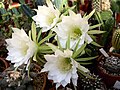
Echinopsis ancistrophora, synonyms including Lobivia ancistrophora, commonly called domino cactus,[3]night blooming hedgehog, Easter lily cactus,[4] is a species of cactus. It has a globular shape, few spines, with large, white flowers attached to long, green tubes. It occurs in Bolivia, at altitudes of 600–1800 metres,[5] and northwest Argentina.[2] It has gained the Royal Horticultural Society's Award of Garden Merit.[6]
The grey-green, single plant body, slightly depressed at the top, is spherical and reaches heights of 5 to 8 centimeters with diameters of 7 to 12 centimeters. It has 10 to 12 straight, very sharp ribs on which there are small, cream-colored, elongated-elliptical areoles that are 1.5 centimeters apart. The spines are grayish brown and often hidden in the areole wool. The upright central spine is up to 2 millimeters long. The 3 to 7 thorns swollen at the base are up to 1.5 millimeters long.
The white to light pink, narrow funnel-shaped flowers, slightly curved above the ovary, are 17 to 20 centimeters long. They appear on the side near the top of the shoot and open at night. The pale green flower tube is up to 15 centimeters long and reaches a diameter of up to 7 centimeters. The elliptical ovary is 15 millimeters long and 8 to 10 millimeters wide. Its purple scales are pointed and have long white and black hairs. The 12 millimeter long style is white like the stamens.[7][8]
White flower
Long tube
Multiple flowers
In botanical garden
Distribution
Echinopsis ancistrophora is widespread near Angosto de Villamontes in the Entre Ríos Municipality in the Tarija Department in Bolivia at altitudes of 600 meters.[5] It is also found in northwest Argentina.[2]
Taxonomy
Echinopsis ancistrophora was first described in 1905 by Carlo Luigi Spegazzini.[9] Boris O. Schlumpberger transferred the species to the genus Lobivia in 2012, but it has since been restored to Echinopsis.[2]
↑ Anderson, Edward F.; Eggli, Urs; Anderson, Edward F. (2005). Das große Kakteen-Lexikon (in German). Stuttgart (Hohenheim): Ulmer. p.244. ISBN3-8001-4573-1.
↑ Backeberg, Curt (January 1983). Die Cactaceae: Handbuch der Kakteenkunde. 2. Cereoideae: (Hylocereeae - Cereeae [Austrocereinae]) (in German). Stuttgart New York: G. Fischer. p.1283. ISBN3-437-30381-3.
This page is based on this Wikipedia article Text is available under the CC BY-SA 4.0 license; additional terms may apply. Images, videos and audio are available under their respective licenses.