Aedesius was a Neoplatonist philosopher and mystic. He was born into a wealthy Cappadocian family, but he moved to Syria, where he was apprenticed to Iamblichos. None of his writings have survived, but there is an extant biography by Eunapius, a Greek sophist and historian of the 4th century who wrote a collection of biographies titled Lives of the Sophists. Aedesius's philosophical doctrine was a mixture between Platonism and eclecticism and, according to Eunapius, he differed from Iamblichus on certain points connected with theurgy and magic.

Sponges, the members of the phylum Porifera, are a basal animal clade as a sister of the diploblasts. They are multicellular organisms that have bodies full of pores and channels allowing water to circulate through them, consisting of jelly-like mesohyl sandwiched between two thin layers of cells.

Eunapius was a Greek sophist, rhetorician, and historian from Sardis in the region of Lydia in Asia Minor. His principal surviving work is the Lives of Philosophers and Sophists, a collection of the biographies of 23 philosophers and sophists. The exact date of his death is unknown but speculated sometime after 414 AD during the reign of Theodosius II.
Chrysanthius of Sardis was a Greek philosopher of the 4th century AD who studied at the school of Iamblichus.
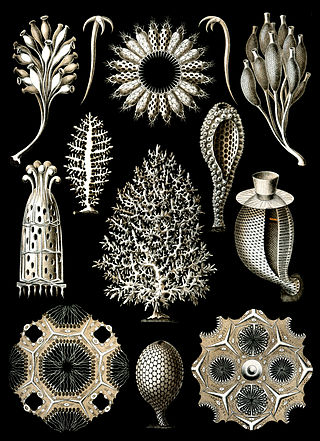
The calcareoussponges are members of the animal phylum Porifera, the cellular sponges. They are characterized by spicules made of calcium carbonate, in the form of high-magnesium calcite or aragonite. While the spicules in most species are triradiate, some species may possess two- or four-pointed spicules. Unlike other sponges, calcareans lack microscleres, tiny spicules which reinforce the flesh. In addition, their spicules develop from the outside-in, mineralizing within a hollow organic sheath.
Maximus of Ephesus was a Neoplatonist philosopher. He is said to have come from a rich family, and exercised great influence over the emperor Julian, who was commended to him by Aedesius. Maximus pandered to the emperor's love of magic and theurgy and won a high position at court, where his overbearing manner made him numerous enemies. He spent an interval in prison after the death of Julian, and eventually was executed by Valens.
Eusebius of Myndus was a 4th-century philosopher, a distinguished Neoplatonist. He is described by Eunapius as one of the links in the "Golden Chain" of Neoplatonism.
Prohaeresius was a fourth-century Armenian Christian teacher and rhetorician originally from Caesarea who taught in Athens. He was one of the leading sophists of the era along with Diophantus the Arab and Epiphanius of Syria.

Bithyniidae is a family of small freshwater snails with an operculum, aquatic gastropod molluscs in the clade Littorinimorpha.
Annandale's rat is a species of rodent in the family Muridae. It is found in Indonesia (Sumatra), Peninsular Malaysia, and Singapore. It was classified as Rattus annandalei until 2017, but mitochondrial and nuclear DNA show that it belongs to the rat genus Sundamys.
Sosipatra was a Greek Neoplatonist philosopher and mystic who lived in Ephesus and Pergamon in the first half of the 4th century CE. The story of her life is told in Eunapius' Lives of the Sophists.
Sopater of Apamea was a distinguished sophist and Neoplatonist philosopher.
Antoninus was a Neoplatonist philosopher who lived in the 4th century. He was a son of Eustathius and Sosipatra, and had a school at Canopus, Egypt. He was an older contemporary of Hypatia who lived and worked nearby in Alexandria. He devoted himself wholly to his pupils, but he never expressed any opinion upon divine matters, and although Eunapius attributes this to Antoninus' piety, he also points out that Antoninus refrained from theurgic rites "perhaps because he kept a wary eye on the imperial views and policy which were opposed to these practices." His moral conduct is described as exemplary. He and his disciples were strongly attached to paganism; but he is said to have been able to see that its end was near at hand, and he predicted that after his death all the splendid temples of the gods would be changed into tombs:
He foretold to all his followers that after his death the temple would cease to be, and even the great and holy temples of Serapis would pass into formless darkness and be transformed, and that a fabulous and unseemly gloom would hold sway over the fairest things on earth. To all these prophecies time bore witness, and in the end his prediction gained the force of an oracle.
Thoosa is a genus of sea sponges in the family Thoosidae. This genus is known for boring holes in corals. It contains sixteen described species.

Spongilidae is a family of sponges that live in freshwater lakes and rivers. The following genera are recognized in the family:
Radiospongilla is a genus of freshwater sponges in the family Spongillidae. It was defined by Penney and Racek in 1968. The type species is Radiospongilla sceptroides.
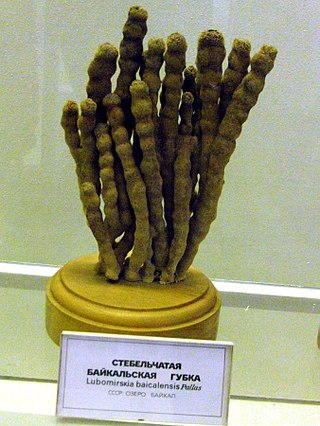
Lubomirskiidae is a family of freshwater sponges from Lake Baikal in Russia.
Amorphinopsis is a genus of sea sponges belonging to the family Halichondriidae.
Metania is a genus of sponges in the family Metaniidae.

