Nomada verecunda is a species in the family Apidae, in the order Hymenoptera . Nomada verecunda is found in North America.
Centris cockerelli is a species in the family Apidae, in the order Hymenoptera . The distribution range of Centris cockerelli includes Central America and North America.

Hoplitis anthocopoides is a species in the family Megachilidae, in the order Hymenoptera . The distribution range of Hoplitis anthocopoides includes Africa, Europe, Northern Asia, and North America.

Formica montana is an ant in the genus Formica in the family Formicidae. A common name for F. montana is "prairie mound ant".

Andrena crataegi, the hawthorn miner bee, is a species of miner bee in the family Andrenidae which is in the order Hymenoptera. Another common name for this species is hawthorn andrena. It is found in North America.

Colletes simulans is a species in the family Colletidae, in the order Hymenoptera. The species is known generally as the spine-shouldered cellophane bee. It is found in North America.
Crabro villosus is a species in the order Hymenoptera, in the class Insecta ("insects"). It is found in North America.

Andrena krigiana is a species in the family Andrenidae, in the order Hymenoptera. The species is known generally as the "dwarf-dandelion andrena". It is found in North America.
Stictiella formosa is a species in the order Hymenoptera, in the class Insecta ("insects"). The distribution range of Stictiella formosa includes Central America and North America.

Manica hunteri is a species of ant in the family Formicidae.

Formica glacialis is a species of ant in the family Formicidae.
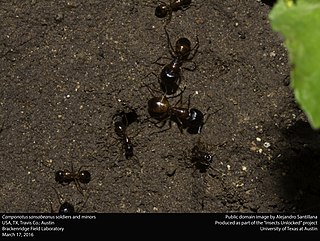
Camponotus sansabeanus is a species of ant in the family Formicidae.

Pheidole metallescens is an ant, a species of higher myrmicine in the family Formicidae.

Trachymyrmex nogalensis is a species of higher myrmicine in the family Formicidae.

Camponotus quercicola is a species of ant in the family Formicidae that is endemic to California and commonly nests in oak trees, as they usually inhabit oak forests.
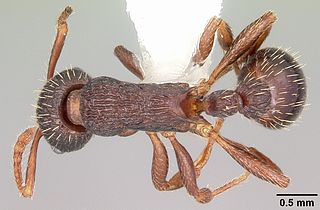
Myrmica spatulata is a species of ant in the family Formicidae. It is found in the forests of the middle and eastern part of the United States and Ontario in Canada.

Formica microphthalma is a species of ant in the family Formicidae.

Neivamyrmex pilosus is a species of army ant in the family Formicidae.

Myrmelachistini is a tribe of ants in the family Formicidae. There are at least 2 genera and 50 described species in Myrmelachistini.

Pogonomyrmex subdentatus is a species of ant in the family Formicidae.

