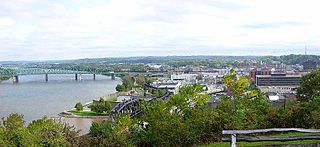
Parkersburg is a city in and the county seat of Wood County, West Virginia, United States. Located at the confluence of the Ohio and Little Kanawha rivers, it is the state's fourth-most populous city and the center of the Parkersburg–Vienna metropolitan area. The city's population was 29,749 at the 2020 census, and its metro population was 89,490. The city is about 14 miles (23 km) south of Marietta, Ohio.

Arthur Ingram Boreman was an American lawyer, politician and judge who helped found the U.S. state of West Virginia. Raised in Tyler County, West Virginia, he served as the state's first Governor, and a United States senator, as well as represented Wood County in the Virginia House of Delegates, and served as a circuit judge before and after his federal service.

Blennerhassett Island Historical State Park is a state park located on Blennerhassett Island, a small island in the Ohio River, located in Wood County, West Virginia, USA. The property was the site of a Palladian mansion owned by Harman Blennerhassett, a participant in some of the alleged intrigues of Aaron Burr, and his wife Margaret Agnew. While the original mansion burned to the ground in 1811, a detailed replica, which can be toured, was built on its foundations in the 1980s. The Blennerhasset mansion greatly resembled George Washington's Mount Vernon, due to its Palladian style.

The Parkersburg Bridge crosses the Ohio River between Parkersburg, West Virginia, and Belpre, Ohio. Designed by Jacob Linville, the bridge has 46 spans: 25 deck plate girder, 14 deck truss, 6 through truss, and 1 through plate girder. 50,000 cubic yards (38,000 m3) of stone were used for the 53 piers. The bridge was constructed from May 1869 to January 1871 by the Baltimore and Ohio Railroad. At the time of its completion, the bridge was reportedly the longest in the world at 7,140 feet (2,180 m).

The Wood County Courthouse is a public building in downtown Parkersburg, West Virginia, in the United States. The courthouse was built in 1899 at a cost of $100,000 in the Richardsonian Romanesque style by local contractors Caldwell & Drake, according to the plans of architect L. W. Thomas of Canton, Ohio. The current courthouse is the fifth to be built in the county replacing one built in 1860. It was added to the National Register of Historic Places in 1979 for its architectural significance. During his 1912 presidential campaign Theodore Roosevelt stopped in Parkersburg and spoke from the Market street entrance of the courthouse. On 2 July 2020 a new steeple was added to the bell tower replacing one that had been removed in 1952. With the new steeple the courthouse is now the tallest in the state at 164 ft.

The Peter G. Van Winkle House was a historic home located in the Julia-Ann Square Historic District in Parkersburg, Wood County, West Virginia. It was built between about 1880 and 1899, and was a two-story duplex in the Queen Anne style. It featured a deck hipped roof with intersecting gables, turrets, and dormers. It was built on property once owned by former United States Senator Peter G. Van Winkle, who died in 1872.

White Top is a knob and spur of Cheat Mountain in southeastern Randolph County, West Virginia, USA. Sitting at an elevation of 4,085 feet (1,245 m), it is located just west of the Shavers Fork of Cheat River and Cheat Bridge. While White Top was originally crossed by the Staunton–Parkersburg Turnpike, modern-day U.S. Route 250 skirts the base of the knob beside Shavers Fork to the north and east.

This is a list of the National Register of Historic Places listings in Wood County, West Virginia.

Blennerhassett Hotel is a historic hotel located at Parkersburg, Wood County, West Virginia. It opened in 1889 and is in the Queen Anne style. The hotel was listed on the National Register of Historic Places in 1982. A full restoration took place in 1986.

Bethel African Methodist Episcopal Church was a historic African Methodist Episcopal church located at 820 Clay Street in Parkersburg, Wood County, West Virginia. It was built in 1887 and was a two-story, stucco building in a vernacular interpretation of the Gothic Revival style. It was one of three black churches in Parkersburg and was the oldest black church building in west-central West Virginia. The church was located in a neighborhood of late 19th-century wood-frame houses only a block from downtown.

First Presbyterian Church, also known as the Calvary Temple Evangelical Church and St. Patrick's Priory Church, is a historic church at 946 Market Street in Parkersburg, Wood County, West Virginia. It was built in 1894, and is a two-story, brick and stone church building in a combined Romanesque / Gothic Revival style. It features a corner bell tower.

The Elks Club was a historic clubhouse building located at Parkersburg, Wood County, West Virginia. It was designed by architect William Howe Patton and built in 1903. It was a four-story, three-bay by six-bay wide, red brick building with terra cotta trim in the Classical Revival style. The first two stories were faced in smooth dressed stone, and feature arched apertures, with central consoles. It was occupied by the Parkersburg Lodge #198, Benevolent and Protective Order of Elks (B.P.O.E.)

Gould House, also known as the Greater Parkersburg Chamber of Commerce, is a historic home located at Parkersburg, Wood County, West Virginia. It was built in 1888, and is a 2+1⁄2-story brick dwelling in an eclectic Late Victorian style. It consists of a central hipped block with projecting and intersecting gables and a hip roofed wing to the rear. It has housed the Chamber of Commerce since 1968.

Parkersburg Women's Club is a historic clubhouse located at Parkersburg, Wood County, West Virginia. It was built between about 1860 and 1879, as a private home in the Italian Villa style. It is a two-story, frame building with a very low-pitched hipped roof. It features a one-story wraparound porch. It has housed the Parkersburg Women's Club since 1921.

"Oakland," also known as the James M. Stephenson House, is a home located in Parkersburg, Wood County, West Virginia. Although a slaveholder and sympathizing with the Confederacy, Stephenson was also married to the sister of Unionist Arthur Boreman, and allowed then Union Army Col. James B. Steedman to use his grove nearby during the American Civil War. However, Union cavalry units occupied this his mansion for a time nonetheless, and damaged furnishings as well as the home and garden.

Henry Cooper House, also known as The Daughters of American Pioneers Museum and Cooper Cabin, is a historic home located at Parkersburg, Wood County, West Virginia. The log cabin was erected in Slate District, Wood County, in 1804, by Henry Cooper, and is believed to be the first two-story log cabin in Wood County. In August 1910, the City of Parkersburg purchased the structure for $400. After being dismantled, the house was rebuilt in the Park in September 1910. In 1911, title was granted by the City Council to the Centennial Chapter - Daughters of American Pioneers. The cabin is open as a museum.

Jackson Memorial Fountain is a historic fountain located at the entrance to City Park at Parkersburg, Wood County, West Virginia. It was built in 1905 and is a cast iron structure that originally had three tiers. The second tier is topped by Parkersburg's Lady of the Lake statue. It features elaborately sculpted and decorated basins and pedestals. The fountain is dedicated to the locally prominent Jackson family, that included General John Jay Jackson and his sons Federal Judge John Jay Jackson, Jr., Governor Jacob B. Jackson, and Circuit Judge and Congressman James M. Jackson.

Avery Street Historic District, is a national historic district located at Parkersburg, Wood County, West Virginia. It is to the east of the Julia-Ann Square Historic District and south of the Parkersburg High School-Washington Avenue Historic District. Primarily residential, it encompasses 109 acres and includes churches, a school, and a small commercial area. Built as Parkersburg's first "suburb" in the late-19th and early-20th century in popular architectural style such as Colonial Revival and Queen Anne, the district exhibits 12 distinctive types of Historic architecture. There are 358 contributing buildings, 59 of which are considered to be pivotal. U.S. Senator Johnson N. Camden (1826-1908) owned most of the land now included in the district. Located in the district are the separately listed Parkersburg Women's Club and the First Presbyterian Church/Calvary Temple Evangelical Church.
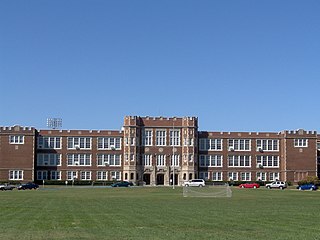
Parkersburg High School–Washington Avenue Historic District, is a national historic district located at Parkersburg, Wood County, West Virginia. The Parkersburg High School was built in 1917 north of the Avery Street Historic District in the Jacobethan Revival style. It was designed by Ohio architect Frank Packard (1866-1923).

James McNeil Stephenson was an American lawyer, businessman and politician who served several terms in the Virginia House of Delegates representing western Virginia counties which in his lifetime became part of the state of West Virginia. His is probably not related to James Stephenson who represented western Virginia counties in the Virginia House of Delegates and U.S. Congress, nor schoolteacher Benjamin L. Stephenson (1826-1871) of Clay County, West Virginia who helped found the new state.