Block Island Southeast Light is a lighthouse located on Mohegan Bluffs at the southeastern corner of Block Island, Rhode Island. It was designated a U.S. National Historic Landmark in 1997 as one of the most architecturally sophisticated lighthouses built in the United States in the 19th century.

Goat Island Light is a lighthouse located off Cape Porpoise near Kennebunkport in southern Maine. Goat Island Light was established in 1835 to guard the entrance to Cape Porpoise Harbor. The original station was upgraded in 1859 to the current brick tower with a fifth order Fresnel lens. Keeper's quarters were added to the island in 1860. The light station was automated by the United States Coast Guard in 1990 and is currently active. The keepers dwellings and tower are leased to the Kennebunkport Conservation Trust. Goat Island Light can be seen from shore in Cape Porpoise Harbor just off State Route 9 north of Kennebunkport or is viewable by boat. The island is currently closed to the public except by special arrangement.

The Heck-Andrews House was finished in 1870 and was one of the first houses in Raleigh, Wake County, North Carolina to be constructed after the American Civil War. It is located at 309 North Blount Street. It was created by G.S.H. Appleget for Mrs. Mattie Heck, the wife of Colonel Jonathan McGee Heck. It is on the National Register of Raleigh Historic Property. The house has a dramatic central tower capped with a convex mansard roof with a balustrade. The central part of the 2+1⁄2-story, Second Empire style frame dwelling is enclosed with a concave mansard roof with patterned slate.

Belgrade and St. David's Church, also known as Pettigrew's Chapel, is a historic Episcopal church and home located at Creswell, Washington County, North Carolina. St. David's Church was built over a number of years. It is a cruciform, weatherboarded frame structure with a cross gable roof. It features a late-19th century two-part bell tower with a four-faced, pyramidal, bell-cast spire. Belgrade was built about 1797, and is a small one-story Georgian style frame dwelling with a steep gable roof. It was the home of the home of Charles "Parson" Pettigrew, first Bishop of the Episcopal Diocese of North Carolina.

The Myers-White House, also known as Sycamore Grove, is a private residence located near Hertford in the Bethel Township of Perquimans County, North Carolina. It is one of the oldest private homes in the state. The exact construction date is not known. It was likely constructed in the early 1700s. Thomas Long (~1730) is assumed to be the architect and builder. It is a 1+1⁄2-story frame dwelling with brick ends and a gambrel roof. It is one of the two known gambrel roof houses with brick ends in the state. It is a member of the small group of 18th century frame houses with brick ends in northeast North Carolina; the group includes the Sutton-Newby House and the Old Brick House.

Emanuel Alston House is a historic home located on Saint Helena Island near Frogmore, Beaufort County, South Carolina. It was built about 1915, and is a rectangular one-story, vernacular frame dwelling on a brick foundation, with a metal hipped roof. The front façade features a full-width porch, with a low hipped roof. A shed or hipped roof dormer located on the front roof slope provides light and ventilation to the attic space.

Seaside Plantation House, also known as Locksley Hall, is a historic plantation house located at Edisto Island, Colleton County, South Carolina. It was built about 1810, and is a 2 1/2-story, Federal style brick dwelling with a gable roof. The house is one room deep with a long porch across the southeast elevation and sits on a raised basement. The central portion of the house is stuccoed brick with frame additions on the first floor.

King House, also known as King-Bazemore House, is a historic plantation house located near Windsor, Bertie County, North Carolina. It was built in 1763, and is a 1+1⁄2-story, frame dwelling with brick ends. It has a gambrel roof and features two interior T-stack end chimneys. It is one of two known gambrel roofed dwellings with brick ends in North Carolina.
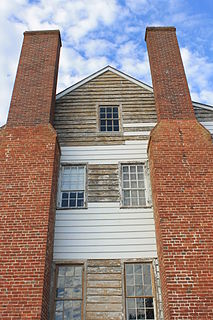
Barker House is a historic home located at Edenton, Chowan County, North Carolina. The original house was built about 1782, and expanded during the 19th century. It is a 2+1⁄2-story frame dwelling with Georgian, Federal, and Greek Revival style design elements. It sits on a brick foundation and has at both ends a pair of single-shoulder exterior chimneys. The front facade features a full-length, two-tier porch carried on superimposed fluted pillars under a shed roof.
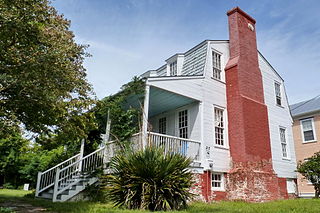
York-Gordon House, more accurately known as the Patrick and Mary Gordon house, is a historic dwelling located at New Bern, Craven County, North Carolina. It was built in 1771, as documented by a letter from Patrick Gordon to William Hooper. Early title research suggested that the house was much older and belonged to Susan York; she evidently lived in an earlier house on this site; her house was probably destroyed in the great storm of 1769. The 1771 house is a 1+1⁄2-story, five bay, frame dwelling with a gambrel roof and Georgian style design elements. A Federal chimneypiece replaced replaced an earlier Georgian chimneypiece in the early 19 century. The house is sheathed in shiplap siding over brick-filled walls, rests on a brick over ballast stone foundation and features a full-width, one-story shed-roof porch, which was added 1786, based on estate records.
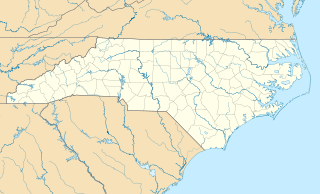
Porter Houses and Armstrong Kitchen is a set of two historic homes and a kitchen building located near Whitakers, Edgecombe County, North Carolina. The first Porter dwelling dates to the last quarter of the 18th century, and is a 1+1⁄2-story frame dwelling with a gambrel roof. It was restored in 1994. The second Porter dwelling also dates to the last quarter of the 18th century, and is a one-room, 1+1⁄2-story frame dwelling with a gable roof. It measures approximately 16 feet wide and 24 feet long. Also on the property is a frame kitchen building built about 1850 and remodeled about 1900.

Hoffman-Bowers-Josey-Riddick House is a historic home located at Scotland Neck, Halifax County, North Carolina. It was built in 1883, and is a 2+1⁄2-story, rectangular, frame dwelling with Stick Style / Eastlake movement design elements. It has a complex polychromed, slate roof gable roof; three-story central tower with hexagonal roof; and one-story rear ell. It features a front porch with sawn balustrade.
Falls–Hobbs House is a historic home located near Statesville, Iredell County, North Carolina. The house is dated to the 1820s or 1830s, and is a 2+1⁄2-story, three bay by two bay, frame dwelling. It has a steeply pitched gable roof, external end chimneys, and rests on a fieldstone foundation. The interior has Georgian, Federal, and Greek Revival style design elements. Also on the property is a contributing well house with a pyramidal roof.
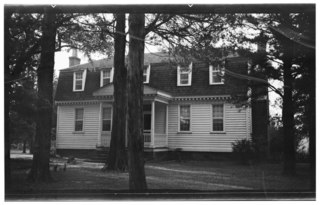
Belvidere, also known as the Exum Newby House and Lamb House, is a historic plantation house located at Belvidere, Perquimans County, North Carolina. It was built about 1767, and is a 1+1⁄2-story, five bay, frame dwelling with an unusual hip on gambrel roof. The Georgian style dwelling is sheathed in weatherboard and rests on a brick pier foundation. In the mid-1970s, Belvidere was sold to radio personality Wolfman Jack.

Sutton-Newby House is a historic plantation house located near Hertford, Perquimans County, North Carolina. It was built about 1745, and is a 1+1⁄2-story, four bay, frame dwelling with a brick end and gable roof. It originally had both ends in brick. It features a full-width, shed roofed front porch and massive double shouldered chimney. It is a member of the small group of 18th century frame houses with brick ends in northeast North Carolina; the group includes the Myers-White House and the Old Brick House.
High Rock Farm is a historic plantation house located in Rockingham County, North Carolina. It dates to the early-19th century, and is a two-story, central hall plan, Federal style brick dwelling with a rear ell. It sits on a full basement and has a hipped roof. The front facade features a pedimented portico supported by two stuccoed columns and with a gallery at the second level.

George W. Logan House, also known as Jobe Hill, is a historic home located near Rutherfordton, Rutherford County, North Carolina. It built about 1842, and is a one-story, five bay, Georgian plan frame dwelling. It is sheathed in weatherboard, has a side gable roof, and two rebuilt exterior end chimneys. It was enlarged and remodeled in the 1890s and in 1985. Also on the property are the contributing brick well house, dairy, outhouse, smokehouse, granary, log double corncrib, and a large log barn. It was the home of prominent North Carolina politician George Washington Logan (1815-1889).
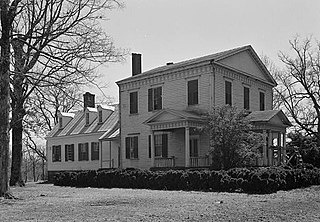
Elgin is a historic plantation house located near Warrenton, Warren County, North Carolina. It was built about 1835, and is a two-story, three bay, Federal style temple-form frame dwelling. It has a gable roof, pedimented front porch, and flanking porches. At the rear is an earlier 1+1⁄2-story frame dwelling with a gable roof. The front facade features a Palladian entrance with sidelights and Tuscan colonnettes. The house is similar in style to Dalkeith.
Coleman-White House, also known as Whitesome, is a historic home located at Warrenton, Warren County, North Carolina. It was built between 1821 and 1824, and is a two-story, three bay, late Federal style rectangular frame dwelling. It has a side gable roof, entrance porch with Tuscan order columns, and exterior end chimneys. At the rear is an earlier 1+1⁄2-story frame dwelling with a gable roof. The front facade features a Palladian entrance with sidelights and Tuscan colonnettes and Palladian window on the second level.

Latham House is a historic home located at Plymouth, Washington County, North Carolina. It was built about 1850, and is a two-story, three bay by two bay, Greek Revival style frame dwelling on a high basement. It has a cross-gable roof, hip roofed wraparound porch, and is sheathed in weatherboard. Plymouth citizens are believed to have taken refuge in its basement during the Battle of Plymouth in 1864.