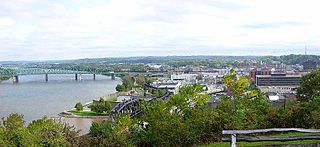
Parkersburg is a city in and the county seat of Wood County, West Virginia, United States. Located at the confluence of the Ohio and Little Kanawha rivers, it is the state's fourth-most populous city and the center of the Parkersburg–Vienna metropolitan area. The city's population was 29,749 at the 2020 census, and its metro population was 89,490. The city is about 14 miles (23 km) south of Marietta, Ohio.

The George Washington Birthplace National Monument is a national monument in Westmoreland County, Virginia, at the confluence of Popes Creek and the Potomac River. It commemorates the birthplace location of George Washington, a Founding Father and the first President of the United States, who was born here on February 22, 1732. Washington lived at the residence until age three and later returned to live there as a teenager.

West Quoddy Head, in Quoddy Head State Park, Lubec, Maine, is the easternmost point of the contiguous United States. In 1808 a lighthouse was constructed at the site to guide ships through the Quoddy Narrows. The current tower, with distinctive red-and-white stripes, was constructed in 1858 and is an active aid to navigation. The 3rd order Fresnel lens is the only 3rd order and one of only eight Fresnel lenses still in use on the Maine Coast.

Shirley Plantation is an estate on the north bank of the James River in Charles City County, Virginia. It is located on scenic byway State Route 5, between Richmond and Williamsburg. It is the oldest active plantation in Virginia, settled in 1613 and is also the oldest family-owned business in North America, when it was acquired by the Hill family, with operations starting in 1638. White indentured servants were initially used as the main labor force until the early 1700s, when black slavery became the primary source of Virginian labor. It used about 70 to 90 African slaves at a time for plowing the fields, cleaning, childcare, and cooking. It was added to the National Register in 1969 and declared a National Historic Landmark in 1970. After the acquisition, rebranding, and merger of Tuttle Farm in Dover, New Hampshire, Shirley Plantation received the title of the oldest business continuously operating in the United States.

Blennerhassett Island Historical State Park is a state park located on Blennerhassett Island, a small island in the Ohio River, located in Wood County, West Virginia, USA. The property was the site of a Palladian mansion owned by Harman Blennerhassett, a participant in some of the alleged intrigues of Aaron Burr, and his wife Margaret Agnew. While the original mansion burned to the ground in 1811, a detailed replica, which can be toured, was built on its foundations in the 1980s. The Blennerhasset mansion greatly resembled George Washington's Mount Vernon, due to its Palladian style.

Elsing Green Plantation, a National Historic Landmark and wildlife refuge, rests upon nearly 3,000 acres (1,200 ha) along the Pamunkey River in King William County, Virginia, a rural county on the western end of the state's middle peninsula, approximately 33 miles (53 km) northeast of the Richmond. The 18th-century plantation, now owned by the Lafferty family, has been in continuous operation for more than 300 years. In addition to the plantation house, dependency buildings and cultivated land, Elsing Green includes 2,454 acres (993 ha) of surrounding farmland, forest and marsh land. Elsing Green has been on the Virginia Landmarks Register and the National Register of Historic Places since 1969, and received formal National Historic Landmark status in 1971.

Lower Brandon Plantation is located on the south shore of the James River in present-day Prince George County, Virginia.

The South Central Falls Historic District is a historic district in Central Falls, Rhode Island. It is a predominantly residential area, densely populated, which was developed most heavily in the late 19th century. It is bounded roughly by Broad Street to the east, the Pawtucket city line to the south, Dexter Street to the west, and Rand Street and Jenks Park to the north. It has 377 contributing buildings, most of which were built before 1920. The district was added to the National Register of Historic Places in 1991.

George Washington's Gristmill was part of the original Mount Vernon plantation, constructed during the lifetime of the United States' first president. The original structure was destroyed about 1850. The Commonwealth of Virginia and the Mount Vernon Ladies’ Association have reconstructed the gristmill and the adjacent distillery. The reconstructed buildings are located at their original site three miles (4.8 km) west of the Mount Vernon mansion near Woodlawn Plantation in the Mont Vernon area of Fairfax County. Because the reconstructed buildings embody the distinctive characteristics of late eighteenth century methods of production and are of importance to the history of Virginia, the site is listed on the National Register of Historic Places despite the fact that the buildings are not original.
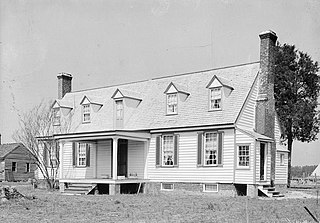
Greenway Plantation is a wood-frame, 1+1⁄2-story plantation house in Charles City County, Virginia. Historic Route 5 and the Virginia Capital Trail bikeway, both of which connect Williamsburg and Richmond pass to slightly south of this private home. Located just west of the county seat Charles City Courthouse, Virginia, Greenway is one of Charles City's earliest and most distinctive Colonial plantations. It was added to the National Register of Historic Places in 1969. Other Virginia historic sites built in the same era and with similar names are considerably west: Greenway Court, Virginia, built in 1747 and mostly demolished in the 1830s, now in Clarke County, and Greenway a house built circa 1780 for Francis Madison, the brother of President James Madison.

Blennerhassett Hotel is a historic hotel located at Parkersburg, Wood County, West Virginia. It opened in 1889 and is in the Queen Anne style. The hotel was listed on the National Register of Historic Places in 1982. A full restoration took place in 1986.

Adam Stephen House is a historic home located at Martinsburg, Berkeley County, West Virginia. It was built between 1772 and 1789, and is a 2+1⁄2-story, stone house measuring 43 feet, 5 inches, by 36 feet, 3 inches. It was the home of Adam Stephen. Built of shaped limestone, it stands on a prominent stone ledge, with two outbuildings in stone and log. After falling into near-ruin, iIt was restored in the 1960s by the General Adam Stephen Memorial Association and is open as a historic house museum. The house was built over a natural cave, with stone steps leading down from the basement. A local caver's organization has worked since 2002 to excavate the cave, which had become plugged with earth, and the excavation is available for tours on open house days.

Farmer's Delight was built in Loudoun County, Virginia in 1791 by Colonel Joseph Flavius Lane. The Federal style brick plantation house incorporates elements of Georgian architecture. The house is now closely associated with American oilman and diplomat George C. McGhee, who owned the property after 1948. The house is maintained by the McGhee Foundation and is listed on the National Register of Historic Places.

Henderson Hall Historic District is a National Register of Historic Places (NRHP)-listed historic district in Boaz, Wood County, West Virginia. The primary contributing property is Henderson Hall, a home in the Italianate style from the first half of the 19th century. Other residences at the site are a tenant house from the end of the 19th century, and "Woodhaven", the 1877 home of Henry Clay Henderson. Additional structures include a smokehouse, two corn cribs, a carriage barn that also served as a schoolhouse, a scale house used for storing agricultural equipment, and two barns. Also included within the district are the 19th-century Henderson family cemetery, a wall, a mounting block, and three mounds associated with the pre-Columbian Adena culture.

Rocklands is a historic home and farm complex located near Gordonsville, Orange County, Virginia. The house was built about 1905, and underwent a major renovation under the direction of William Lawrence Bottomley in 1933–1935. It is a 2+1⁄2-story, five-bay, Georgian Revival style brick dwelling with a hipped roof. The front facade features a monumental Ionic order hexastyle portico. Also on the property are the contributing guest house ; a small service court designed by Bottomley and consisting of a garage, servant's house, woodshed, and tunnel; a 19th-century coach barn of wood-frame construction; the mid-19th century farm manager's house; Spencer Neale, Jr., Residence ; bank barn ; and a brick house (1822).
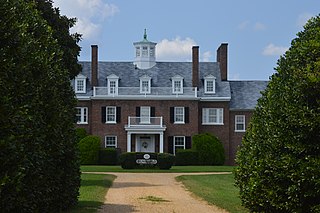
Bushfield, also known as Bushfield Manor, is a historic 2+1⁄2-story Flemish bond, 18th century brick Colonial Revival mansion located in Mount Holly, Westmoreland County, Virginia.

Valley View is a mid-19th-century Greek Revival residence and farm overlooking the South Branch Potomac River northwest of Romney, West Virginia. The house is atop a promontory where Depot Valley joins the South Branch Potomac River valley.

The Aaron Jr. and Susan Parker Farm is a historic farm property at 1715 Brook Road in Cavendish, Vermont. Now just 16 acres (6.5 ha), the property includes a c. 1815 Federal style farmhouse, and a well-preserved early 19th century English barn. The farmstead was listed on the National Register of Historic Places in 2014.