
John von Neumann was a Hungarian-American mathematician, physicist, computer scientist, engineer and polymath. Von Neumann was regarded as perhaps the mathematician with the widest coverage of the subject in his time and was said to have been "the last representative of the great mathematicians who were equally at home in pure and applied mathematics". He integrated pure and applied sciences.

The Southwestern United States, also known as the American Southwest or simply the Southwest, is a geographic and cultural region of the United States that generally includes Arizona, New Mexico, and adjacent portions of California, Colorado, Nevada, Oklahoma, Texas, and Utah. The largest cities by metropolitan area are Phoenix, Las Vegas, El Paso, Albuquerque, and Tucson. Prior to 1848, in the historical region of Santa Fe de Nuevo México as well as parts of Alta California and Coahuila y Tejas, settlement was almost non-existent outside of Nuevo México's Pueblos and Spanish or Mexican municipalities. Much of the area had been a part of New Spain and Mexico until the United States acquired the area through the Treaty of Guadalupe Hidalgo in 1848 and the smaller Gadsden Purchase in 1854.
Michael L. Rosenzweig is a professor of ecology and evolutionary biology at the University of Arizona who has developed and popularized the concept of Reconciliation ecology. He received his Ph.D in zoology at the University of Pennsylvania in 1966 and has gone on to hold a number of positions around the United States.

Cylindropuntia imbricata, the cane cholla, is a cactus found in the Southwestern United States and northern Mexico, including some cooler regions in comparison to many other cacti. It occurs primarily in the arid regions of the Southwestern United States in the states of Kansas, Oklahoma, Texas, New Mexico, Arizona, Colorado, and Nevada. It is often conspicuous because of its shrubby or even tree-like size, its silhouette, and its long-lasting yellowish fruits.

In 1984, the International Organization for Succulent Plant Study set up a working party, now called the International Cactaceae Systematics Group, to produce a consensus classification of the cactus family, down to the level of genus. Their classification has been used as the basis for systems published since the mid-1990s. Treatments in the 21st century have generally divided the family into around 125–130 genera and 1,400–1,500 species, which are then arranged in a number of tribes and subfamilies. However, subsequent molecular phylogenetic studies have shown that a very high proportion of the higher taxa are not monophyletic, i.e. they do not contain all of the descendants of a common ancestor. As of March 2017, the internal classification of the family Cactaceae remained uncertain and subject to change. A classification incorporating many of the insights from the molecular studies was produced by Nyffeler and Eggli in 2010.

Cylindropuntia is a genus of cacti, containing species commonly known as chollas, native to northern Mexico and the Southwestern United States. They are known for their barbed spines that tenaciously attach to skin, fur, and clothing. Stands of cholla are called cholla gardens. Individuals within these colonies often exhibit the same DNA, as they were formerly tubercles of an original plant.

Grusonia is a genus of opuntioid cacti, originating from the North American Deserts in Southwest United States and northern Mexico, including Baja California. Authors differ on precise boundaries of the genus, which has been included in Cylindropuntia.
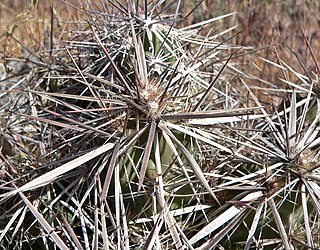
Corynopuntia, also known as club chollas, is a genus in the family Cactaceae, established by Knuth in 1935. Molecular phylogenetic studies suggest that it should be included in Grusonia, a view accepted by Plants of the World Online as of June 2021.
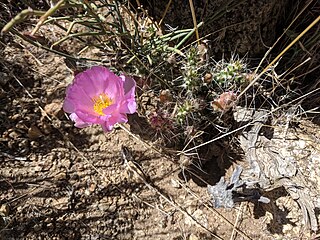
Grusonia pulchella (Engelm.) H.Rob., also known as sagebrush cholla, is a tuberous species of opuntioid cactus from the Mojave Desert of central Nevada, eastern California, northwestern Arizona and western Utah in the United States. Grusonia pulchella has at various times been included in Opuntia or placed in a separate genus Micropuntia.

The environmental impact of meat production varies because of the wide variety of agricultural practices employed around the world. All agricultural practices have been found to have a variety of effects on the environment. Some of the environmental effects that have been associated with meat production are pollution, greenhouse gas emissions through fossil fuel usage, animal methane, effluent waste, and water and land consumption. Meat is obtained through a variety of methods, including organic farming, free range farming, intensive livestock production, subsistence agriculture, hunting, and fishing.

The saguaro is a tree-like cactus species in the monotypic genus Carnegiea that can grow to be over 12 meters tall. It is native to the Sonoran Desert in Arizona, the Mexican state of Sonora, and the Whipple Mountains and Imperial County areas of California. The saguaro blossom is the state wildflower of Arizona. Its scientific name is given in honor of Andrew Carnegie. In 1994, Saguaro National Park, near Tucson, Arizona, was designated to help protect this species and its habitat.
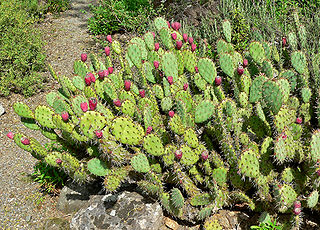
Opuntia, commonly called prickly pear or pear cactus, is a genus of flowering plants in the cactus family Cactaceae. Prickly pears are also known as tuna (fruit), sabra, nopal from the Nahuatl word nōpalli for the pads, or nostle, from the Nahuatl word nōchtli for the fruit; or paddle cactus. The genus is named for the Ancient Greek city of Opus, where, according to Theophrastus, an edible plant grew and could be propagated by rooting its leaves. The most common culinary species is the Indian fig opuntia.
This is an overview of the fossil flora and fauna of the Maastrichtian-Danian Hell Creek Formation.

Mammillaria barbata Engelm. is a small cactus native to Chihuahua, Sonora, and Durango, with the common name greenflower nipple cactus. It is found in mountainous locations in the Sierra Madre Occidental. It has delicate white to pink flowers. The fruits are red and oblong. They are edible but too small to be of much food value to humans.
Cylindropuntia abyssi, common name Peach Springs cholla, is a species of cactus endemic to northwestern Arizona. It is known from only from the Grand Canyon and in Peach Springs Canyon, on the Hualapai Reservation in Mohave County. It grows in desert scrub on limestone ledges and hilltops. The natural range of the species is fairly small, but it is locally abundant and growing in an isolated area with few threats to the species survival.

Donald Ryder Dickey (1887–1932) was an American ornithologist, mammalogist, and nature photographer. He collected 50,000 specimens and produced 7,500 photographs and moving images of nature subjects. At his death, his collection of bird and mammal specimens was the largest private collection in the United States.


