Hessian state election, 2008

Last updated
Hesse state election, 2008
Flag of Hesse.svg
  2003 27 January 2008 2009  

All 110 seats of the Landtag of Hesse

  First party Second party Third party
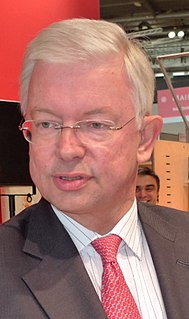
  Roland Koch 03.jpg DE Ypsilanti by Steschke 03.jpg JoergUweHahn CRW1767.jpg
Leader Roland Koch Andrea Ypsilanti Jörg-Uwe Hahn
Party CDU SPD FDP
Last election 56 seats, 48.8% 33 seats, 29.1% 9 seats, 7.9%
Seats won 42 42 11
Seat change -14 +9 +2
Percentage 36.8% 36.7% 9.4%

  Fourth party Fifth party
  Tarek Al-Wazir.jpg
Leader Tarek Al-Wazir Willi van Ooyen
Party Green Left
Last election 12 seats, 10.1%none
Seats won 9 6
Seat change -3 +6
Percentage 7.5% 5.1%

Minister-President before election

Roland Koch (acting)
CDU

Elected Minister-President

Roland Koch
CDU

Coat of Arms of Germany.svg
This article is part of a series on the
politics and government of
Germany
Foreign relations

The state election to elect members of the Landtag of Hesse was held in the German state of Hesse on 27 January 2008.

Landtag of Hesse legislature of the state of Hesse, Germany

The Landtag of Hesse is the Parliament of the State of Hesse in the Federal Republic of Germany. It convenes in the Stadtschloss, Wiesbaden. As a Legislature it is responsible for passing laws at the state level and enacting the budget. Its most important function is to elect and control the state government. The constitution of the State of Hesse describes the role of the Landtag in §§ 75 to 99.

Hesse State in Germany

Hesse or Hessia, officially the State of Hesse, is a federal state (Land) of the Federal Republic of Germany, with just over six million inhabitants. The state capital is Wiesbaden; the largest city is Frankfurt am Main.

Contents

Background and issues

For the previous 5 years, Hesse's state government (Landtag) had been ruled by the CDU, which had taken a majority of seats in the 2003 elections.

In the run-up to the election, opinion polls were showing that the CDU had lost popularity. The incumbent CDU minister-president Roland Koch initiated a tough-approach campaign against immigrant youth violence as an electoral tactic. [1] The German political left attacked it as xenophobic at the time. Other issues were various economic issues including minimum wage concerns, education, and controversy over the planned major expansion of the Rhine-Main airport.

Roland Koch German politician

Roland Koch is a German jurist and former conservative politician of the CDU. He was the 7th Minister President of Hesse from 7 April 1999, immediately becoming the 53rd President of the Bundesrat, completing the term begun by his predecessor as Minister President, Hans Eichel, until his resignation on 31 August 2010. During his time in office, Koch was widely regarded as one of Chancellor Angela Merkel's main rivals within the CDU.

Minimum wage lowest wage which can be paid legally in a state for working

A minimum wage is the lowest remuneration that employers can legally pay their workers—the price floor below which workers may not sell their labor. Most countries had introduced minimum wage legislation by the end of the 20th century.

The far-left Linke party stood for elections in Hesse for the first time in 2008, as did the far-right NPD. The generally sour political mood was as "a rising tide lifting the boats" of all non-centrist parties.

Linke is a German surname deriving from the German word meaning "left". It can refer to:

National Democratic Party of Germany Far-right political party in Germany

The National Democratic Party of Germany is a far-right and ultranationalist political party in Germany.

Inconclusive outcome

The 2008 election saw the CDU's share of the vote plummet to its lowest level since the 1966 Landtag election. (This abysmal performance by the CDU was also mirrored in the Bavaria state election later that year, which saw CDU/CSU support decline to its lowest level ever.)

The SPD, under its leader Andrea Ypsilanti, increased its share of the vote substantially, from 29% to 37%, and it claimed victory as a result. The other winner—and perhaps the bigger winner overall considering their relative starting positions and the subsequent events in Hesse politics—was the far-left Linke party. They entered the Hesse Landtag with 5.1% of the vote, clearing the five-percent hurdle. This was the second western Landtag in which the Linke party had won seats (the first having been earlier in 2008 in Lower Saxony).

Social Democratic Party of Germany political party in Germany

The Social Democratic Party of Germany is a social-democratic political party in Germany.

Andrea Ypsilanti German politician

Andrea Ypsilanti is a German politician.

The electoral threshold is the minimum share of the primary vote which a candidate or political party requires to achieve before they become entitled to any representation in a legislature. This limit can operate in various ways. For example, in party-list proportional representation systems an election threshold requires that a party must receive a specified minimum percentage of votes, either nationally or in a particular electoral district, to obtain any seats in the legislature. In multi-member constituencies using preferential voting, besides the electoral threshold, to be awarded a seat, a candidate is also required to achieve a quota, either on the primary vote or after distribution of preferences, which depends on the number of members to be return from a constituency.

The SPD and the CDU both wound up with 42 seats (of 110). Being that neither was able to form a majority, there was a several-month-long lull, during which no one knew what would happen. The center-right CDU could not form a government with its most natural ally the free-marketist FDP, nor could the center-left SPD with its most natural ally the Greens. And no one wanted a grand coalition of the two centrist parties (SPD and CDU). The far-left Linke party and its 6 seats was thus the kingmaker, exactly the result it had hoped for. [2]

Ypsilanti had long refused to negotiate with the far-left, but finally caved in and began talks to include them in a red-green-red coalition (SPD-Greens-Linke), with herself as Minister-President. This was a very controversial move, which sparked an internal revolt within the SPD as many members bitterly refused to participate in power-sharing with "neo-Communists" [3] (the Linke is the successor party to the East German ruling party 1949-1989). In November 2008, one day before Ypsilanti should have been elected Minister-President in the Landtag, four MPs of the Hesse SPD made a vote of no-confidence on her leadership, after which it was clear that no government was able to be formed. [4] This inconclusive result forced new elections, which were held in January 2009.

Results

e    d  Summary of the 27 January 2008 election results for the Landtag of Hesse
Party Ideology Vote % (change) Seats (change) Seat %
Christian Democratic Union (CDU) Christian democracy 36.8% −12.0% 42 −14 38.2%
Social Democratic Party (SPD) Social democracy 36.7% +7.6% 42 +9 38.2%
Free Democratic Party (FDP) Free market 9.4% +1.5% 11 +2 10.0%
Alliance '90/The Greens (Die Grünen) Green politics 7.5% −2.6% 9 −3 8.2%
The Left (Die Linke) Democratic socialism 5.1% +5.1% 6 +6 5.5%
The Republicans (Republikaner) National conservatism 1.0% −0.3%
Free Voters (Freie Wähler) Various, lean right 0.9% +0.9%
National Democratic Party (NPD) Far-right, ultranationalist 0.9% +0.9%
Animal Welfare Party (Tierschutzpartei) Animal rights 0.6% -0.2%
Family Party (FAMILIEN) Family advocacy 0.3% +0.3%
Pirate Party (PIRATEN) Single-Issue 0.3% +0.3%
Gray Panthers (Graue) Pensioner's Advocacy 0.2% +0.2%
Starting Now (Volksabstimmung) Far-right 0.1% +0.1%
The Violets (Violetten) Spiritualist 0.1% +0.1%
Independent Citizens' Party (UB) 0.1% +0.1%
All Others 0.1% −1.9%
Total 100.0%  110 0 100.0%

Turnout was at 64.3%, slightly down from 64.6% in the 2003 elections.

Popular Vote
CDU
36.81%
SPD
36.69%
FDP
9.43%
B'90/GRÜNE
7.53%
DIE LINKE
5.13%
REP
1.01%
FW
0.89%
NPD
0.88%
Other
1.64%
Landtag seats
CDU
38.18%
SPD
38.18%
FDP
10.00%
B'90/GRÜNE
8.18%
DIE LINKE
5.45%

Pre-election polls

Party FG Infra Emnid Forsa FG Forsa Infra TNS Forsa
Date 11.01. 09.01. 05.01. 12.12. 7.12. 26.09. 06.09. 24.07. 28.06.
CDU 40% 40% 42% 41% 40% 43% 42% 40% 41%
SPD 36% 35% 32% 30% 34% 30 % 32% 33% 27%
Greens 7% 9% 10% 11% 9% 9 % 10% 11% 11%
FDP 8% 9% 8% 9% 7% 8% 8% 7% 9%
The Left 5% 4% 5% 5% 6% 5 % 4% 5% 6%
Other Parties ? % 3% 3% 4% 4% 5 % 4% 4% 6%

FG=Forschungsgruppe Wahlen; Infra=Infratest dimap; TNS=TNS Infratest

Related Research Articles

The Saxony state election of 2004, was conducted on 19 September 2004, to elect members to the Landtag of Saxony.
The Left (Germany) political party in Germany

The Left, also commonly referred to as the Left Party, is a democratic socialist political party in Germany. It is considered to be left-wing populist by some researchers. The party was founded in 2007 as the result of the merger of the Party of Democratic Socialism (PDS) and the Electoral Alternative for Labour and Social Justice (WASG). Through the PDS, the party is the direct descendant of the ruling party of the former East Germany (GDR), the Socialist Unity Party of Germany (SED).

The Politics of Hesse takes place within a framework of a federal parliamentary representative democratic republic, where the Federal Government of Germany exercises sovereign rights with certain powers reserved to the states of Germany including Hesse. The state has a multi-party system where, as in most other states of former Western Germany and the federal level, the two main parties are the centre-right Christian Democratic Union (CDU) and the centre-left Social Democratic Party of Germany (SPD).
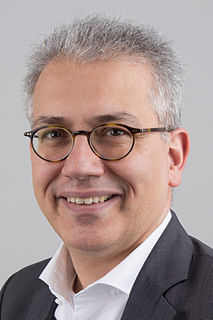
Tarek Al-Wazir German politician

Tarek Mohammed Al-Wazir is a politician in the German Green Party. Since January 2014 he has been deputy to the Hessian prime minister Volker Bouffier, and Hessian Minister of Economics, Energy, Transport and Regional Development. He is a member of the Landtag of Hesse and was co-chair of the Hessian Green Party.

Landtag of Thuringia parliament of the German state of Thuringia

The Landtag of Thuringia is the parliament of the German federal state of Thuringia. It convenes in Erfurt and currently consists of 91 members of five Parties. According to the free state's constitution, the primary functions of the Landtag are to pass laws, elect the Minister-President and control the government of Thuringia.

Dagmar Metzger German politician

Dagmar Metzger is a German lawyer and politician, and a former member of the Parliament of Hesse for the Social Democratic Party of Germany (SPD).

Early state elections for the Landtag of Hesse were held in Hesse on 18 January 2009. The reason for the early elections was the inability of the parties to form a government after the inconclusive 2008 Hessian election.

Willi van Ooyen German politician

Willi van Ooyen is a German politician of the socialist Linke Party, and current leader of the Linke party's bloc in the Hessian Landtag. He is a self-described "Marxist".

State elections were held in Brandenburg on 27 September 2009, the same day as the German federal elections and the Schleswig-Holstein state elections. The elections determined control of the Landtag of Brandenburg.
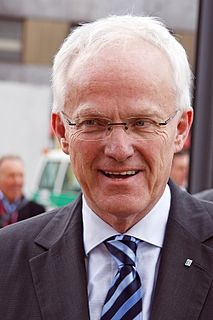
2010 North Rhine-Westphalia state election election

The North Rhine-Westphalia state election, 2010, was an election held on 9 May 2010, to elect members to the Landtag of the German state of North Rhine-Westphalia. The incumbent government at the election was the Christian Democrat (CDU)–FDP administration of Minister-President Jürgen Rüttgers. The biggest opposition party was the Social Democratic Party, led by Hannelore Kraft since 2005.

2010 German presidential election

An indirect presidential election was held in Germany on 30 June 2010 following the resignation of Horst Köhler as President of Germany on 31 May 2010. Christian Wulff, the candidate nominated by the three governing parties, the Christian Democratic Union, the Christian Social Union of Bavaria and the Free Democratic Party, was elected President in the third ballot. His main contender was the candidate of two opposition parties, the Social Democratic Party and the Alliance '90/The Greens, independent anti-communist human rights activist Joachim Gauck.

2012 North Rhine-Westphalia state election

The North Rhine-Westphalia state election, 2012 was a snap election held on 13 May 2012, to elect members to the Landtag of the German state of North Rhine-Westphalia, after the former Landtag was dissolved on 14 March 2012. The red-green minority government led by Minister-President Hannelore Kraft was returned with a 19-seat majority and were able to continue governing the state.

A state election occurred in Schleswig-Holstein on 6 May 2012. All 69 seats in the Landtag of Schleswig-Holstein were contested in this election.

2016 Baden-Württemberg state election 2016 state election in Baden-Württemberg, Germany

The Baden-Württemberg state election 2016 was held on 13 March 2016 to elect members to Baden-Württemberg's State diet, the Landtag of Baden-Württemberg in Stuttgart. It was the 15th state election since the foundation of Baden-Württemberg in 1952. Going into the election, Winfried Kretschmann of Alliance '90/The Greens led a coalition government of his party with the Social Democrats. After the election, Kretschman was confirmed in May 2016 leading a coalition with the CDU, the first time the Greens have led such a coalition in Germany.

2016 Rhineland-Palatinate state election

The 2016 Rhineland-Palatinate state election was held on 13 March 2016 to elect all 101 members to the Landtag of Rhineland-Palatinate. Seats are allotted by proportional representation with a 5% threshold. State elections were held on the same day in Baden-Württemberg and Saxony-Anhalt.

2016 Mecklenburg-Vorpommern state election

The Mecklenburg-Vorpommern State Elections, 2016 were held on 4 September 2016, to elect members to the 7th Landtag of Mecklenburg-Vorpommern. All 71 seats in the Landtag were contested and around 1.3 million voters were eligible to cast ballots. Postal voting began in August ahead of the September 4 polling day. State elections in Mecklenburg-Vorpommern use the Hare-Niemeyer method of proportional representation to allocate seats in the Landtag.

A state election was held in Hesse on 28 October 2018.

References