Related Research Articles
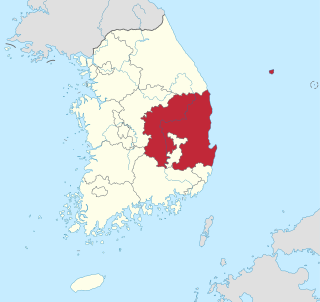
North Gyeongsang Province is a province in eastern South Korea and with an area of 19,030 km2 (7,350 sq mi) the largest province in the Korean peninsula. The province was formed in 1896 from the northern half of the former Gyeongsang province, and remained a province of Korea until the country's division in 1945, then became part of South Korea.

South Gyeongsang Province is a province in the southeast of South Korea. The provincial capital is at Changwon. It is adjacent to the major metropolitan center and port of Busan. The UNESCO World Heritage Site Haeinsa, a Buddhist temple that houses the Tripitaka Koreana and tourist attraction, is located in this province. Automobile and petrochemical factories are largely concentrated along the southern part of the province, extending from Ulsan through Busan, Changwon, and Jinju.

Daegu, formerly spelled Taegu and officially known as the Daegu Metropolitan City, is a city in southeastern South Korea.

Gyeongsang was one of the eight provinces of Korea during the Joseon dynasty. Gyeongsang was located in the southeast of Korea.

Gyeongju, historically known as Seorabeol, is a coastal city in the far southeastern corner of North Gyeongsang Province in South Korea. It is the second largest city by area in the province after Andong, covering 1,324 km2 (511 sq mi) with a population of 264,091 people Gyeongju is 370 km (230 mi) southeast of Seoul, and 55 km (34 mi) east of Daegu. The city borders Cheongdo and Yeongcheon to the west, Ulsan to the south and Pohang to the north, while to the east lies the coast of the Sea of Japan. Numerous low mountains—outliers of the Taebaek range—are scattered around the city.

Yeungnam University is a private research university located in Gyeongsan, North Gyeongsang, South Korea. The university's predecessors, Taegu College and Chunggu College, were founded in Daegu in 1947 and 1950 respectively. In 1967, the two colleges were merged by President Park Chung-hee to form Yeungnam University. In 1972, the university's new main campus opened in Gyeongsan east of Daegu. The university includes colleges of Law and Medicine as well as a university hospital. It ranked 1st in the rate for passing the bar exam for the second straight year (2015~2016), it also ranked 6th in providing CEOs in Korea's top 100 companies (2015), and 6th in providing the CEOs in Companies listed on KOSDAQ (2014). Yeungnam University is ranked 501 in the Academic Ranking of World Universities by Shanghai Jiao Tong University.

Miryang, formerly also spelled as 推火郡, Milbeol (密伐) and Milseong (密城), is a city in Gyeongsangnam-do Province, South Korea. Its name is originated from the tribal country named Miri midong guk (彌離彌凍國). There are various hypotheses as to the meaning of Miryang, such as Milky Way, Galaxy, dragon's field, The Wheat Field and the watery field. Neighboring cities include Changnyeong to the west, Cheongdo to the north, Ulsan to the east, and Yangsan, Gimhae, and Changwon to the south. The city bird is the Korean magpie, the city tree is the pine, and the city flower is the royal azalea.

The Nakdonggang River or Nakdonggang is the longest river in South Korea, and passes through major cities such as Daegu and Busan. It takes its name from its role as the eastern border of the Gaya confederacy during Korea's Three Kingdoms Era.

Hubaekje or Later Baekje was one of the Later Three Kingdoms of Korea, along with Taebong and Silla. Later Baekje was a Korean dynastic kingdom founded by the disaffected Silla general Gyeon Hwon in 900, whom led the local gentry and populace that were in large Baekje descent holding onto their collective consciousness until the twilight days of Later Silla. With the former Silla general declaring the revival of the Baekje kingdom of old, the Baekje refugees from the old territories and a portion of the Rank Six Nobility from Silla seeking the opportunity of rising up the ranks gathered under his leadership. Led by the charismatic and capable Gyeon Hwon who was also a competent field commander, Later Baekje in its early days was advantageous in the power game against the newly found kingdom Goryeo and the declining Silla. However, despite its fertile territories in the Jeolla Province and capable military prowess, it eventually fell to Wang Geon's Goryeo army in 936 due to political strife and Gyeon Hwon's defection towards Goryeo. Its capital was at Jeonju, in present-day North Jeolla province.
Gyeon Hwon was the king and founder of Later Baekje, one of the Later Three Kingdoms of Korea, and reigned from 892 to 935. Some records render his name as "Jin Hwon" (진훤). He was also the progenitor of the Hwanggan Gyeon clan. Substantial accounts of his life are preserved in the Samguk Sagi, which presents a single narrative, and the Samguk Yusa, which presents excerpts about him from various sources.

Korean ceramic history begins with the oldest earthenware from around 8000 BC. Throughout the history, the Korean peninsula has been home to lively, innovative, and sophisticated art making. Long periods of stability have allowed for the establishment of spiritual traditions, and artisan technologies specific to the region. Korean ceramics in Neolithic period have a unique geometric patterns of sunshine, or it's decorated with twists. In Southern part of Korea, Mumun pottery were popular. Mumun togi used specific minerals to make colors of red and black. Korean pottery developed a distinct style of its own, with its own shapes, such as the moon jar or Buncheong sagi which is a new form between earthenware and porcelain, white clay inlay celadon of Goryeo, and later styles like minimalism that represents Korean Joseon philosophers' idea. Many talented Korean potters were captured and brought to Japan during the invasions of Korea, where they heavily contributed to advancing Japanese pottery. Arita ware, founded by Yi Sam-pyeong opened a new era of porcelain in Japan. Another Japanese representative porcelain, Satsuma ware was also founded by Dang-gil Shim and Pyeong-ui Park. 14th generation of Su-kwan Shim have been using the same name to his grandfather and father to honor they are originally Korean, 14th Su-kwan Shim is honorable citizen of Namwon, Korea.

Seowon were the most common educational institutions of Korea during the Joseon Dynasty. They were private institutions, and combined the functions of a Confucian shrine and a preparatory school. In educational terms, the seowon were primarily occupied with preparing students for the national civil service examinations. In most cases, seowon served only pupils of the aristocratic yangban class. On 6 July 2019, UNESCO recognized a collection of nine seowon as World Heritage Sites.
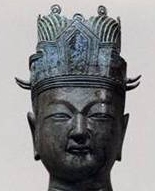
Taejo of Goryeo, also known as Taejo Wang Geon, was the founder of the Goryeo dynasty, which ruled Korea from the 10th to the 14th century. Taejo ruled from 918 to 943, achieving unification of the Later Three Kingdoms in 936.
Gyeongju is a coastal city in the far southeastern corner of North Gyeongsang province in South Korea. It is the second largest city by area in the province after Andong, covering 1,324 km2 with a population of 269,343 people according to the 2008 census. The early history of Gyeongju is closely tied to that of the Silla kingdom, of which it was the capital for nearly one thousand years.
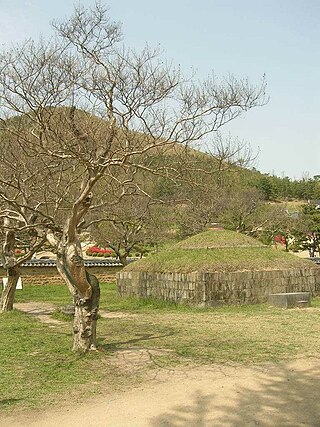
Sin Sung-gyeom was a Korean general during the turbulent Later Three Kingdoms period in the early 10th century. Born in Gwanghaeju, he became a general in the kingdom of Taebong. He was instrumental in helping Wang Geon, who later founded the state of Goryeo to achieve power. He is widely viewed as the founder of the Pyeongsan Sin clan, which includes the famous actress Shin Se-kyung.

Palgongsan, also Palgong Mountain, and previously called Gongsan, also Gong Mountain during the Later Three Kingdoms period, is a mountain in southeastern South Korea, lying on an outlier of the Taebaek range. It stands on the northeastern border between Daegu metropolitan city and North Gyeongsang province. Its peak is 1193 m above sea level.
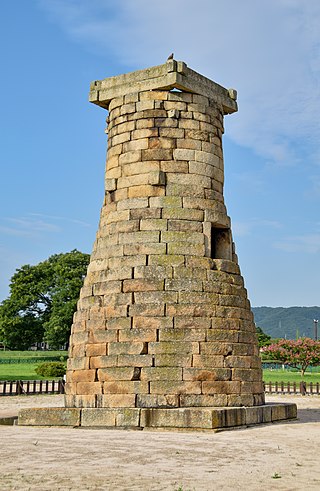
Wolseong-dong is an administrative dong or a neighbourhood in the administrative subdivisions of the Gyeongju City, North Gyeongsang province, South Korea. It consists of nine legal dong including Inwang-dong, Gyo-dong, Dongbang-dong, Doji-dong, Namsan-dong, Pyeong-dong, Guhwang-dong, Bomun-dong and Baeban-dong
References
- ↑ Lee (1984), p. 377.
- ↑ Kim, Iggy (2000-07-19). "The Korean War - a war of counter-revolution". Green Left Weekly . Archived from the original on 2009-08-28.
- ↑ Lee (1984), p. 384.
- ↑ "군위 품은 '그랜드 대구' 출범…신공항과 함께 재도약 꿈꾼다" [The 'Grand Daegu' emerges after integrating Gunwi, and it dreams of a rebound with a new airport]. Yonhap news (in Korean). 2023-07-01. Retrieved 2023-07-01.
- Cumings, Bruce (2005). Korea's place in the sun: A modern history . New York: W.W.Norton. ISBN 0-393-31681-5.
- Daegu-Gyeongbuk Historical Society (대구-경북역사연구회). 역사 속의 대구, 대구사람들 (Yeoksa sok-ui Daegu, Daegu saramdeul) (Daegu and its people in history). Seoul: Jungsim. ISBN 89-89524-09-1.
- FPCP (Foundation for the Preservation of Cultural Properties). Daegu Chilgok Sam Taekji Munhwayejeok Balguljosa Bogoseo [Excavation Report of the Cultural Site at Localities 2 and 3, Building Area 3, Chilgok, Daegu]. 3 vols. Antiquities Research Report 62. FPCP, Gyeongju, 2000.
- Kim, Yung-Chung, ed. (1976). Women of Korea:A history from ancient times to 1945. Seoul: Ewha Womans University Press. ISBN 89-7300-116-7.
{{cite book}}:|author=has generic name (help)CS1 maint: multiple names: authors list (link) - Lee, Ki-baik (1984). A new history of Korea, rev. ed. Tr. by E.W. Wagner and E.J. Shultz . Seoul: Ilchogak. ISBN 89-337-0204-0.
- Nahm, Andrew C. (1996). Korea: A history of the Korean people, 2nd ed. Seoul: Hollym. ISBN 1-56591-070-2.
- Shin, Hyeong-seok (신형석). (1999). 통일신라의 새로운 수도가 될 뻔했던 대구 (Tongilsilla-ui saeroun sudo-ga doel ppeonhaetteon Daegu) (Daegu, which almost became the new capital of Unified Silla). In Daegu-Gyeongbuk Historical Society, ed., pp. 78–91.
- YICP (Yongnam Institute of Cultural Properties). Daegu Dongcheon-dong Chwirak Yujeok [The Settlement Site at Dongcheon-dong, Daegu]. 3 vols. Research Report of Antiquities, Vol. 43. YICP, Daegu, 2002. ISBN 89-88226-41-0
- YUM (Yeungnam University Museum). Siji-eui Munhwayujeok I [Cultural Sites of Siji I]. Research Report No. 26. Yeungnam University Museum, Gyeongsan, 1999a.
- YUM (Yeungnam University Museum). Siji-eui Munhwayujeok VIII: Chwirakji Bonmun [Cultural Sites of Siji VIII: Settlement Site Text]. Research Report No. 33. Yeungnam University Museum, Gyeongsan, 1999b.