Protobothrops jerdonii, also known commonly as Jerdon's pitviper, the yellow-speckled pit viper, and the oriental pit viper, is a species of venomous snake in the subfamily Crotalinae of the family Viperidae. The species is native to India, Nepal, Myanmar, China, and Vietnam. Three subspecies are recognized, including the nominate subspecies described here.

The Indian golden gecko or Beddome's golden gecko is a species of gecko known only from the Eastern Ghats of India. It was rediscovered from the hills near present-day Tirupati. The rediscovery was after over 100 years since its description.
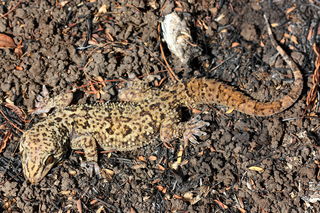
Hemidactylus maculatus, also known as the spotted leaf-toed gecko or giant spotted gecko, is a species of large gecko found in the Western Ghats of India and in parts of Sri Lanka.
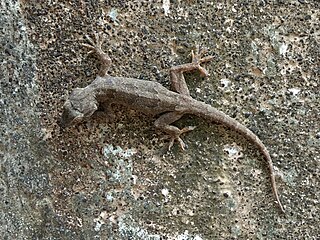
Leschenault's leaf-toed gecko is a species of gecko, a lizard in the family Gekkonidae. The species is endemic to South Asia and parts of West Asia. It is often found inside homes. Its scientific name commemorates French botanist Jean Baptiste Leschenault de la Tour.
Beddome's day gecko is a species of lizard in the family Gekkonidae. The species is endemic to India.
Boie's day gecko is a species of lizard in the family Gekkonidae. The species is endemic to India.
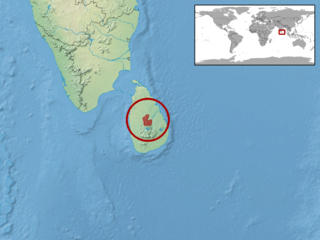
The Kandyan day gecko or Kandyan rock gecko is a species of diurnal gecko found in Sri Lanka.
The Sispara day gecko is a species of gecko found in the Nilgiri Hills of India.
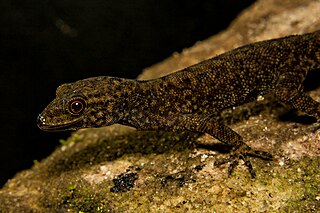
The Wynad day gecko is a species of gecko. It is endemic to the Western Ghats in Kerala, India, and only known from two locations, Wayanad and Silent Valley National Park.

Cyrtodactylus deccanensis, also commonly known as Deccan ground gecko, Günther's Indian gecko, or the banded ground gecko, is a species of gecko found in the northern Western Ghats of India. It has been found from northern Maharashtra, with a habitat range possibly extending to southern Gujarat. Cyrtodactylus albofasciatus was previously considered conspefic with Cyrtodactylus deccanensis but is now accepted as a valid species.
Lawder's bent-toed gecko is a species of gecko, a lizard in the family Gekkonidae. The species is endemic to northern India. Its type locality is "Kumaon", restricted to Almora by Malcolm Arthur Smith. It is named after Mr. A. Lawder who collected the holotype. His identity is not known for sure, but he is likely to have been A.W. Lawder who was a member of the Geological Society of London, as was Ferdinand Stoliczka who described the species. It is sometimes placed in the genus Cyrtopodion.
Hemidactylus karenorum, commonly known as the Burmese leaf gecko, the Burmese leaf-toed gecko, or the Burmese spotted gecko, is a species of gecko, a lizard in the family Gekkonidae. The species is endemic to Southeast Asia.

The reticulate leaf-toed gecko is a species of terrestrial, nocturnal, insectivorous gecko found in rocky areas of South India. It takes refuge under stones on ground during day time and emerges out at night for its activities.
Hemidactylus subtriedrus, also known as Jerdon's gecko or Madras blotched gecko, is a species of gecko found in India and Sri Lanka.

Hemidactylus triedrus, also known as the termite hill gecko, Dakota's leaf-toed gecko, or blotched house gecko, is a species of gecko found in South Asia. The race lankae of Sri Lanka, is now given species status and known as Hemidactylus lankae

Ophisops beddomei, commonly known as Beddome's snake-eye or Beddome’ s lacerta, is a species of lizard in the family Lacertidae. The species is a diurnal and fast-moving terrestrial lizard, which is endemic to the Western Ghats of India.

Ophisops jerdonii, commonly known as Jerdon's cabrita, Jerdon's snake-eye, or Punjab snake-eyed lacerta, is a species of lacertid lizard, which is distributed in east Afghanistan, Pakistan, and India.
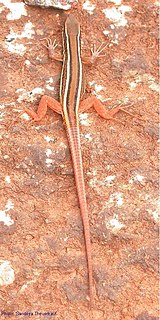
Ophisops leschenaultii, commonly called Leschenault's snake-eye, Leschenault’s lacerta, or Leschenault's cabrita, is a species of lacertid lizard endemic to India and eastern Sri Lanka. In Sri Lanka, this lizard is called Pandura katussa in Sinhala. In some parts of the country, it is also called Heeraluwa or sikanala, which is more common name for all skink-like reptiles.

Jerdon's sea snake is a species of venomous sea snake in the subfamily Hydrophiinae.
Cnemaspis boulengerii, also known commonly as Boulenger's rock gecko or the Con Dao round eyed gecko, is a species of lizard in the family Gekkonidae. The species is endemic to Côn Sơn Island in southern Vietnam.