
Lantana is a town in Palm Beach County, Florida, United States. It is 37 miles north from Fort Lauderdale. This town is part of the Miami metropolitan area. The population was 10,423 at the 2010 United States Census.
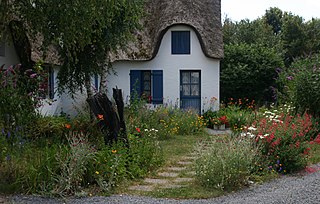
A wildlife garden is an environment created by a gardener that serves as a sustainable haven for surrounding wildlife. Wildlife gardens contain a variety of habitats that cater to native and local plants, birds, amphibians, reptiles, insects, mammals and so on. Establishing a garden that emulates the environment before the residence was built and/or renders the garden similar to intact wild areas nearby (rewilding) will allow natural systems to interact and establish an equilibrium, ultimately minimizing the need for gardener maintenance and intervention. Wildlife gardens can also play an essential role in biological pest control, and also promote biodiversity, native plantings, and generally benefit the wider environment.

Lantana ( ) is a genus of about 150 species of perennial flowering plants in the verbena family, Verbenaceae. They are native to tropical regions of the Americas and Africa but exist as an introduced species in numerous areas, especially in the Australian-Pacific region, South and Northeastern part of India. The genus includes both herbaceous plants and shrubs growing to 0.5–2 m (1.6–6.6 ft) tall. Their common names are shrub verbenas or lantanas. The generic name originated in Late Latin, where it refers to the unrelated Viburnum lantana.

A wildflower is a flower that grows in the wild, meaning it was not intentionally seeded or planted. The term implies that the plant probably is neither a hybrid nor a selected cultivar that is in any way different from the way it appears in the wild as a native plant, even if it is growing where it would not naturally. The term can refer to the flowering plant as a whole, even when not in bloom, and not just the flower.
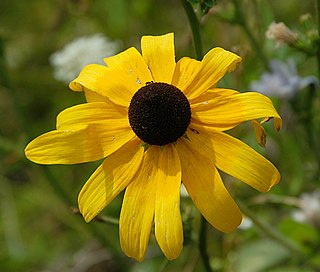
Rudbeckia hirta, commonly called black-eyed Susan, is a North American flowering plant in the family Asteraceae, native to Eastern and Central North America and naturalized in the Western part of the continent as well as in China. It has now been found in all 10 Canadian Provinces and all 48 of the states in the contiguous United States.

Rubus parviflorus, commonly called thimbleberry, is a species of Rubus native to northern temperate regions of North America. It bears edible red fruit similar in appearance to a raspberry, but shorter, almost hemispherical. Because the fruit does not hold together well, it has not been commercially developed for the retail berry market, but is cultivated for landscapes. The plant has large hairy leaves and no thorns.

Grindelia squarrosa, also known as a curly-top gumweed or curlycup gumweed, is a small North American biennial or short-lived perennial plant.

Cardamine concatenata, the cutleaved toothwort, crow's toes, pepper root or purple-flowered toothwort, is a flowering plant in Brassicaceae. It owes its name to the tooth-like appearance of its rhizome. It is a perennial woodland wildflower native to eastern North America. It is considered a spring ephemeral and blooms in March, April, and/or May.

Viburnum lantana, the wayfarer or wayfaring tree, is a species of Viburnum, native to central, southern and western Europe, northwest Africa, and southwestern Asia. The vigorous deciduous European treelike shrub is common along waysides.

The Lady Bird Johnson Wildflower Center at The University of Texas at Austin is the state botanical garden and arboretum of Texas. The center features more than 900 species of native Texas plants in both garden and natural settings and is home to a breadth of educational programs and events. The center is 284 acres and located 10 miles southwest of downtown Austin, Texas just inside the edge of the distinctive Texas hill country. It straddles both Edwards Plateau and Texas Blackland Prairies ecosystems.

Natural landscaping, also called native gardening, is the use of native plants, including trees, shrubs, groundcover, and grasses which are indigenous to the geographic area of the garden.
Philip Alexander Munz, botanist, plant taxonomist and educator (1892–1974), worked at the Rancho Santa Ana Botanic Garden, and was a professor of botany at Pomona College, serving as dean there for three years.

Helenium autumnale is a North American species of flowering plants in the sunflower family. Common names include common sneezeweed and large-flowered sneezeweed.
Lantana camara is a species of flowering plant within the verbena family (Verbenaceae), native to the American tropics. Other common names of L. camara include big-sage (Malaysia), wild-sage, red-sage, white-sage (Caribbean), korsu wiri or korsoe wiwiri (Suriname), tickberry, West Indian lantana, umbelanterna, putus in Bengal and Gu Phool in Assam, India.
Lantana pastazensis is a species of flowering plant in the verbena family, Verbenaceae, that is endemic to Ecuador. Its natural habitat is lowland tropical moist forests. It is mildly toxic due to the presence of pentacyclic terpenoids.

Lantana montevidensis is a species of lantana known by many common names, such as: trailing lantana, weeping lantana, creeping lantana, small lantana, purple lantana or trailing shrubverbena.

Amphicarpaea bracteata is an annual to perennial vine in the legume family, native to woodland, thickets, and moist slopes in eastern North America.
Baho-baho is Filipino for 'smelly'. It is the common name of two flowering plants known for their pungent odors.
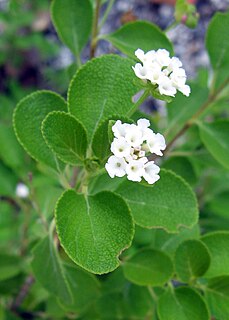
Lantana involucrata, commonly known as buttonsage, is a species of flowering plant in the verbena family. It is native to the American tropics, where it is widespread in well-drained areas. It is also found on the Galapagos Islands and Bermuda.
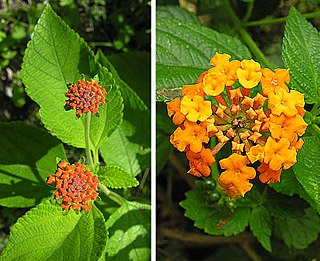
Lantana urticoides, also known as West Indian shrubverbena, Texas lantana or calico bush, is a three- to five-foot perennial shrub that grows in Mexico and the U.S. states of Texas, Louisiana and Mississippi especially along the Gulf coast. The plant can blossom from spring until the first frost. It is a species of flowering plant within the verbena family, Verbenaceae.

