Lantawan, Basilan

Last updated
Lantawan
Municipality
Municipality of Lantawan
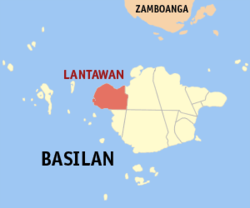
Ph locator basilan lantawan.png
Map of Basilan with Lantawan highlighted
Philippines location map (square).svg
Red pog.svg
Lantawan
Location within the Philippines
Coordinates: 6°39′N121°52′E / 6.65°N 121.87°E / 6.65; 121.87 Coordinates: 6°39′N121°52′E / 6.65°N 121.87°E / 6.65; 121.87
Country Flag of the Philippines.svg  Philippines
Region Autonomous Region in Muslim Mindanao (ARMM)
Province Basilan
District Lone District
Barangays 25 (see Barangays)
Government [1]
  Type Sangguniang Bayan
   Mayor Rustam M. Ismael
  Electorate 12,011 voters (2016)
Area [2]
  Total 405.04 km2 (156.39 sq mi)
Population (2015 census) [3]
  Total 24,594
  Density 61/km2 (160/sq mi)
Time zone UTC+8 (PST)
ZIP code 7301
PSGC 150703000
IDD : area code +63(0)62
Climate type Tropical climate
Income class 3rd municipal income class
Revenue (₱) 91,738,134.51 (2016)
Native languages Chavacano
Yakan
Tagalog
Website www.lantawan.gov.ph

Lantawan, officially the Municipality of Lantawan, (Tausūg: Lupah Lantawan; Chavacano: Municipalidad de Lantawan; Tagalog : Bayan ng Lantawan), is a 3rd class municipality in the province of Basilan, Philippines. According to the 2015 census, it has a population of 24,594 people. [3]

Tagalog language Austronesian language

Tagalog is an Austronesian language spoken as a first language by a quarter of the population of the Philippines and as a second language by the majority. Its standardized form, officially named Filipino, is the national language of the Philippines, and is one of two official languages alongside English.

Basilan Province in Bangsamoro Autonomous Region in Muslim Mindanao, Philippines

The Province of Basilan is an island province of the Philippines in the Bangsamoro Autonomous Region. Basilan Island is the largest and northernmost of the major islands of the Sulu Archipelago. It is just off the southern coast of the geographic Zamboanga Peninsula.

Philippines Republic in Southeast Asia

The Philippines, officially the Republic of the Philippines, is an archipelagic country in Southeast Asia. Situated in the western Pacific Ocean, it consists of about 7,641 islands that are categorized broadly under three main geographical divisions from north to south: Luzon, Visayas, and Mindanao. The capital city of the Philippines is Manila and the most populous city is Quezon City, both part of Metro Manila. Bounded by the South China Sea on the west, the Philippine Sea on the east and the Celebes Sea on the southwest, the Philippines shares maritime borders with Taiwan to the north, Vietnam to the west, Palau to the east, and Malaysia and Indonesia to the south.

Contents

On August 25, 2007, 10 of its barangays were separated and constituted into the new municipality of Hadji Muhtamad. [4] [5] The municipality now only consists of 25 barangays found on Basilan Island.

Barangays

Lantawan is politically subdivided into 25 barangays. [6]

Barangay administrative division in the Philippines

A barangay or baranggay (, formerly referred to as barrio, is the smallest administrative division in the Philippines and is the native Filipino term for a village, district or ward. In metropolitan areas, the term often refers to an inner city neighbourhood, a suburb or a suburban neighborhood. The word barangay originated from balangay, a kind of boat used by a group of Austronesian peoples when they migrated to the Philippines.

PSGC Barangay Population ±% p.a.
2015 [3] 2010 [7]
150703001 Atong-atong 9.6% 2,368 1,155 14.65%
150703018 Bagbagon 3.4% 829 793 0.85%
150703003 Baungis 2.1% 524 515 0.33%
150703019 Bulan-bulan 5.9% 1,463 1,333 1.79%
150703004 Bulanza 3.1% 771 605 4.72%
150703037 Calayan 2.1% 507 452 2.21%
150703026 Calugusan 3.5% 870 796 1.71%
150703027 Canibungan 7.5% 1,847 1,472 4.42%
150703029 Landugan 1.8% 452 390 2.85%
150703007 Lantawan Proper ( Poblacion ) 3.7% 919 943 −0.49%
150703031 Lawi-lawi 4.0% 994 681 7.47%
150703030 Lawila 2.6% 643 467 6.28%
150703024 Lower Bañas 2.4% 599 550 1.64%
150703008 Lower Manggas 4.2% 1,025 598 10.80%
150703036 Luuk-Maluha 2.0% 498 491 0.27%
150703011 Matarling 3.8% 929 1,337 −6.70%
150703012 Matikang 3.7% 918 857 1.32%
150703033 Pamucalin 5.0% 1,228 1,143 1.38%
150703035 Paniongan 2.5% 612 524 3.00%
150703038 Parian-Baunoh 4.1% 1,001 843 3.32%
150703021 Suba-an (Pangasahan) 3.6% 895 516 11.06%
150703034 Switch Yakal 4.3% 1,056 944 2.16%
150703016 Tairan 8.6% 2,104 1,562 5.84%
150703025 Upper Bañas 2.3% 571 466 3.94%
150703017 Upper Manggas 3.9% 971 654 7.82%
Total24,59420,0873.93%

Demographics

Population census of Lantawan
YearPop.±% p.a.
1960 27,493    
1970 8,528−11.03%
1975 14,081+10.58%
1980 17,733+4.72%
1990 19,340+0.87%
1995 25,613+5.40%
2000 27,487+1.53%
2007 28,978+0.73%
2010 20,087−12.49%
2015 24,594+3.93%
Source: Philippine Statistics Authority [3] [7] [8] [9]

In the 2015 census, Lantawan had a population of 24,594. [3]


Notable people

Islamic State of Iraq and the Levant Salafi jihadist terrorist and militant group

The Islamic State of Iraq and the Levant, also known as the Islamic State of Iraq and Syria, officially as the Islamic State (IS) and by its Arabic language acronym Daesh, is a Salafi jihadist militant group and former unrecognised proto-state that follows a fundamentalist, Salafi doctrine of Sunni Islam. ISIL gained global prominence in early 2014 when it drove Iraqi government forces out of key cities in its Western Iraq offensive, followed by its capture of Mosul and the Sinjar massacre.

Abu Sayyaf Jihadist militant group in the Philippines

Abu Sayyaf, unofficially known as the Islamic State of Iraq and the Levant – Philippines Province, is a Jihadist militant and pirate group that follows the Wahhabi doctrine of Sunni Islam. It is based in and around Jolo and Basilan islands in the southwestern part of the Philippines, where for more than four decades, Moro groups have been engaged in an insurgency seeking to make the province independent. The group is considered violent and was responsible for the Philippines' worst terrorist attack, the bombing of Superferry 14 in 2004, which killed 116 people. The name of the group is derived from the Arabic abu, and sayyaf ("swordsmith"). As of 2012, the group was estimated to have between 200 and 400 members, down from 1,250 in 2000. They use mostly improvised explosive devices, mortars and automatic rifles.

Related Research Articles

Hadji Panglima Tahil, Sulu Municipality in Bangsamoro Autonomous Region in Muslim Mindanao, Philippines

Hadji Panglima Tahil, officially the Municipality of Hadji Panglima Tahil, is a 6th class municipality in the province of Sulu, Philippines. According to the 2015 census, it has a population of 6,375 people.

Madamba Municipality in Bangsamoro Autonomous Region in Muslim Mindanao, Philippines

Madamba, officially the Municipality of Madamba, is a 4th class municipality in the province of Lanao del Sur, Philippines. According to the 2015 census, it has a population of 17,756 people.

Maluso, Basilan Municipality in Bangsamoro Autonomous Region in Muslim Mindanao, Philippines

Maluso, officially the Municipality of Maluso,, is a 4th class municipality in the province of Basilan, Philippines. According to the 2015 census, it has a population of 40,646 people.

Sumisip, Basilan Municipality in Bangsamoro Autonomous Region in Muslim Mindanao, Philippines

Sumisip, officially the Municipality of Sumisip,, is a 1st class municipality in the province of Basilan, Philippines. According to the 2015 census, it has a population of 41,730 people.

Tipo-Tipo, Basilan Municipality in Bangsamoro Autonomous Region in Muslim Mindanao, Philippines

Tipo-Tipo, officially the Municipality of Tipo-Tipo,, is a 3rd class municipality in the province of Basilan, Philippines. According to the 2015 census, it has a population of 19,163 people.

Tuburan, Basilan Municipality in Bangsamoro Autonomous Region in Muslim Mindanao, Philippines

Tuburan, officially the Municipality of Tuburan,, is a 2nd class municipality in the province of Basilan, Philippines. According to the 2015 census, it has a population of 20,207 people.

Sultan sa Barongis Municipality in Bangsamoro Autonomous Region in Muslim Mindanao, Philippines

Sultan sa Barongis, officially the Municipality of Sultan sa Barongis, is a 2nd class municipality in the province of Maguindanao, Philippines. According to the 2015 census, it has a population of 22,425 people.

Talayan Municipality in Bangsamoro Autonomous Region in Muslim Mindanao, Philippines

Talayan, officially the Municipality of Talayan, is a 4th class municipality in the province of Maguindanao, Philippines. According to the 2015 census, it has a population of 30,032 people.

Matanog, Maguindanao Municipality in Bangsamoro Autonomous Region in Muslim Mindanao, Philippines

Matanog, officially the Municipality of Matanog, is a 4th class municipality in the province of Maguindanao, Philippines. According to the 2015 census, it has a population of 29,770 people.

Guindulungan, Maguindanao Municipality in Bangsamoro Autonomous Region in Muslim Mindanao, Philippines

Guindulungan, officially the Municipality of Guindulungan, is a — municipality in the province of Maguindanao, Philippines. According to the 2015 census, it has a population of 19,911 people.

Rajah Buayan, Maguindanao Municipality in Bangsamoro Autonomous Region in Muslim Mindanao, Philippines

Rajah Buayan, officially the Municipality of Rajah Buayan, is a — municipality in the province of Maguindanao, Philippines. According to the 2015 census, it has a population of 23,652 people.

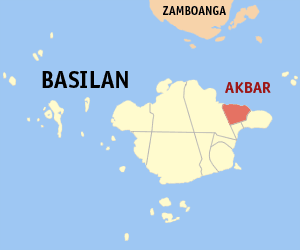
Akbar, Basilan Municipality in Bangsamoro Autonomous Region in Muslim Mindanao, Philippines

Akbar, officially the Municipality of Akbar,, is a — municipality in the province of Basilan, Philippines. According to the 2015 census, it has a population of 17,531 people.

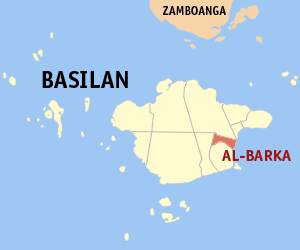
Al-Barka, Basilan Municipality in Bangsamoro Autonomous Region in Muslim Mindanao, Philippines

Al-Barka, officially the Municipality of Al-Barka,, is a — municipality in the province of Basilan, Philippines. According to the 2015 census, it has a population of 20,905 people.

Hadji Mohammad Ajul, Basilan Municipality in Bangsamoro Autonomous Region in Muslim Mindanao, Philippines

Hadji Mohammad Ajul, officially the Municipality of Hadji Mohammad Ajul,, is a — municipality in the province of Basilan, Philippines. According to the 2015 census, it has a population of 19,307 people.

Ungkaya Pukan, Basilan Municipality in Bangsamoro Autonomous Region in Muslim Mindanao, Philippines

Ungkaya Pukan, officially the Municipality of Ungkaya Pukan,, is a — municipality in the province of Basilan, Philippines. According to the 2015 census, it has a population of 18,441 people.

Pandag, Maguindanao Municipality in Bangsamoro Autonomous Region in Muslim Mindanao, Philippines

Pandag, officially the Municipality of Pandag, is a — municipality in the province of Maguindanao, Philippines. According to the 2015 census, it has a population of 25,057 people.

Northern Kabuntalan, Maguindanao Municipality in Bangsamoro Autonomous Region in Muslim Mindanao, Philippines

Northern Kabuntalan, officially the Municipality of Northern Kabuntalan, is a 5th class municipality in the province of Maguindanao, Philippines. According to the 2015 census, it has a population of 25,232 people.

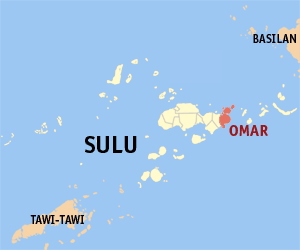
Omar, Sulu Municipality in Bangsamoro Autonomous Region in Muslim Mindanao, Philippines

Omar, officially the Municipality of Omar, is a — municipality in the province of Sulu, Philippines. According to the 2015 census, it has a population of 25,116 people.

Hadji Muhtamad, Basilan Municipality in Bangsamoro Autonomous Region in Muslim Mindanao, Philippines

Hadji Muhtamad, officially the Municipality of Hadji Muhtamad,, is a — municipality in the province of Basilan, Philippines. According to the 2015 census, it has a population of 25,085 people.

Tabuan-Lasa, Basilan Municipality in Bangsamoro Autonomous Region in Muslim Mindanao, Philippines

Tabuan-Lasa, officially the Municipality of Tabuan-Lasa,, is a — municipality in the province of Basilan, Philippines. According to the 2015 census, it has a population of 24,188 people.

References

  1. "Municipality". Quezon City, Philippines: Department of the Interior and Local Government. Retrieved 31 May 2013.
  2. "Province: Basilan". PSGC Interactive. Quezon City, Philippines: Philippine Statistics Authority . Retrieved 12 November 2016.
  3. 1 2 3 4 5 Census of Population (2015). "ARMM – Autonomous Region in Muslim Mindanao". Total Population by Province, City, Municipality and Barangay. PSA . Retrieved 20 June 2016.
  4. "Muslim Mindanao Autonomy Act No. 200; An Act Creating the Municipality of Hadji Muhtamad in the Province of Basilan and for Other Purposes" (PDF). Regional Legislative Assembly, Autonomous Region in Muslim Mindanao. Archived from the original (PDF) on 4 February 2016. Retrieved 27 January 2016.
  5. "Five (5) New Cities, Two (2) Municipalities and a Barangay created in the Third Quarter of 2007". National Statistical Coordination Board. 13 November 2007. Archived from the original on 24 November 2007. Retrieved 10 November 2016.
  6. "Municipal: Lantawan, Basilan". PSGC Interactive. Quezon City, Philippines: Philippine Statistics Authority . Retrieved 8 January 2016.
  7. 1 2 Census of Population and Housing (2010). "ARMM – Autonomous Region in Muslim Mindanao". Total Population by Province, City, Municipality and Barangay. NSO . Retrieved 29 June 2016.
  8. Censuses of Population (1903–2007). "ARMM – Autonomous Region in Muslim Mindanao". Table 1. Population Enumerated in Various Censuses by Province/Highly Urbanized City: 1903 to 2007. NSO.
  9. "Province of Basilan". Municipality Population Data. Local Water Utilities Administration Research Division. Retrieved 17 December 2016.