
Myrmecia is a genus of ants first established by Danish zoologist Johan Christian Fabricius in 1804. The genus is a member of the subfamily Myrmeciinae of the family Formicidae. Myrmecia is a large genus of ants, comprising at least 93 species that are found throughout Australia and its coastal islands, while a single species is only known from New Caledonia. One species has been introduced out of its natural distribution and was found in New Zealand in 1940, but the ant was last seen in 1981. These ants are commonly known as bull ants, bulldog ants or jack jumper ants, and are also associated with many other common names. They are characterized by their extreme aggressiveness, ferocity, and painful stings. Some species are known for the jumping behavior they exhibit when agitated.
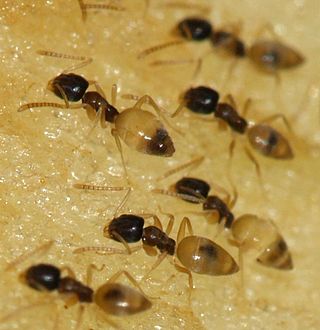
Tapinoma is a genus of ants that belongs to the subfamily Dolichoderinae. The genus currently comprises 74 described species distributed worldwide in tropical and temperate regions. Members of are generalized foragers, nesting in a wide variety of habitats, ranging from grasslands, open fields, woodlands, to inside buildings. The majority of species nest in the ground under objects such as stones or tree logs, other species build nests under bark of logs and stumps, in plant cavities, insect galls or refuse piles.

Cardiocondyla is an Old World genus of ants in the subfamily Myrmicinae.

Leptanilla is a genus of ant in the subfamily Leptanillinae. Like other genera in this subfamily, the queen is fed by the hemolymph of their own larvae, which have specialized processes for this purpose.

Aenictus is a large army ant genus distributed in the Old World tropics and subtropics. It contains about 181 species, making it one of the larger ant genera of the world.
Larval hemolymph feeding is a behaviour trait found in the queens of some species of ant. This is found mainly in the ants of the subfamily Amblyoponinae and give them the other name of Dracula ant. In colonies of the Amblyopone silvestrii the queens feed on the hemolymph of their larvae when food is not available. In one species, Myopopone castanea, worker ants consume larval hemolymph. This is said to be a precursor to trophallaxis in other ant families. The larvae themselves are not killed by this process. This behaviour is also seen in Proceratium and in Leptanilla the larvae have special organs that exude the haemolymph. On the other hand, the foundresses suppress larval hemolymph feeding (LHF) when prey is available, allowing them to rear the first workers more swiftly. The nondestructive form of cannibalism can be regarded as a nutritive adaptation related to: (1) the lack of social food transfer in this species, and (2) its specialized predation on large sporadic prey (centipedes). LHF similar to that in Amblyopone was found in Proceratium and another type of LHF, with a larval specialized exudatory organ, in Leptanilla.
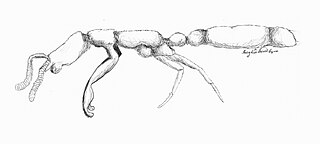
Leptanilla japonica is an uncommon highly migratory, subterranean ant found in Japan. They are tiny insects, with workers measuring about 1.2 mm and queens reaching to about 1.8 mm, and live in very small colonies of only a few hundred individuals at a time Its sexual development follows a seasonal cycle that affects the colony's migration and feeding habits, and vice versa. L. japonica exhibits specialized predation, with prey consisting mainly of geophilomorph centipedes, a less reliable food source that also contributes to their high rate of nest migration. Like ants of genera Amblyopone and Proceratium, the genus Leptanilla engages in larval hemolymph feeding (LHF), with the queen using no other form of sustenance. LHF is an advantageous alternative to the more costly cannibalism. Unlike any other ant, however, members of Leptanilla, including L. japonica, have evolved a specialized organ dubbed the “larval hemolymph tap” that reduces the damage LHF inflicts on the larvae. LHF has become this species' main form of nutrition.
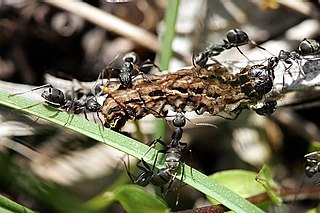
Formica japonica is a species of ant in the genus Formica. It is found in Russian, Mongolia, China, Korea, Japan, and Taiwan. It is one of the most common ants in Japan.

Stigmatomma is a genus of ants in the subfamily Amblyoponinae. The genus has a worldwide distribution, and like most other amblyoponines, Stigmatomma species are specialized predators. First described by Roger (1859), it was for a long time considered to be a synonym of Amblyopone until it was revived as an independent genus by Yoshimura & Fisher (2012) based on worker mandible morphology.

Probolomyrmex is a genus of ants in the subfamily Proceratiinae. The genus is distributed throughout the tropics and subtropics. The ants are very rare, and are rarely collected in the field, but they appear to be nesting in the leaf litter or in rotten wood. Little is known about their biology.
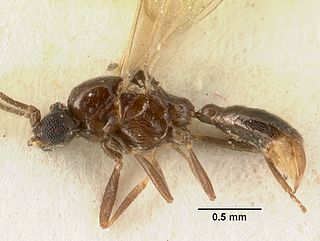
Yavnella is a genus of ants in the subfamily Leptanillinae. Its two species are distributed in India and Israel. The genus is known only from male specimens.

Anomalomyrma is an Asian genus of ants in the subfamily Leptanillinae. The genus was originally described in 1990 with the type species Anomalomyrma taylori, based on a single dealate queen from Borneo. Workers were unknown until 2011, when two new species were described from Peninsular Malaysia and the Philippines.

Leptanilla javana is a species of ant in the subfamily Leptanillinae.

Protanilla is a genus of subterranean ants in the subfamily Leptanillinae. Known from the Indomalayan realm, the genus contains about thirteen species. The genus was erected by Taylor (1990) for the type species P. rafflesi, described from workers from Peninsular Malaysia. Species in this genus have long and downcurved mandibles with peg-like tooth on the inner margins. Four species are known from China, one from Taiwan, one from Sri Lanka and a couple from India.

Nylanderia is a large genus of ants in the subfamily Formicinae. The genus has a nearly cosmopolitan distribution with species inhabiting a wide array of habitats in almost all geographic regions. Nylanderia, currently containing over 110 species, is an ecologically important genus, with some species reported as being invasive. The ants are small to medium in size and range in color from pale yellow to black.
Protanilla furcomandibula, formerly Furcotanilla furcomandibula, is a species of ant in the subfamily Leptanillinae. It is only known from Yunnan, China, where it nests in the soil and forages on the ground. Queens and males are unknown.

Leptanilla havilandi is a species of ant in the subfamily Leptanillinae. The species can be found in Singapore and Malaysia.

Leptanilla voldemort is a species of ant in the genus Leptanilla and was described in 2024.


