
A blizzard is a severe snowstorm characterized by strong sustained winds of at least 56 km/h (35 mph) and lasting for a prolonged period of time—typically three hours or more. A ground blizzard is a weather condition where snow is not falling but loose snow on the ground is lifted and blown by strong winds. Blizzards can have an immense size and usually stretch to hundreds or thousands of kilometres.

Blizzard Entertainment, Inc. is an American video game developer and publisher based in Irvine, California, and is a subsidiary of Activision Blizzard. The company was founded on February 8, 1991, under the name Silicon & Synapse, Inc. by three graduates of the University of California, Los Angeles: Michael Morhaime, Frank Pearce and Allen Adham. The company originally concentrated on the creation of game ports for other studios' games before beginning development of their own software in 1993 with games like Rock n' Roll Racing and The Lost Vikings. In 1994, the company became Chaos Studios, Inc., then Blizzard Entertainment after being acquired by distributor Davidson & Associates.

World of Warcraft (WoW) is a massively multiplayer online role-playing game (MMORPG) released in 2004 by Blizzard Entertainment. It is the fourth released game set in the Warcraft fantasy universe. World of Warcraft takes place within the Warcraft world of Azeroth, approximately four years after the events at the conclusion of Blizzard's previous Warcraft release, Warcraft III: The Frozen Throne. The game was announced in 2001, and was released for the 10th anniversary of the Warcraft franchise on November 23, 2004. Since launch, World of Warcraft has had eight major expansion packs produced for it: The Burning Crusade, Wrath of the Lich King, Cataclysm, Mists of Pandaria, Warlords of Draenor, Legion and Battle for Azeroth, and Shadowlands.
1998 saw many sequels and prequels in video games and several new titles such as Half-Life, Metal Gear Solid, F-Zero X, The Legend of Zelda: Ocarina of Time, Gex: Enter the Gecko, Xenogears, Banjo-Kazooie, Spyro the Dragon and MediEvil. The year has been retrospectively considered one of the best in video gaming due to the release of several critically acclaimed, commercially successful and influential titles across all platforms and genres.
StarCraft is a military science fiction media franchise created by Chris Metzen and James Phinney and owned by Blizzard Entertainment. The series, set in the beginning of the 26th century, centers on a galactic struggle for dominance among four species—the adaptable and mobile Terrans, the ever-evolving insectoid Zerg, the powerfully enigmatic Protoss, and the "god-like" Xel'Naga creator race—in a distant part of the Milky Way galaxy known as the Koprulu Sector. The series debuted with the video game StarCraft in 1998. It has grown to include a number of other games as well as eight novelizations, two Amazing Stories articles, a board game, and other licensed merchandise such as collectible statues and toys.

Activision Blizzard, Inc. is an American video game holding company based in Santa Monica, California. The company was founded in July 2008 through the merger of Activision, Inc. and Vivendi Games. The company is traded on the NASDAQ stock exchange under the ticker symbol ATVI, and since 2015 has been one of the stocks that make up the S&P 500. Activision Blizzard currently includes five business units: Activision Publishing, Blizzard Entertainment, King, Major League Gaming, and Activision Blizzard Studios.
Snowmageddon, Snowpocalypse, and Snowzilla are portmanteaus of the word "snow" with either "Armageddon", "Apocalypse" and "Godzilla" respectively. Snowmageddon and Snowpocalypse were used in the popular press in Canada during January 2009, and was also used in January 2010 by The Guardian reporter Charlie Brooker to characterise the sensationalist reaction of television news to a period of snowfall across the UK. The Washington Post, out of Washington, DC, ran an online poll asking for reader feedback prior to the February 5–6, 2010 North American blizzard on February 4, 2010, and several blogs, including the Washington Post's own blog, followed that up by using either "Snowmageddon" or "Snowpocalypse" before, during, and after the storm hit.

The December 2009 North American blizzard was a powerful nor'easter that formed over the Gulf of Mexico in December 2009, and became a major snowstorm that affected the East Coast of the United States and Canadian Atlantic provinces. The snowstorm brought record-breaking December snowfall totals to Washington, D.C., Baltimore, and Philadelphia.

The 2009 North American Christmas blizzard was a powerful winter storm and severe weather event that affected the Midwestern United States, Great Plains, Southeastern United States, the Eastern Seaboard, and parts of Ontario. The storm began to develop on December 22 before intensifying to produce extreme winds and precipitation by the morning of December 24. The storm's rapid development made it difficult for forecasters to predict. The blizzard was reported to have claimed at least 21 lives, and disrupted air travel during the Christmas travel season. In the Southeastern and Central United States, there were 27 reported tornadoes on December 23–24. The storm, a Category 5 "Extreme" one on the Regional Snowfall Index, was the first winter weather event to rank as such since the Blizzard of '96.
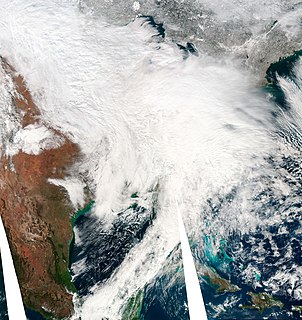
The February 5–6, 2010 North American blizzard, commonly referred to as Snowmageddon, was a paralyzing and crippling blizzard that had major and widespread impact in the Northeastern United States. The storm's center tracked from Baja California Sur on February 2nd, 2010 to the East coast on February 6, 2010, before heading east out into the Atlantic. Effects were felt to the north and west of this track in northern Mexico, California, and the Southwestern, Midwestern, Southeastern, and most notably Mid-Atlantic States. Severe weather, including extensive flooding and landslides in Mexico, and historic snowfall totals in every one of the Mid-Atlantic states, brought deaths to Mexico, New Mexico, Virginia, Pennsylvania and Maryland.

The February 9–10, 2010 North American blizzard was a winter and severe weather event that afflicted the Midwest, Mid-Atlantic and New England regions of the United States between February 9–11, 2010, affecting some of the same regions that had experienced a historic Nor'easter three days prior. The storm brought 10 to 20 inches of snow across a wide swath from Washington, DC to New York City, with parts of the Baltimore metro area receiving more than 20 inches (51 cm). This storm began as a classic "Alberta clipper", starting out in Canada and then moving southeast, and finally curving northeast while rapidly intensifying off the New Jersey coast, forming an eye. The National Weather Service, in an interview with The Baltimore Sun's weather reporter Frank Roylance, likened this storm to a Category 1 hurricane. Forecasters told Roylance that "Winds topped 58 mph over part of the Chesapeake Bay, and 40 mph gusts were common across the region as the storm's center deepened and drifted slowly along the mid-Atlantic coast". This storm system, in conjunction with the first storm 3 days prior, has been nicknamed Snoverkill.
The March 2010 nor'easter or St. Patrick's Day nor'easter was a powerful nor'easter that impacted the Northeastern United States and Eastern Canada from March 12–16, 2010, resulting in at least nine deaths. The slow-moving storm produced over 10 inches (25 cm) of rain in New England, causing widespread flooding of urban and low-lying areas. Winds of up to 70 miles per hour (110 km/h) snapped trees and power lines, resulting in over 1 million homes and businesses left without electricity. The storm also caused extensive coastal flooding and beach erosion. The nor'easter was the fifth major winter storm to impact the Mid-Atlantic and New England in the 2009–10 North American winter storm season.
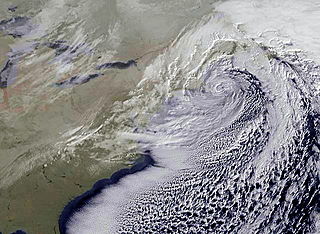
The December 2010 North American blizzard was a major nor'easter and historic blizzard affecting the Contiguous United States and portions of Canada from December 5–29, 2010. From January 4–15, the system was known as Windstorm Benjamin in Europe. It was the first significant winter storm of the 2010–11 North American winter storm season and the fifth North American blizzard of 2010. The storm system affected the northeast megalopolis, which includes major cities such as Norfolk, Philadelphia, Newark, New York City, Hartford, Providence, and Boston. The storm brought between 12 and 32 inches of snow in many of these areas.

Heroes of the Storm is a crossover multiplayer online battle arena video game developed and published by Blizzard Entertainment and released on June 2, 2015, for Microsoft Windows and macOS. The game features various characters from Blizzard's franchises as playable heroes, as well as different battlegrounds based on Warcraft, Diablo, StarCraft, and Overwatch universes. The game is free-to-play, based on freemium business model, and is supported by microtransactions which can be used to purchase heroes, visual alterations for the heroes in the game, mounts, and other cosmetic elements. Blizzard does not call the game a "multiplayer online battle arena" or an "action real-time strategy" because they feel it is something different with a broader playstyle; they refer to it as an online "hero brawler".

The March 2014 North American winter storm, also known as Winter Storm Titan, was an extremely powerful Winter storm that affected much of the United States and portions of Canada. It was one of the most severe winter storms of the 2013–14 North American winter storm season, storm affecting most of the Western Seaboard, and various parts of the Eastern United States, bringing damaging winds, flash floods, blizzard conditions, icy conditions.

Overwatch is a team-based multiplayer first-person shooter developed and published by Blizzard Entertainment. Described as a "hero shooter," Overwatch assigns players into two teams of six, with each player selecting from a roster of over 30 characters, known as "heroes," each with a unique style of play that is divided into three general roles that fit their purpose. Players on a team work together to secure and defend control points on a map or escort a payload across the map in a limited amount of time. Players gain cosmetic rewards that do not affect gameplay, such as character skins and victory poses, as they play the game. The game was initially launched with only casual play, but a competitive ranked mode, various 'arcade' game modes, and a player-customizable server browser were added after release. Additionally, Blizzard has added new characters, maps, and game modes post-release, all free of charge, with the only additional cost to players being optional loot boxes to earn cosmetic items. It was released for PlayStation 4, Xbox One, and Windows in May 2016, and Nintendo Switch in October 2019.
The 2009–10 North American winter season started in late 2009 and ended in mid-2010.

The 2010–11 North American winter season started in late 2010 and ended in mid-2011.

The 2016–17 North American winter refers to winter in North America as it occurred across the continent from late 2016 through early 2017. During the winter, a weak La Niña was expected to influence weather conditions across the continent. Several notable events occurred during the season, including a potent winter storm that affected the East Coast of the United States in early January, the second-largest winter tornado outbreak on record later that month, and an unusually warm February. In addition, towards the end of the season, a large cyclonic storm system that caused a large tornado outbreak, flooding, and a potent blizzard in the heart of the country. However, the most notable event of the winter was a powerful blizzard that impacted the Northeast and New England in mid-March, towards the end of the season.
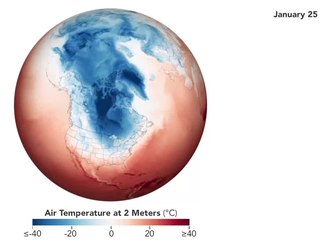
The 2018–19 North American winter refers to winter in North America as it occurred across the continent from late 2018 through early 2019. Notable events have included a rare snow in the Southeast in December, a strong cold wave and several major winter storms in the Midwest, and upper Northeast and much of Canada late January and early February, record snowstorms in the Southwest late February, two nor'easters that affected the east coast early March, deadly tornado outbreaks in the Southeast, collapsing buildings in Quebec, a historic mid-April blizzard in the Midwest, but the most notable event all season was a record-breaking bomb cyclone that affected much of central USA and Canada in mid March. Unlike previous winters, a developing El Niño was expected to influence weather patterns across North America. Overall, however, winter of 2018 - 2019 was mild along the mid and lower East Coast, West Coast, and most of the southern Plains.