Cass Gilbert was an American architect. An early proponent of skyscrapers, his works include the Woolworth Building, the United States Supreme Court building, the state capitols of Minnesota, Arkansas, and West Virginia, the Detroit Public Library, the Saint Louis Art Museum and Public Library. His public buildings in the Beaux Arts style reflect the optimistic American sense that the nation was heir to Greek democracy, Roman law and Renaissance humanism. Gilbert's achievements were recognized in his lifetime; he served as president of the American Institute of Architects in 1908–09.

The Minnesota State Capitol is the seat of government for the U.S. state of Minnesota, in its capital city of Saint Paul. It houses the Minnesota Senate, Minnesota House of Representatives, the office of the Attorney General and the office of the Governor. The building also includes a chamber for the Minnesota Supreme Court, although court activities usually take place in the neighboring Minnesota Judicial Center.

National Park Service rustic – sometimes colloquially called Parkitecture – is a style of architecture that developed in the early and middle 20th century in the United States National Park Service (NPS) through its efforts to create buildings that harmonized with the natural environment. Since its founding in 1916, the NPS sought to design and build visitor facilities without visually interrupting the natural or historic surroundings. The early results were characterized by intensive use of hand labor and a rejection of the regularity and symmetry of the industrial world, reflecting connections with the Arts and Crafts movement and American Picturesque architecture.

Endion station is a former train station in Duluth, Minnesota, United States. It was built in 1899 to serve the Endion neighborhood but was relocated to Canal Park in 1986 to make way for expansion of Interstate 35. Passenger service through the station had ceased in 1961 and freight service in 1978.

Staples station is an Amtrak intercity train station in Staples, Minnesota, United States, served by Amtrak's daily Empire Builder service. It was built in December 1909 by the Northern Pacific Railway. The architects of the station were Charles A. Reed and Allen H. Stem, who also designed the Northern Pacific's King Street Station in Seattle, Washington, and the New York Central Railroad's Grand Central Terminal in New York City.

The Barstow Harvey House, also known as Harvey House Railroad Depot and Barstow station, is a historic building in Barstow, California. Originally built in 1911 as Casa del Desierto, a Harvey House hotel and Santa Fe Railroad depot, it currently serves as an Amtrak station and government building housing city offices, the Barstow Chamber of Commerce and Visitor Center, and two museums.
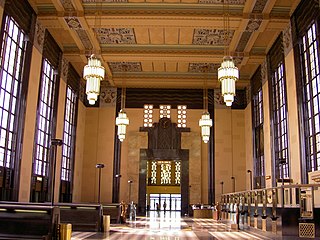
The Union Station, at 801 South 10th Street in Omaha, Nebraska, known also as Union Passenger Terminal, is "one of the finest examples of Art Deco architecture in the Midwest". Designated an Omaha Landmark in 1978, it was listed as "Union Passenger Terminal" on the National Register of Historic Places in 1971, and was designated a National Historic Landmark in 2016. The Union Station is also a contributing property to the Omaha Rail and Commerce Historic District. It was the Union Pacific's first Art Deco railroad station, and the completion of the terminal "firmly established Omaha as an important railroad terminus in the Midwest".

Battle Hall, also known as the "Cass Gilbert Building" and "The Old Library," is a historic library on the campus of the University of Texas at Austin in Austin, Texas. It is one of four buildings on campus that have been added to the National Register of Historic Places. The others are the Littlefield House, University Junior High School and Little Campus.

Aitkin station in Aitkin, Minnesota, United States, is a brick passenger depot built on the Northern Pacific Railway mainline, opening on January 26, 1916. The rail line is now part of the BNSF Railway. The depot symbolizes the importance of the railroad in Aitkin's growth and development.

The Nevada–California–Oregon Railway was a 3 ft narrow gauge railroad originally planned to connect Reno, Nevada, to the Columbia River. However, only 238 mi (383 km) of track were laid so service never extended beyond Lakeview, Oregon. Because of the company’s reputation for mismanagement, it was often called the "Narrow, Crooked & Ornery" railroad.

Reed and Stem is an American architectural and engineering firm. The firm was founded in St. Paul, Minnesota in 1891 as a partnership between Charles A. Reed (1858–1911) and Allen H. Stem (1856–1931), the successful partnership captured a wide range of commissions. The firm was reformed as Wank Adams Slavin Associates in 1961, and adopted the name WASA Studio in 2004.

Wayzata station is a historic train depot in Wayzata, Minnesota, United States. Constructed and operated by the Great Northern Railway, the station was in service from 1906 until 1971. The depot is positioned along Lake Minnetonka in downtown Wayzata with steps leading down to the lakeshore. Although no longer transporting passenger trains, the BNSF Railway line going through Wayzata is still active today.

Thief River Falls station is a historic train station in Thief River Falls, Minnesota. The station was built in 1913 to replace an earlier station and saw passenger traffic until 1967. It was listed on the National Register of Historic Places in 1995 as the Minneapolis, St. Paul and Sault Ste. Marie Railroad Depot and now serves as the Thief River Falls city hall.
Northern Pacific Depot, Northern Pacific Railway Depot, Northern Pacific Passenger Depot, Northern Pacific Railroad Depot, or Northern Pacific Railway Passenger Depot may refer to the following stations in the United States:

The Fargo station is a former railway station in Fargo, North Dakota. Built in 1898, it was listed on the National Register of Historic Places in 1975 as the Northern Pacific Railway Depot.

The Bismarck station in Bismarck, North Dakota was built in 1900 by the Northern Pacific Railway. It is in Mission/Spanish Revival style and was designed by architects Reed & Stem. It "is notable for its Spanish mission-style architecture, a familiar mode in the Southwest and California but uncommon in the northern plains." After the Northern Pacific Railway and then Burlington Northern Railroad discontinued passenger service, Amtrak's North Coast Hiawatha used the station from 1971 until it was discontinued in 1979.

The Missoula station in Missoula, Montana, was built by the Northern Pacific Railway in 1901. The current structure is the third depot built in Missoula by the Northern Pacific, which reached Missoula in 1883. It was listed on the National Register of Historic Places in 1985, as the Northern Pacific Railroad Depot.

The Little Falls and Dakota Depot, also called the Starbuck Depot, is a former railway station in Starbuck, Minnesota. It was in service from 1882 to 1982. The depot was listed on the National Register of Historic Places in 2006 for having local significance under the themes of commerce, exploration/settlement, and transportation. It was nominated for its associations with the expansion of rail lines and European settlement into the region, and the growth of Starbuck as an agricultural trade center. The depot was restored beginning in 1986 by the non-profit Starbuck Depot Society, and it is now part of an open-air museum.

Keokuk Union Depot is an historic train station on the west bank of the Mississippi River near downtown Keokuk, Iowa, United States. It was built from 1890 to 1891, and it was listed on the National Register of Historic Places in 2013.

The Freedman's Bank Building, previously known as the Treasury Annex, is a historic office building located on the corner of Madison Place and Pennsylvania Avenue NW in Washington, D.C. It sits on the east side of Lafayette Square, a public park on the north side of the White House, and across from the Treasury Building. The adjoining properties include the Howard T. Markey National Courts Building to the north and the former Riggs National Bank to the east.