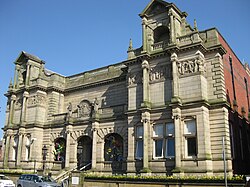
Lower Chesham, also known as Lower Chesham Hall, is a Grade II* listed historic building on Bell Lane in Bury, Greater Manchester, England. Built in 1713, it is one of the oldest surviving houses in the area and is noted for its architectural and historical significance.
Lower Chesham Hall was constructed in 1713 by Richard Kay of Baldingstone, a cousin of John Kay, the inventor of the flying shuttle—a key innovation in the textile industry during the Industrial Revolution.[1] The hall replaced an earlier timbered house known as Chesham Fold, which was demolished the same year. Some timbers from the old house were reused in the first dissenting chapel in Bury.[1]
During the 19th and early 20thcenturies, the hall was associated with Bury's growing prosperity linked to textile manufacturing. In 1920 part of the building was sold to the church and converted into St Paul's Institute Church Hall,[2] which served as a community hub with facilities for sports and parish events. Later, part of the hall facing Chesham Crescent was converted into a modern care home, and other sections of the property were also used for care facilities.[1]
On 26 May 1976, Lower Chesham was designated a Grade II* listed building.[3]
Architecture
Lower Chesham Hall is built in a 17th-century style despite its early 18th-century construction date. The structure is made of coursed squared sandstone, with mullioned and transomed windows.[4] It is three storeys in height, featuring string courses, a cornice, and a stone slab roof with coped gables topped by ball finials. Internally, the hall is reputed to contain a fine staircase, decorated plaster ceilings, and leaded mullioned stair windows.[3]
Heritage at Risk Register
In 2018 the hall was listed on Historic England's Heritage at Risk Register with its condition rated as "fair".[5] The owner proposed funding essential repairs—such as fixing chimneys, the roof, pointing, lead work, gutters, windows, and doors, along with internal redecoration to address damp and decay—through a "cross-funding" scheme involving the construction of three new homes on part of the site.[1][2] In 2025 Lower Chesham Hall was removed from the register.[6]
This page is based on this Wikipedia article Text is available under the CC BY-SA 4.0 license; additional terms may apply. Images, videos and audio are available under their respective licenses.