
Pyrrhocoridae is a family of insects with more than 300 species world-wide. Many are red coloured and are known as red bugs and some species are called cotton stainers because their feeding activities leave an indelible yellow-brownish stain on cotton crops. A common species in parts of Europe is the firebug, and its genus name Pyrrhocoris and the family name are derived from the Greek roots for fire "pyrrho-" and bug "coris". Members of this family are often confused with, but can be quickly separated from, Lygaeidae by the lack of ocelli on the top of the head.

The Lygaeidae are a family in the Hemiptera, with more than 110 genera in four subfamilies. The family is commonly referred to as seed bugs, and less commonly, milkweed bugs, or ground bugs. Many species feed on seeds, some on sap or seed pods, others are omnivores and a few, such as the wekiu bug, are insectivores. Insects in this family are distributed across the world.

Dinidoridae is a small family of hemipteran "true bugs" comprising about sixteen genera and a hundred species the Hemiptera suborder Heteroptera. As a group the family does not have any common name. Until the late 19th century they were generally regarded as a subfamily of Pentatomidae.

The Blissidae are a family in the Hemiptera, comprising nearly 50 genera and 400 species. The group has often been treated as a subfamily of the Lygaeidae but was resurrected as a full family by Thomas Henry (1997).
Ischnodemus is a genus in the true bug family Blissidae. The review by Slater (1979) listed 95 species. The genus is found in all major zoogeographic regions, being most abundant on various species of Gramineae. The bodies of the adults are moderately to very elongated. The genus name was coined to refer to this slenderness, from the Greek ἰσχνόσ (ischnos) "feeble" and δέμασ (demas) "body".

Graptostethus is a genus in the insect family Lygaeidae. Although originally restricted to the Old World some species like G. servus have spread to parts of the New World.
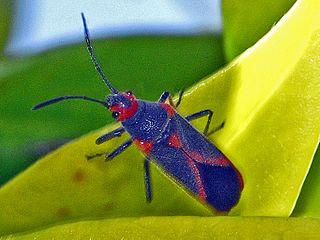
Lygaeinae is a subfamily of ground bugs in the insect family Lygaeidae.
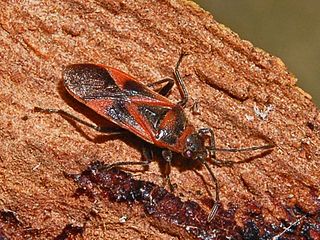
Arocatus is a genus of bugs in the family Lygaeidae.

Ochrimnus is a genus of seed bugs in the family Lygaeidae. There are more than 40 described species in Ochrimnus.

Podopinae, known as turtle bugs, are a subfamily of the insect family Pentatomidae. The type genus is Podops.

Oedancala is a genus of true bugs in the family Pachygronthidae. There are about 14 described species in Oedancala.
Pachygronthidae is a family of true bugs in the order Hemiptera. There are about 14 genera and more than 80 described species in Pachygronthidae.

Oncopeltus is a genus of seed bugs in the family Lygaeidae, which has at least 40 described species.

Melanopleurus is a genus of seed bugs in the family Lygaeidae. There are more than 20 described species in the genus Melanopleurus.
Cistalia is a genus of dirt-colored seed bugs in the family Rhyparochromidae. There are about eight described species in Cistalia.
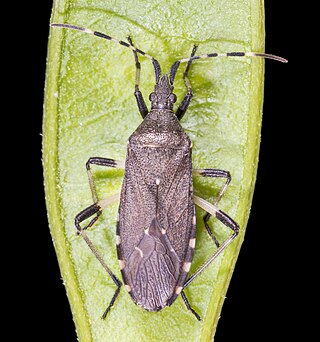
Dicranocephalus is the sole genus of true bugs in the family Stenocephalidae. There are about 30 described species in the genus Dicranocephalus.

Melacoryphus is a genus of seed bugs in the family Lygaeidae. There are about 11 described species in Melacoryphus, found in Central and North America.

Melanerythrus mactans is a species of seed bug in the family Lygaeidae, found in Australia and Pacific Islands.

Pachygrontha is a genus of seed bugs and allies in the family Pachygronthidae. There are more than 30 described species in Pachygrontha.
This page is based on this
Wikipedia article Text is available under the
CC BY-SA 4.0 license; additional terms may apply.
Images, videos and audio are available under their respective licenses.

