
Xanthidae is a family of crabs known as gorilla crabs, mud crabs, pebble crabs or rubble crabs. Xanthid crabs are often brightly coloured and are highly poisonous, containing toxins which are not destroyed by cooking and for which no antidote is known. The toxins are similar to the tetrodotoxin and saxitoxin produced by puffer fish, and may be produced by bacteria in the genus Vibrio living in symbiosis with the crabs, mostly V. alginolyticus and V. parahaemolyticus.

Macrophthalmus is a genus of crabs which are widespread across the Indo-Pacific. It contains the following species : Species in this genus are often referred to as sentinel crabs.

Geosesarma is genus of small freshwater or terrestrial crabs, typically less than 10 mm (0.4 in) across the carapace. They live and reproduce on land with the larval stages inside the egg. They are found from India, through Southeast Asia, to the Solomon Islands and Hawaii.

Pilumnoidea is a superfamily of crabs, whose members were previously included in the Xanthoidea. The three families are unified by the free articulation of all the segments of the male crab's abdomen and by the form of the gonopods. The earliest fossils assigned to this group are of Eocene age.
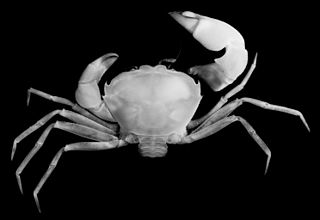
Pseudozioidea is a superfamily of crabs, formerly treated in the Eriphioidea, Carpilioidea, Xanthoidea, Pilumnoidea and Goneplacoidea. A number of fossils from the Eocene onwards are known from the family Pseudoziidae. Eleven genera are recognised in three families:

Palicoidea is a superfamily of crabs, comprising the two families Crossotonotidae and Palicidae. Together, they contain 13 genera, including two genera in the Palicidae known only from fossils. The two families were previously treated as two subfamilies in a Palicidae of wider circumscription.

Etisus is a genus of crabs, containing the following extant species:

Gelasimus vocans is a species of fiddler crab. It is found across the Indo-Pacific from the Red Sea, Zanzibar and Madagascar to Indonesia and the central Pacific Ocean. It lives in burrows up to 50 centimetres (20 in) deep. Several forms of G. vocans have been recognised, with their authors often granting them the taxonomic rank of full species or subspecies.

Epiactaea is a genus of crabs in the family Xanthidae, containing the following species:

Pilodius is a genus of crabs in the family Xanthidae, containing the following species:
Hepatoporus is a genus of crabs in the family Xanthidae, containing the following species:
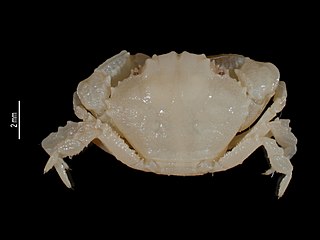
Paramedaeus is a genus of crabs in the family Xanthidae, containing the following species:
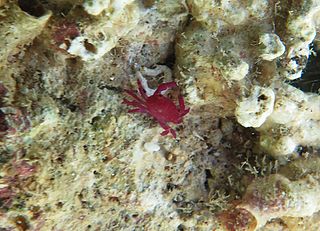
Liomera is a genus of crabs in the family Xanthidae. It contains the following species:
Epiactaeodes is a genus of crabs in the family Xanthidae, containing the following species:
Paractaeopsis quadriareolata is a species of crabs in the family Xanthidae, the only species in the genus Paractaeopsis.
Crosnierius is a genus of crabs in the family Xanthidae, containing the following species:

Demania is a genus of crabs in the family Xanthidae, containing the following species:
Lioxanthodes is a genus of crabs in the family Xanthidae, containing the following species:
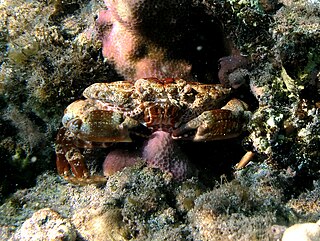
Neoxanthias is a genus of crabs in the family Xanthidae, containing the following species:

Platypodia is a genus of crabs in the family Xanthidae, containing the following species:


