Related Research Articles
The Amundsen Glacier is a major Antarctic glacier, about 7 to 11 km wide and 150 km (80 nmi) long. It originates on the Antarctic Plateau where it drains the area to the south and west of Nilsen Plateau, then descends through the Queen Maud Mountains to enter the Ross Ice Shelf just west of the MacDonald Nunataks.

The Prince Charles Mountains are a major group of mountains in Mac. Robertson Land in Antarctica, including the Athos Range, the Porthos Range, and the Aramis Range. The highest peak is Mount Menzies, with a height of 3,228 m (10,591 ft). Other prominent peaks are Mount Izabelle and Mount Stinear. These mountains, together with other scattered peaks, form an arc about 420 km (260 mi) long, extending from the vicinity of Mount Starlight in the north to Goodspeed Nunataks in the south.

Right Whale Bay is a bay 1.5 miles (2.4 km) wide, entered between Craigie Point and Nameless Point along the north coast of South Georgia Island. The bay is named for the southern right whales found in the area. South Georgia has historically been well known for whaling. The bay is linked to Morsa Bay on the island's south coast by a mountain pass called Ernesto Pass.

Church Bay is a bay 4.5 nautical miles (8 km) wide, indenting the north coast of South Georgia between Low Rock Point and Cape North. It is separated from Schlieper Bay by the Scree Gap.
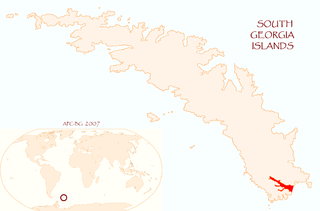
Drygalski Fjord is a bay 1 mile (1.6 km) wide which recedes northwestwards 7 miles (11 km), entered immediately north of Nattriss Head along the southeast coast of South Georgia. It was charted by the Second German Antarctic Expedition, 1911–12, under Wilhelm Filchner, and named for Professor Erich von Drygalski, the leader of the First German Antarctica Expedition, 1901–03.
Esmark Glacier is a glacier flowing into the west part of Jossac Bight on the south coast of South Georgia. It was named by the Norwegian expedition under Olaf Holtedahl, 1927–28, most likely for Jens Esmark, professor of mineralogy at the University of Kristiania (Oslo), Norway. To the northwest is Mount Cunningham.

Salisbury Plain is a broad coastal plain found with the Bay of Isles on the north coast of South Georgia. It lies between the mouths of Grace and Lucas glaciers on the southern coast of the bay, with Mount Ashley south of it. Best known as the breeding site for as many as 60,000 King penguins, its beaches are also covered with many Southern elephant seals and Antarctic fur seals.

Mollyhawk Island is a small, tussock-covered island lying between Seaward Rock and Crescent Island in the northern part of the Bay of Isles, South Georgia. It was charted in 1912–13 by Robert Cushman Murphy, an American naturalist aboard the brig Daisy. The island was surveyed in 1929–30 by Discovery Investigations personnel and named in association with Albatross Island, Prion Island and other natural history names in the Bay of Isles given by Murphy, "mollyhawk" being a name for a type of young gull.
Invisible Island is a small, tussock-covered island lying close southeast of Crescent Island and Mollyhawk Island in the Bay of Isles, South Georgia. It was charted in 1912–13 by Robert Cushman Murphy, an American naturalist aboard the brig Daisy, and was probably named by Discovery Investigations personnel who surveyed the Bay of Isles in 1929–30.
Mount Worsley is a mountain, 1,105 m, on the west side of Briggs Glacier in South Georgia. It was surveyed by the South Georgia Survey in the period 1951–57, and named by the United Kingdom Antarctic Place-Names Committee (UK-APC) for Frank Arthur Worsley (1872–1943), skipper of the Endurance on 1914-16 Imperial Trans-Antarctic Expedition. Worsley accompanied Ernest Shackleton in the James Caird from Elephant Island to King Haakon Bay, South Georgia, and made the overland crossing with him to Stromness whaling station.

Skua Island is an island immediately northeast of Prion Island in the entrance to the Bay of Isles, South Georgia. Charted in 1912-13 by Robert Cushman Murphy, American naturalist aboard the brig Daisy. Surveyed in 1929-30 by DI personnel and named in association with Albatross Island, Prion Island and other natural history names given in the Bay of Isles by Murphy in 1912–13.

Moraine Fjord is an inlet 3.5 nautical miles long with a reef extending across its entrance, forming the west head of Cumberland East Bay, South Georgia. It was charted by the Swedish Antarctic Expedition under Otto Nordenskjöld, 1901–04, who so named it because of the large glacial moraine at its entrance.
Helland Glacier is a glacier 4 nautical miles (7 km) long flowing southwest from Mount Paget to Rocky Bay, on the south side of South Georgia. It was mapped by Olaf Holtedahl during his visit to South Georgia in 1927–28, and named by him for Amund Helland, a Norwegian mining geologist and glaciologist.
Jewell Glacier is a short glacier flowing south-southwest from Mount Grant into Jossac Bight on the south coast of South Georgia. It was named by the UK Antarctic Place-Names Committee in 1982 after John A. Jewell, a British Antarctic Survey field assistant in this area in 1976–77, at Rothera Research Station in 1977–78, and Base Commander at Rothera, 1978–80.
Mount Corneliussen is a mountain, 1,540 metres (5,050 ft) high, standing 1 nautical mile (2 km) north of Mount Globus at the west end of the Allardyce Range of South Georgia. It was surveyed by the South Georgia Survey in the period 1951–57, and named by the UK Antarctic Place-Names Committee for Norwegian engineers Carl and Erling Corneliussen, who between 1923 and 1938 were responsible for improvements in whaling equipment, especially devices in connection with explosive harpoons.
Douglas Crag is a crag, 1,670 metres (5,480 ft) high, standing 1 nautical mile (2 km) southeast of Mount Macklin at the south end of the Salvesen Range of South Georgia. It was surveyed by the South Georgia Survey in the period 1951–57, and named by the UK Antarctic Place-Names Committee for George V. Douglas, a geologist with the British expedition under Ernest Shackleton, 1921–22.
Low Reef is a reef extending for 1 nautical mile (2 km) from the east end of Annenkov Island, which lies off South Georgia in the South Atlantic. The name "Low Rock" appeared on a 1931 Admiralty chart for the northeastern rock of this reef. The South Georgia Survey, 1956–57, reported that it was the reef which required a name to distinguish it from nearby Hauge Reef.
Seaward Rock is a rock close to the northeast of Mollyhawk Island, which is the northern and most seaward rock in a group of islands occupying the central part of the Bay of Isles, South Georgia.
Mount Regulator is a mountain, 655 m, standing 1 nautical mile (1.9 km) west of Right Whale Bay on the north side of South Georgia. Surveyed by the SGS in the period 1951–57, and named by the United Kingdom Antarctic Place-Names Committee (UK-APC) for the Regulator. The Regulator was an American sealing ship that was wrecked during the 1799–1800 season. The crew was rescued by an unknown British sealing ship. Captain Edmund Fanning of New York returned during the next season and found deserted shelters at Right Whale Bay, built by the crew of the Regulator before their rescue.
Pyramid Peak is a peak, 475 metres (1,558 ft) high, surmounting Cape Buller at the west side of the entrance to the Bay of Isles, South Georgia Island. It was mapped in 1902 by the Swedish Antarctic Expedition and named descriptively "Die Pyramide."
References
- ↑ "Globus, Mount". Geographic Names Information System . United States Geological Survey, United States Department of the Interior . Retrieved 26 April 2012.
 This article incorporates public domain material from "Globus, Mount". Geographic Names Information System . United States Geological Survey.
Capital: King Edward Point | |||||||
| General | |||||||
| Settlements / Whaling stations | |||||||
| South Georgia islands | |||||||
| South Sandwich Islands |
| ||||||
| Seamounts | |||||||
| Landmarks |
| ||||||

 | This South Georgia and the South Sandwich Islands location article is a stub. You can help Wikipedia by expanding it. |