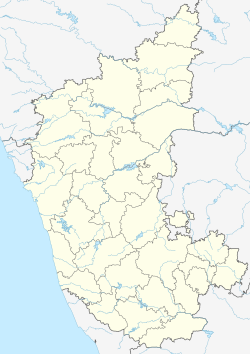
Mulki is a small town with residents belonging to different religious communities.[vague] It is situated approximately 10 km north of Suratkal. Karnad is a locality within Mulki.
Geography
Mulki has an average elevation of 7 metres above mean sea level. It is located in the Karavalli region of Karnataka, an area noted for its suitability for agriculture and industrial development. The town lies along the banks of the Shambhavi River, which originates in Kudremukh and flows into the Arabian Sea at Sasthithlu Beach.
Etymology
According to local historians, the name Mulki is derived from the word for "herb," meaning medicinal plant, a term found in both Kannada and Tulu. The name Mulike is believed to have originated from the abundance of medicinal plants in the area. Over time, Mulike is said to have evolved into Mulke and subsequently into Mulki.
Historical accounts also suggest that the present-day settlement did not exist in its current form around 400 years ago, when the course of the Shambhavi River is believed to have flowed differently through the region.
History
Present-day Karnad was historically a riverside settlement. Accounts by foreign travellers indicate that, in 1623 AD, Karnad functioned as a trading centre on the banks of the river. According to the Italian travellers Barbosa (1516 AD) and Della Valle (1623 AD), the area corresponding to present-day Mulki was inundated during that period. Over time, changes in the course of the river led to the emergence of land on which Mulki later developed.
The Savant dynasty, which ruled the region from the 14th to the 18th century, initially established its capital at Elingje. The capital was later shifted successively to Seemanthoor and then to Padupanambur, where the royal family continues to reside. The book Mulkiya Savantaru, written by folk scholar Muddu Moodubelle, documents the history of Mulki and the Savant rulers.
Historically, the region was known as Volalanke (also spelled Olalanke), a name believed to refer to its geographical character as an "island within a river," as it was once surrounded by the Shambhavi River. Subsequent shifts in the river's course connected the area to the mainland. In the 16th century, the saint and poet Kanakadasa is believed to have visited the town and renamed it Mulki. The name is variously thought to be derived either from the Kannada word moolike (meaning "herb"), reflecting the area's vegetation, or from the Urdu word mulk (meaning "land").
Mulki is also home to the historic Sri Lakshmi Venkatesha Temple, a significant religious and cultural centre in the town. The temple, locally known as SLVT, is dedicated to Lord Venkatesha, a form of Vishnu. It attracts devotees from across the region and is associated with traditional rituals, festivals, and cultural activities.
Shri Ugra Narasimha idol at Mulki
Mulki is home to the historic Shri Venkataramana Temple, which houses the idol of Shri Ugra Narasimha, a fierce manifestation of the Hindu deity Vishnu. The idol is noted for its distinctive iconography, depicting Narasimha with eight arms and three eyes, standing on one leg. In religious tradition, this form symbolises the destruction of evil and the protection of devotees.
According to traditional accounts, the idol was consecrated in 1569 CE on the day of Margashira Poornima by Srimad Vijayeendra Thirtha Swamiji, a pontiff of the Kashi Math Samsthan. The idol is believed to have been discovered in present-day Kerala, either from a well along with other images or from an ancient site near Cochin known as Varahapuram. Some legends further associate the idol with the mythological devotee Prahlada, suggesting that it was later passed down to his grandson, King Bali.
The Shri Venkataramana Temple is regarded as one of the oldest temples in the region. It is traditionally said to have been established in 1260 CE by Shri Soira Vittal Bhat with the patronage of the local Jain ruler Savanth. The temple is an important religious centre for the Goud Saraswat Brahmin community and includes shrines dedicated to several deities, including Shri Venkataramana, Shri Bindu Madhava, and Shri Ugra Narasimha.
The temple continues to attract devotees from across the region. Worship of Shri Ugra Narasimha remains a central aspect of the temple's religious life, particularly during annual festivals and special rituals.
Demographics
As of 2011[update] India census,[2] Mulki had a population of 17,274. Males constituted 48 per cent of the population and females 52 per cent. Mulki recorded an average literacy rate of 88 per cent, higher than the Karnataka state average of 75.3 per cent. Male literacy stood at 83 per cent, while female literacy was 76 per cent. Approximately 10 per cent of the population was under six years of age.
Skilled workers in Mulki are engaged in small-scale cottage industries and local businesses. Agriculture and fishing also make significant contributions to the local economy. The town has a fish market that serves as an important centre for the trade of locally caught fish.
Surfing
Mulki has emerged as a notable surfing destination in India, offering relatively uncrowded beaches and favourable surf conditions from September to early June, with a break during the monsoon season.[3][4]
Several surf clubs operate in the area, providing surfing lessons and board rentals, including Mantra Surf Club and Indica Surf Club. Many of these clubs also offer kayaking and stand-up paddleboarding in nearby estuaries. These facilities are primarily located at Sasihithlu Beach in Mulki.
Bappanadu Sri Durga Parameshwari Temple
The Bappanadu Sri Durga Parameshwari Temple is dedicated to the goddess Durga, who is worshipped here in the form of a linga. According to local tradition, the temple was established several centuries ago by a Muslim trader named Bappa, who is believed to have discovered the linga submerged in water while engaged in trade in the area. The locality is said to have derived its name from Bappa.
In keeping with this tradition, the family of Bappa Byari continues to be honoured during temple rituals. During processions involving the utsava murti, the family is presented with prasada, and they customarily offer flowers and fruits to the deity. This practice is often cited as a symbol of long-standing communal harmony in the region.
The temple is situated adjacent to NH 66 on the route to Udupi.[5]
Transportation
Mulki is located along NH 66 and State Highway 70. Express and private bus services operate regularly between Mangalore and Udupi, with Mulki serving as an intermediate stop. Bus services are also available from Mulki to nearby destinations such as Kateel, Kinnigoli, and Moodabidre.
The nearest airport is Mangalore International Airport at Bajpe, located approximately a 45-minute drive from the town. Mulki is a recognised stop for several private express bus operators.
News and information about Mulki are primarily covered by media outlets based in the nearby cities of Mangalore and Udupi. Prominent local news sources include:
7. Sthanika, B. (1992). Temples of South Kanara. Udupi: Tulu Sahitya Academy.
8. Kashi Math Samsthan. (n.d.). History of Shri Venkataramana Temple, Mulki. Retrieved from https://www.kashimath.org
9. Nayak, R. (2004). Goud Saraswat Brahmins: A Historical Overview. Mangalore: GSB Sabha Publications.
10. Rao, B.S. (2010). "Sacred Spaces of Coastal Karnataka." Journal of South Indian History, 12(1), 45–59.
11. Mulki Shri Venkataramana Temple Committee. (2019). Temple Souvenir for Annual Rathotsava. Mulki: Shri Venkataramana Temple Publication.
12. Hegde, S. (2007). "Cultural Heritage of Coastal Karnataka Temples." Karnataka Itihasa Academy Journal, 18(2), 88–93.
13. Bhat, N. (2022). "Legends of Narasimha in Tulunadu." Tulunadu Monthly Digest, Issue 47.
14. Udupi District Administration. (n.d.). Tourism in Udupi District. Retrieved from https://udupi.nic.in
15. Shenoy, P. (2020). "The Mystery of the Narasimha Idol in Mulki." Coastal Heritage Blog. Retrieved from https://coastalheritage.in/narasimha-mulki}}></7. Sthanika, B. (1992). Temples of South Kanara. Udupi: Tulu Sahitya Academy.
8. Kashi Math Samsthan. (n.d.). History of Shri Venkataramana Temple, Mulki. Retrieved from https://www.kashimath.org
9. Nayak, R. (2004). Goud Saraswat Brahmins: A Historical Overview. Mangalore: GSB Sabha Publications.
10. Rao, B.S. (2010). "Sacred Spaces of Coastal Karnataka." Journal of South Indian History, 12(1), 45–59.
11. Mulki Shri Venkataramana Temple Committee. (2019). Temple Souvenir for Annual Rathotsava. Mulki: Shri Venkataramana Temple Publication.
12. Hegde, S. (2007). "Cultural Heritage of Coastal Karnataka Temples." Karnataka Itihasa Academy Journal, 18(2), 88–93.
13. Bhat, N. (2022). "Legends of Narasimha in Tulunadu." Tulunadu Monthly Digest, Issue 47.
14. Udupi District Administration. (n.d.). Tourism in Udupi District. Retrieved from https://udupi.nic.in
15. Shenoy, P. (2020). "The Mystery of the Narasimha Idol in Mulki." Coastal Heritage Blog. Retrieved from https://coastalheritage.in/narasimha-mulki}}7. Sthanika, B. (1992). Temples of South Kanara. Udupi: Tulu Sahitya Academy.
8. Kashi Math Samsthan. (n.d.). History of Shri Venkataramana Temple, Mulki. Retrieved from https://www.kashimath.org
9. Nayak, R. (2004). Goud Saraswat Brahmins: A Historical Overview. Mangalore: GSB Sabha Publications.
10. Rao, B.S. (2010). "Sacred Spaces of Coastal Karnataka." Journal of South Indian History, 12(1), 45–59.
11. Mulki Shri Venkataramana Temple Committee. (2019). Temple Souvenir for Annual Rathotsava. Mulki: Shri Venkataramana Temple Publication.
12. Hegde, S. (2007). "Cultural Heritage of Coastal Karnataka Temples." Karnataka Itihasa Academy Journal, 18(2), 88–93.
13. Bhat, N. (2022). "Legends of Narasimha in Tulunadu." Tulunadu Monthly Digest, Issue 47.
14. Udupi District Administration. (n.d.). Tourism in Udupi District. Retrieved from https://udupi.nic.in
This page is based on this Wikipedia article Text is available under the CC BY-SA 4.0 license; additional terms may apply. Images, videos and audio are available under their respective licenses.



 India
India 
