
Herpetology is a branch of zoology concerned with the study of amphibians and reptiles. Birds, which are cladistically included within Reptilia, are traditionally excluded here; the separate scientific study of birds is the subject of ornithology.
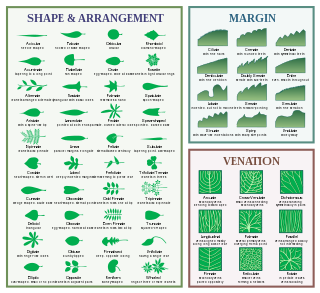
Dendrology or xylology is the science and study of woody plants, specifically, their taxonomic classifications. There is no sharp boundary between plant taxonomy and dendrology; woody plants not only belong to many different plant families, but these families may be made up of both woody and non-woody members. Some families include only a few woody species. Dendrology, as a discipline of industrial forestry, tends to focus on identification of economically useful woody plants and their taxonomic interrelationships. As an academic course of study, dendrology will include all woody plants, native and non-native, that occur in a region. A related discipline is the study of sylvics, which focuses on the autecology of genera and species.

Pauropoda is a class of small, pale, millipede-like arthropods in the subphylum Myriapoda. More than 900 species in twelve families are found worldwide, living in soil and leaf mold. Pauropods look like centipedes or millipedes and may be a sister group of the latter, but a close relationship with Symphyla has also been posited. The name Pauropoda derives from the Greek pauros and pous or podus, because most species in this class have only nine pairs of legs as adults, a smaller number than those found among adults in any other class of myriapods.

The hooked squid, family Onychoteuthidae, currently comprise about 20–25 species, in six or seven genera. They range in mature mantle length from 7 cm to a suggested length of 2 m for the largest member, Onykia robusta. The family is characterised by the presence of hooks only on the tentacular clubs, a simple, straight, funnel–mantle locking apparatus, and a 'step' inside the jaw angle of the lower beak. With the exception of the Arctic Ocean, the family is found worldwide.

Onychoteuthis banksii, the common clubhook squid, is a species of squid in the family Onychoteuthidae. It is the type species of the genus Onychoteuthis. This species was thought to have a worldwide distribution but with the revision of the genus Onychoteuthis in 2010, it is now accepted that Onychoteuthis banksii is restricted to the central and northern Atlantic and the Gulf of Mexico while a recently described species, Onychoteuthis horstkottei, is found in the Pacific Ocean. The type locality is the Gulf of Guinea.
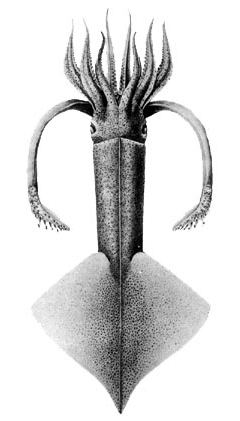
Onychoteuthis is a genus of squid in the family Onychoteuthidae. The type species is Onychoteuthis bergii. While the genus is found worldwide in tropical and subtropical oceans, they can also occur in the North Pacific Ocean. There were previously considered to be four species in the genus but there are now considered to be roughly 10. These squid are frequently observed in the surface waters at night and they are often caught using dipnet at nightlight stations. The young squid are usually the only specimens captured using standard midwater trawls, the older squid are apparently able to avoid the trawls. They can, however be collected from the air as individuals are able to leap high out of the water, sometimes even landing on the deck of a ship.

Onychoteuthis borealijaponica, the boreal clubhook squid, is a species of squid in the family Onychoteuthidae. It is the largest member of the genus Onychoteuthis, reaching a mantle length of 30 cm in males and 37 cm in females. Maturity is reached at 250 mm for males, and 300–350 mm in females. There are 24–27 hooks on each club, which is more than any other species in the genus Onychoteuthis. It is a pelagic species native to the North Pacific, although it migrates into Subarctic waters during the summer from its more southerly winter spawning grounds.

Phragmoteuthis is a genus of extinct coleoid cephalopod known from the late Triassic to the lower Jurassic. Its soft tissue has been preserved; some specimens contain intact ink sacs. It had an internal phragmocone and ten arms.

Betacoronavirus gravedinis is a species of coronavirus which infects humans and cattle. The infecting virus is an enveloped, positive-sense, single-stranded RNA virus and is a member of the genus Betacoronavirus and subgenus Embecovirus. Like other embecoviruses, it has an additional shorter spike-like surface protein called hemagglutinin esterase (HE) as well as the larger coronavirus spike protein.

Geophilidae is a family of soil centipedes in the superfamily Geophiloidea and the order Geophilomorpha. In 2014, a phylogenetic analysis based on morphological and molecular data found this family to be polyphyletic. To avoid this polyphyly, authorities dismissed the families Aphilodontidae, Dignathodontidae, Linotaeniidae, and Macronicophilidae, which are now deemed to be junior synonyms for Geophilidae. Authorities also moved some genera from Geophilidae to form the family Zelanophildae in order to avoid the polyphyly of the family Geophilidae. The family Geophilidae now includes more than 650 species in more than 120 genera. This family has a cosmopolitan distribution, with species found almost worldwide.
Yingvirus is a genus of negative-strand RNA viruses which infect invertebrates. Member viruses have bisegmented genomes. It is the only genus in the family Qinviridae, which is the only family in Muvirales, which is the only order in Chunqiuviricetes. There are eight species in the genus.
Onychoteuthis horstkottei is a species of squid in the family Onychoteuthidae. The species is endemic to the Pacific Ocean.
Onychoteuthis prolata is a species of squid in the family Onychoteuthidae. They can be found in the Eastern Pacific Ocean off the coast of Hawaii, and can grow to 15.5 centimeters in length.

Walvisteuthis youngorum is a species of squid from the family Onychoteuthidae. They can be found off of the northern Hawaiian Islands. They are rarely seen due to the depth that they reside in, and have only been filmed once, in 2015.
Enoploteuthis jonesi is a species of squid from the family Enoploteuthidae. The species is gonochoric and can be found in the Pacific Ocean.
Enoploteuthis higginsi is a species of squid from the family Enoploteuthidae. The species is gonochoric, and can be found in the Eastern Pacific Ocean.
Enoploteuthis obliqua is a species of squid from the family Enoploteuthidae. The species is rarely documented, but has been observed in the North Pacific Ocean.
Enoploteuthis galaxias is a species of squid from the family Enoploteuthidae. The species has been observed in the North Pacific Ocean.

Sepia lorigera, also known as the spider cuttlefish, is a species of cuttlefish in the family Sepiidae. The species has been observed from off the coasts of Japan and Vietnam, and adults can reach a maximum size of ~25 centimeters. Members of the species are gonochoric.
Photonectes dinema is a species of deep-sea fish in the genus Photonectes. The species has been observed in the Atlantic Ocean, and adults can reach a maximum length of ~25 centimeters.


