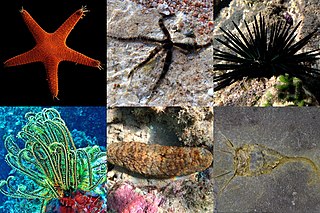
An echinoderm is any animal of the phylum Echinodermata, which includes starfish, brittle stars, sea urchins, sand dollars and sea cucumbers, as well as the sessile sea lilies or "stone lilies". While bilaterally symmetrical as larvae, as adults echinoderms are recognisable by their usually five-pointed radial symmetry, and are found on the sea bed at every ocean depth from the intertidal zone to the abyssal zone. The phylum contains about 7,600 living species, making it the second-largest group of deuterostomes after the chordates, as well as the largest marine-only phylum. The first definitive echinoderms appeared near the start of the Cambrian.

Brittle stars, serpent stars, or ophiuroids are echinoderms in the class Ophiuroidea, closely related to starfish. They crawl across the sea floor using their flexible arms for locomotion. The ophiuroids generally have five long, slender, whip-like arms which may reach up to 60 cm (24 in) in length on the largest specimens.

Amphiuridae are a large family of brittle stars of the suborder Gnathophiurina. Some species are used to study echinoderm development and bioluminescence.
Ophiocanops fugiens is a living species in the brittle star family Ophiocanopidae. Though once considered to be the only one living species in this brittle star family, recent research has brought to light three specimens of Ophiocanops that differ substantially from O. fugiens. It has been regarded as the most primitive brittle star, close to Paleozoic forms, though other authors have disagreed with the view. Classification of O. fugiens is highly argued. Ophiocanops is usually placed in the order Oegophiurida or regarded as a genus incertae sedis or even given its own subclass Oegophiuridea. Some recent data suggest its relationship to the extant family Ophiomyxidae.

Ophionereididae are a family of brittle stars.
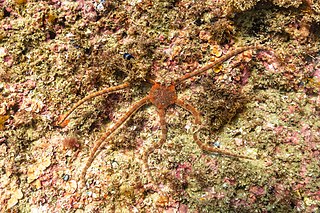
Ophioderma is a genus of brittle stars in the family Ophiodermatidae. Research on the Ophiuroid rubicundum species has discovered the creatures oppurtunistic behaviors and ability to adapt in the circumstances of a new given environment. Alongside their high adaptability, their strong feeding responses allow them to thrive in the depths of the coral reefs seen in the western Atlantic.
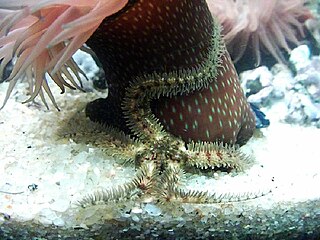
Ophiothrix fragilis is a species of brittle star in the order Ophiurida. It is found around the coasts of western Europe and is known in Britain as the common brittle star. It is also found along the coast of South Africa where it is known as the hairy brittle star.

Ophiocoma scolopendrina is a species of brittle star belonging to the family Ophiocomidae. Restricted to life in the intertidal, they live in the Indo-Pacific. They can typically be found within crevices or beneath borders on intertidal reef platforms. Unlike other Ophiocoma brittle stars, they are known for their unique way of surface-film feeding, using their arms to sweep the sea surface and trap food. Regeneration of their arms are a vital component of their physiology, allowing them to efficiently surface-film feed. These stars also have the ability to reproduce throughout the year, and have been known to have symbiotic relationships with other organisms.
Ophionereis reticulata, the reticulated brittle star, is a brittle star in the family Ophionereididae. It is found in shallow parts of the western Atlantic, Caribbean Sea and Gulf of Mexico.

Amphipholis squamata, common names brooding snake star and dwarf brittle star, is a species complex of brittle stars in the family Amphiuridae.

Ophiactis savignyi is a species of brittle star in the family Ophiactidae, commonly known as Savigny's brittle star or the little brittle star. It occurs in the tropical and subtropical parts of all the world's oceans and is thought to be the brittle star with the most widespread distribution. It was first described by the German zoologists Johannes Peter Müller and Franz Hermann Troschel in 1842. The specific name honours the French zoologist Marie Jules César Savigny.

Ophiopholis aculeata, the crevice brittle star or daisy brittle star, is a species of brittle star in the family Ophiactidae. It has a circum-polar distribution and is found in the Arctic Ocean, the northern Atlantic Ocean and the northern Pacific.

Ophionereis schayeri, Schayer's brittle star, is a brittle star in the family Ophionereididae.
Ailsa McGown Clark (1926–2014) was a British zoologist, who principally studied echinoderms and was a specialist on asteroidea. She worked at the Natural History Museum for most of her career.

Ophiomastix wendtii, also known by its common name, the red ophiocoma, and formerly as Ophiocoma wendtii, is a species of brittle stars that inhabits coral reefs from Bermuda to Brazil, primarily in the Caribbean sea. These brittle stars have long, thin arms emanating from a small, disk-shaped body, and club-like spines along its arms. They are about the size of an outstretched human hand.
Ophionereis is a genus of echinoderms belonging to the family Ophionereididae.
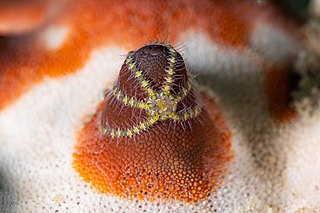
Ophiothela mirabilis is a species of ophiuroid brittle star within the family Ophiotrichidae. O. mirabilis is an epizoic species which have a non-parasitic relationship with host sponges or gorgonians. Although native to the Pacific Ocean, it has invaded the Caribbean and southwestern Atlantic since late 2000. Many of its characteristics, including reproduction and diet, allow O. mirabilis opportunities to quickly propagate and spread through habitats.

Ophionereis annulata, commonly known as the banded brittle star, is a species of brittle star in the family Ophionereididae.


