
Papilio alcmenor, the redbreast, is a species of swallowtail butterfly found in South Asia.

Byasa polyeuctes, the common windmill, is the most common member in India of the windmills genus (Byasa), comprising tailed black swallowtail butterflies with white spots and red submarginal crescents.
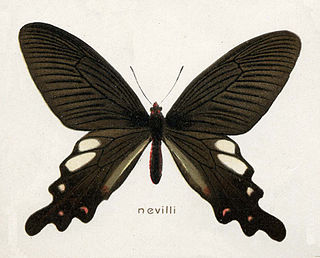
Byasa nevilli, the Nevill's windmill, is a butterfly found in India that belongs to the windmills genus (Byasa), comprising tailed black swallowtail butterflies with white spots and red submarginal crescents.

Papilio nephelus is a species of swallowtail butterfly belonging to the family Papilionidae. Subspecies include P. n. chaon, the yellow Helen, and P. n. sunatus, the black and white Helen.
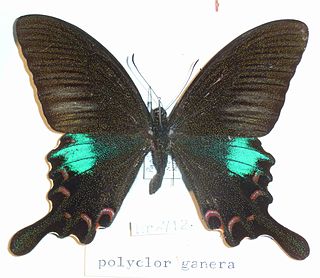
Papilio polyctor, the common peacock, is a swallowtail butterfly found in the Indian subcontinent. It is found in the Himalayas and parts of India from the foothills to 7,000 feet (2,100 m) between March and October. It has distinct dry- and wet-season forms. The butterfly frequents Buddleia flowers. Its food plant is Zanthoxylum alatum of the family Rutaceae. Papilio polyctor has three subspecies, consisting of Papilio polyctor significans, Papilio polyctor stockleyi, and Papilio polyctor xiei.
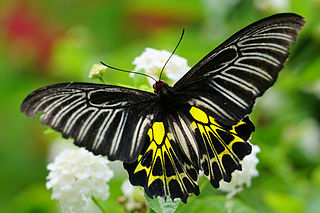
Troides aeacus, the golden birdwing, is a large tropical butterfly belonging to the swallowtail family, Papilionidae.

Meandrusa sciron, the brown gorgon, is a species of swallowtail butterfly found in parts of South Asia and Southeast Asia. It belongs to the hooked swallowtails genus, Meandrusa, of the family Papilionidae. The brown gorgon is found in India from Sikkim to Assam and north Burma and is not considered to be threatened. Though not uncommon, it is protected under Indian law under the name gyas.

Losaria coon, the common clubtail, is a butterfly belonging to the swallowtail family, Papilionidae. The butterfly belongs to the clubtails, genus Losaria. It includes several subspecies and is found from the Nicobar Islands and Assam in India, east to Hainan in China, and south through Indochina, to Java and other islands of Indonesia and Bangladesh.

Papilio (Chilasa) epycides, the lesser mime, is a swallowtail butterfly found in India and parts of South-East Asia. The butterfly belongs to the mime (Chilasa) subgenus or the black-bodied swallowtails. It is a mimic of a common Indian Danainae, the glassy tiger butterfly.

Byasa latreillei, the rose windmill, is a butterfly from the windmills genus (Byasa), found in various parts of Asia, comprising tailed black swallowtail butterflies with white spots and red submarginal crescents.
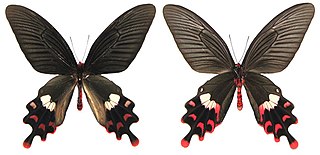
Byasa polla, the De Nicéville's windmill, is a butterfly found in India that belongs to the windmills genus (Byasa), comprising tailed black swallowtail butterflies with white spots and red submarginal crescents.

Parnassius stoliczkanus, the Ladakh banded Apollo, is a rare high-altitude butterfly which is found in Central Asia. It is a member of the snow Apollo genus (Parnassius) of the swallowtail family. It is named after the naturalist and explorer Ferdinand Stoliczka.

Parnassius delphius, the banded Apollo, is a high-altitude butterfly which is found in Central Asia. It is a member of the genus Parnassius of the swallowtail family, Papilionidae.

Parnassius charltonius, the regal Apollo, is a high-altitude butterfly which is found in India. It is a member of the snow Apollo genus (Parnassius) of the swallowtail family (Papilionidae). This handsome butterfly is found at altitudes from 9,000 to 13,000 feet from Chitral to Kumaon.

Parnassius acco, the varnished Apollo, is a high-altitude butterfly found in Asia. It is a member of the snow Apollo genus Parnassius of the swallowtail family, Papilionidae.

Parnassius hannyngtoni, the Hannyngton's Apollo, is a high-altitude butterfly which is found in India. It is a member of the snow Apollo genus (Parnassius) of the swallowtail family (Papilionidae). Some sources also spell the name as P. hunnygtoni. It is named after Frank Hannyngton who obtained the specimen from the Chumbi Valley.

Parnassius simo, the black-edged Apollo, is a high-altitude butterfly found in the Himalayas which belongs to the Papilionidae (swallowtail) family.

Parnassius hardwickii, the common blue Apollo, is a high-altitude butterfly which is found in South Asia. It is a member of the snow Apollo genus (Parnassius) of the swallowtail family (Papilionidae). This butterfly is found from the Chitral District to Sikkim and is found from 6,000 to 17,000 feet, making it one of the most commonly encountered species of Apollo in the Indian subcontinent.

Parnassius jacquemontii, the keeled Apollo, is a high altitude butterfly which is found in India and Pakistan. It is a member of the snow Apollo genus (Parnassius) of the swallowtail family (Papilionidae). It is also fairly common at high altitudes from Chitral to Kumaon.

Parnassius epaphus, the common red Apollo, is a high altitude butterfly which is found in India and Nepal. It is a member of the snow Apollo genus (Parnassius) of the swallowtail family (Papilionidae). It is found from 9,000 to 13,000 feet from Chitral District to Sikkim and western regions of Nepal. It is not considered rare.


