
A Commentary on the Sixth Edition UNIX Operating System by John Lions is a highly influential 1976 publication containing analytical commentary on the source code of the 6th Edition Unix computer operating system "resident nucleus" software, plus copy formatted and indexed by Lions, of said source code obtained from the authors at AT&T Bell Labs.
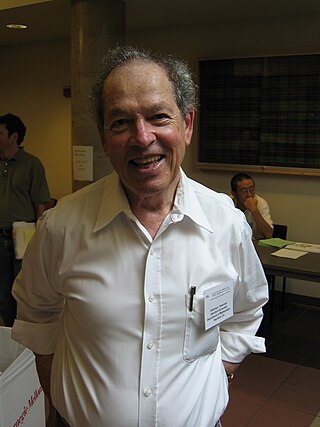
Solomon Feferman was an American philosopher and mathematician who worked in mathematical logic. In addition to his prolific technical work in proof theory, computability theory, and set theory, he was known for his contributions to the history of logic and as a vocal proponent of the philosophy of mathematics known as predicativism, notably from an anti-platonist stance.
E. Ann Matter is former Associate Dean for Arts & Letters and Professor of Religious Studies Emerita at the University of Pennsylvania. She specializes in Medieval Christianity, including mysticism, women and religion, sexuality and religion, manuscript and textual studies, biblical interpretation and sacred music.
Ruth Vanita is an Indian academic, activist and author who specialises in British and Indian literary history with a focus on gender and sexuality studies. She also teaches and writes on Hindu philosophy.
Richard E. Foglesong is an American historian and political scientist who focuses on Florida and U.S. politics, New Urbanism and the politics of urban development, Hispanic politics, and the history of Walt Disney World and the Reedy Creek Improvement District. He is the George and Harriet Cornell Professor of Politics, Emeritus at Rollins College.
Gregory David Shelton Anderson is an American linguist specializing in languages of Siberia, Munda languages, and auxiliary verbs. Anderson earned his doctorate in linguistics from the University of Chicago in 2000, and is currently director of the Living Tongues Institute for Endangered Languages. He was featured in the documentary film The Linguists.

M. A. Rafey Habib is an academic humanities scholar and poet.
Alan Jacobs is a scholar of English literature and a literary critic. He is a distinguished professor of the humanities in the honors program of Baylor University.

William Washabaugh is Professor Emeritus of anthropology at the University of Wisconsin–Milwaukee. He has pursued studies of Creole languages, Sign languages of the Deaf, flamenco artistry, sport fishing, and cinema.
Raymond H. Thompson is a Canadian scholar of medieval literature specializing in King Arthur and the Matter of Britain, and in the reinterpretation of this material in modern literature. He is a professor emeritus in the Department of English at Acadia University in Canada.
Bonnie Costello is an American literary scholar, currently the William Fairfield Warren Distinguished Professor of English at Boston University. Her books include works on the poets Marianne Moore, Elizabeth Bishop, and W. H. Auden, and the relation of visual art to poetry through landscape painting and still life.
John Andrew Frey was an American philologist.
Jon C. Teaford is professor emeritus in the History Department at Purdue University. He specializes in American urban history and early on in his career he specialized in legal history.
Sherman Kopald Stein is an American mathematician and an author of mathematics textbooks. He is a professor emeritus at the University of California, Davis. His writings have won the Lester R. Ford Award and the Beckenbach Book Prize.
Anita Burdman Feferman was an American historian of mathematics and biographer, known for her biographies of Jean van Heijenoort and of Alfred Tarski.
Elizabeth Dore (1946-2022) was a professor of Latin American Studies, specialising in class, race, gender and ethnicity, with a focus on modern history. She was professor emerita of Modern Languages and Linguistics at the University of Southampton, and had a PhD from Columbia University.
Thomas Shelburne Ferguson is an American mathematician and statistician. He is a professor emeritus of mathematics and statistics at the University of California, Los Angeles.
Judith Veronica Field is a British historian of science with interests in mathematics and the impact of science in art, an honorary visiting research fellow in the Department of History of Art of Birkbeck, University of London, former president of the British Society for the History of Mathematics, and president of the Leonardo da Vinci Society.
Erna Lesky was an Austrian pediatrician and historian of medicine. She was the first woman on the medical faculty of the University of Vienna, and was named as "one of the most illustrious medical historians of the twentieth century" by Owen Harding Wangensteen.
Stephen H. Rapp Jr is an American professor and scholar of history, with a focus and primary research investigating the Roman Empire, ancient Iran, Armenia and Georgia. He is a professor of history at Sam Houston State University.


