Cavillator is a monotypic genus of Zimbabwean jumping spiders containing the single species, Cavillator longipes. It was first described by Wanda Wesołowska in 2000, and is only found in Zimbabwe.
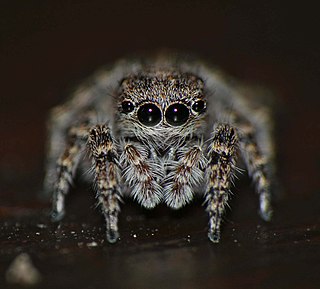
Langelurillus is a spider genus of the family Salticidae. All the described species occur only in Africa.

Langona is a genus of spiders in the family Salticidae. Langona species are similar to those of the genus Aelurillus. In 2015, it was listed in the subtribe Aelurillina. The subtribe is allocated to the tribe Aelurillini in the clade Saltafresia. In 2017, it was grouped with nine other genera of jumping spiders under the name Aelurillines.
Pignus is a genus of African jumping spiders that was first described by Wanda Wesołowska in 2000. As of August 2019 it contains only three species, found only in Africa: P. lautissimum, P. pongola, and P. simoni.

Stenaelurillus is a genus of jumping spiders that was first described by Eugène Louis Simon in 1886. Most species live in Africa, with some species found in Asia, including China. All species have two white longitudinal stripes on the carapace, and both sexes show strong bristles around the eyes. The name is a combination of the Greek sten- "narrow" and the salticid genus Aelurillus.
Pignus simoni is a species of jumping spider in the genus Pignus. It is native to South Africa.

Wanda Wesołowska is a Polish zoologist known for her work with jumping spiders. She has described more species of jumping spider than any contemporary writer, and is second only to Eugène Simon in the history of arachnology. Originally a student of ornithology, she developed an interest in jumping spiders while still a student at the Siedlce University of Natural Sciences and Humanities in the 1970s.

Langona mediocris is a species of jumping spider in the genus Langona that lives in Zimbabwe. The male was first described by Wanda Wesołowska in 2000. The female has not been identified. The spider is large and brown-black with a carapace between 3 and 3.4 mm long and a abdomen between 2.7 and 3.1 mm. The carapace has two converging white stripes while the abdomen has a single stripe. The legs are orange and the pedipalps yellow. As is typical for the genus, the chelicerae are toothless. The long, thin embolus is hidden within a pocket in the cymbium and has a spiralled tip. The male differs from the similar Langona bitumorata by the single bump on its palpal bulb.
Mogrus ignarus is a species of jumping spider in the genus Mogrus that is endemic to Zimbabwe. The spider was first defined in 2000 by the Polish arachnologist Wanda Wesołowska. It has a dark brown carapace that is between 2.6 and 2.8 mm and has two white stripes on the back and a white abdomen that is between 2.6 and 3.0 mm long and a large brown stripe that takes up one third of its back. The spider has brownish legs with long brown spines and hairs. It is similar to other Mogrus spiders. The male has a distinctive membrane and appendage at the base of its embolus on the palpal bulb which distinguishes its from other species in the genus. The female has not been described.

Afraflacilla altera is a species of jumping spider in the genus Afraflacilla that lives in South Africa and Zimbabwe. The spider was first described in 2000 by Wanda Wesołowska and originally allocated to the genus Pseudicius. It was moved to its current name by Jerzy Prószyński in 2016. The spider is small, with an elongated carapace and abdomen that are between 1.6 and 17 mm and between 2.1 and 2.6 mm long respectively. The male and female are similar in size and shape, although the female is generally lighter. They have a similar pattern of three white dots on each side of the brown abdomen. The spider is superficially almost indistinguishable from other species in the genus, particularly Afraflacilla karinae and Afraflacilla venustula. It can be best differentiated by its copulatory organs, particularly the shape of the male tibial apophyses, or appendages, and the arrangement of pouches and openings on the female epigyne.
Pignus pongola is a species of jumping spider in the genus Pignus that lives in South Africa. The species was first described in 2009 by Wanda Wesołowska and Charles Haddad. It thrives in Mediterranean forests, woodlands, and scrub, including forest near rivers and coasts like fynbos. The spider is medium-sized, with a carapace that measures typically 3.6 mm (0.14 in) long and an abdomen 3.4 mm (0.13 in) long. It has a pattern similar to members of the Philaeus genus, to which Pignus is related. The most mouthparts are distinctive. While the chelicerae are similar in some respects to other species in the genus, they have a unique shape, being particularly large with a single long fang. The male's copulatory organs are also unusual. The palpal bulb has an unusually shaped tegulum, out of which extends a long thin embolus that curves up the bulb to its end. The female has not been described.
Pellenes bulawayoensis is a jumping spider species in the genus Pellenes that lives in Lesotho, South Africa and Zimbabwe. The male was first identified by Wanda Wesołowska in 2000 and the female in 2011.
Habrocestum formosum is a jumping spider species in the genus Habrocestum that lives in Zimbabwe. It was first described by Wanda Wesołowska in 2000.
Habrocestum superbum is a jumping spider species in the genus Habrocestum that lives in Zimbabwe. It was first described by Wanda Wesołowska in 2000.
Langelurillus ignorabilis is a species of jumping spider in the genus Langelurillus that lives in Zimbabwe. The female was first described in 2008 by Wanda Wesołowska and Meg Cumming based on an example discovered with ten spiderlings. The male has not been identified. The spider is small with a dark brown carapace 2.7 mm (0.11 in) long and a brownish-grey abdomen 3.0 mm (0.12 in) long. It has short yellow legs. The species is similar to others in its genus and also member of the genus Langona, but differs in the design of the copulatory organs. For example, the seminal ducts are longer and have more loops than Langona bethae.

Langelurillus minutus is a species of jumping spider in the genus Langelurillus that lives in Namibia and Zimbabwe. It was first described in 2011 by Wanda Wesołowska and Meg Cumming. The spider is small, with a cephalothorax that is between 1.8 and 2.3 mm long and an abdomen between 1.5 and 3.9 mm long. The male is noticeably smaller than the female, which is reflected in the species name. The species is generally brown, but has indistinct patches on its abdomen and orange or orange-yellow legs. The male has a very convex palpal bulb and the female an epigyne with a large pocket and compact multi-chambered receptacles.
Thyenula sempiterna is a jumping spider species in the genus Thyenula that lives in Zimbabwe and South Africa. The female was first described in 2000 and the male in 2014.
Dendryphantes rafalskii is a jumping spider in the genus Dendryphantes that lives in South Africa and Zimbabwe. The species was first described by Wanda Wesołowska in 2000.
Parajotus refulgens is a jumping spider species in the genus Parajotus that lives in Botswana, Democratic Republic of the Congo, Nigeria and Zimbabwe. The species was first identified by Wanda Wesołowska in 2000.
Xuriella prima is the type species of jumping spider in the genus Xuriella first described in 2000 by Wanda Wesołowska and Anthony Russell-Smith. First discovered in Tanzania, it has also been identified in South Africa and Zimbabwe.

