19 September 1983 (1983-09-19)– 11 March 1988 (1988-03-11)
Play School is a British children's television series produced by the BBC which ran from 21 April 1964 until 11 March 1988. It was created by Joy Whitby and was aimed at preschool children.[1] Each programme followed a broad theme and consisted of songs, stories and activities with presenters in the studio, along with a short film introduced through either the square, round or arched window in the set.
The programme spawned numerous spin-offs in Britain and other countries and involved many presenters and musicians during its run. Despite a revamp in 1983, Play School maintained the same basic formula throughout its 24-year history, but changes to the BBC's children's output led to the programme's cancellation in 1988, when it was replaced by Playbus, which soon became Playdays.
Broadcast history
Play School was the first programme shown on BBC2's launch day.[2] It originally appeared on weekdays at 11am on BBC2 and received holiday runs on BBC1 in Summer 1964 and 1965, later acquiring a mid-afternoon BBC1 repeat as the opening programme of BBC1's teatime children's schedule. The morning showing was transferred to BBC1 on 19 September 1983 when BBC Schools programming transferred to BBC2, and was shown 30 minutes earlier, at 10.30am. It remained in that slot after daytime television was launched in October 1986 and continued to be broadcast at that time until the programme ended in October 1988.
When the BBC scrapped the afternoon edition of Play School in April 1985 to make way for new programmes in that slot, a Sunday morning compilation was launched called Hello Again!. This came seven months after the programme's length was reduced from 25 minutes to 20 minutes.
There were several opening sequences for Play School during its run, the first being "Here's a house, here's a door. Windows: 1 2 3 4. Ready to knock? Turn the lock – It's Play School". This changed in the early 1970s to "A house – with a door. 1, 2, 3, 4. Ready to play? What's the day? It's..." In this version blinds opened on the windows as the numbers were spoken.
The blinds were no longer featured towards the end of the 1970s and the word "windows" was added before "1 2 3 4". The final opening sequence involved a multicoloured house with no apparent windows. This was used from 1983 until the end of the programme. This saw the most radical revamp of the programme overall (not just in the opening titles). The opening legend then became "Get ready. To play. What's the day? It's...".
A section of each episode was a filmed excursion into the outside world taken through one of three windows: the young viewers were invited to guess whether the round, square, or arched window would be chosen that day, usually by means of the phrase, "...Have a look – through the....(whichever) window". A triangular window was added in 1983. Very often the film would be of a factory producing something such as chocolate biscuits, or of a domestic industry such as refuse collection, but a number of subject matters were covered, such as watching animals or fish, boats on a lake, children in a playground or at school, a family going tenpin bowling, people in a café and visiting a jumble sale, among other things.
At the beginning of the 1983 revamp, the windows were now referred to as "shapes" as in "let's have a look through one of the shapes...". After the shapes were moved to a spinning disc, the programme went back to using windows which resembled those used in the late 70s, albeit with the addition of the triangular window. Whenever they were shown now, only the window that the show was using for the day would be on the set.
Each episode would also include a short story read from a book, introduced by checking the time on a clock. Normally the clock would show either an hour or a half hour and the young viewers were asked, "Can you tell what time the clock says today? Well, the long hand is pointing straight up, so that means it's something o'clock – and the short hand is pointing to the number...two (or whatever). So today, the clock says, two...o'...clock" (the latter phrase always delivered very slowly). This was followed by, "But what's underneath the clock?", and viewers would then see a turntable under the clock featuring certain items such as toy animals or clocks, which were, in a clever twist, always a clue to the forthcoming story. This was all accompanied by a slightly eerie, yet undeniably catchy, clock-like tune. (On one occasion, the item under the clock turned out to be none other than Little Ted, so the presenter concerned said, "What a very odd place for a toy to be!" and the story appropriately turned out to be about odd things.)
Both the clock and the three window option live on in the children's programme Tikkabilla, which borrows much from Play School, while a similar choice of portal into a film clip was provided by the abdomen-mounted video displays in the children's show Teletubbies.
Most of the programmes were studio-based, but there were a number of outside broadcasts at a variety of locations, such as zoos, seasides, central London, churches, schools and farms.
There would also be songs, games, poems and stories, as well as regular painting and craft activities. The presenters would frequently invite the younger viewers to participate at home, usually by means of the prompt, 'Can you do that?' They normally signed off at the end of each episode by saying, "Time for us to go now, but only until tomorrow, so goodbye until tomorrow" – or, at the end of a week, "Goodbye, until it's our turn to be here again". (The latter phrase stemmed from the fact that the presenters changed from one week to the next.)
From 1971 to 1984, Play School also had a sister programme called Play Away.
Many 2 inch Quadruplex videotape master copies of Play School editions were wiped by the BBC in 1993 on the assumption that they were of no further use and that only a small number of episodes needed to be retained in the archive.[5] As a result 3664 went missing.[6]
On 14 October 2024, the Film Is Fabulous project announced that they had recovered an episode of the show, namely the black-and-white episode first broadcast on 12 August 1965, with presenters Marian Diamond and Rick Jones.[7] the recovery of the episode is aptly timed as the show was celebrating its 60th anniversary. This brought the number of episodes missing down to 3663.
Overseas sales and adoption
Don Spencer, who appeared on the original British version and also on the Australian adaptation
Play School was sold to Australia, and was then followed by local production. The Australian version has been produced since 1966, and is the only version still in production. Similarly New Zealand bought the programme before producing their own from 1972 to 1982 & 1986 to 1989. The Canadian adaptation was Polka Dot Door and ran from 1971 to 1993.
Other countries including Lekestue in Norway (1971–81), Das Spielhaus in Switzerland (1968–1994), Das Kleine Haus in Austria (1969–1975), Giocagiò in Italy (1966–1970), La Casa Del Reloj in Spain (1971–74), and Israel were provided with scripts and film segments so they could produce their own versions.[8]
Presenters
The first show was presented by Virginia Stride and Gordon Rollings. Other presenters throughout the 24-year run included
Many musicians worked on the programme over the years: they included Jonathan Cohen, William Blezard, Peter Gosling, Alan Grahame, Paul Reade, Spike Heatley, Alan Rushton, Pedro Goble, Anne Dudley, John Gould, Martin Yates, Peter Pontzen and Peter Pettinger. Some of them, in particular Cohen, Gosling, Grahame and Reade, occasionally appeared on camera, especially during Christmas editions.[9]
Toys
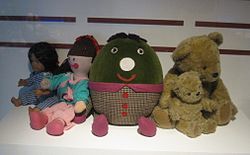
The presenters were accompanied by a supporting cast of cuddly toys and dolls. The five regulars were:
Humpty, a dark green large egg-shaped soft toy with tweed trousers, to look like Humpty Dumpty from the nursery rhyme, as he was the first Play School toy introduced, since the first programme on 21 April 1964. Several versions were made.
Teddy/Big Ted and Little Ted, twin teddy bears. Little Ted debuted in 1968. Before this, Big Ted was called "Teddy".
Jemima, a rag doll with long red (or pink) and white striped legs.
Hamble was a little doll and one of the original five toys but dropped from the show during the 1980s to be replaced by Poppy. According to Joy Whitby, creator of Play School, Hamble was chosen as representative of a more "downtrodden", humble background than the "middle-class" associations that the teddy bears had.[11] She was disliked by presenters as she could not be cuddled.[12] According to the BBC website Chloe Ashcroft "did a terrible thing to Hamble. She just would not sit up...so one day I got a very big knitting needle, a big wooden one, and I stuck it right up her bum, as far as her head. So she was completely rigid, and she was much much better after that".[12]
Poppy, a black doll, replaced Hamble in November 1986 in response to changing attitudes in society (the Hamble doll was also getting rather fragile at this point).
A rocking horse named Dapple, for Jeremy Bentham's horse, was first seen in May 1965 and made occasional appearances, when a particular song or item suggested it. The final line up of toys are on display as exhibits of the National Science and Media Museum, Bradford. The original Humpty was developed by soft toy makers "Ostrobogulous Toys", run by Kristin Baybars—daughter of Blair Hughes-Stanton and Ida Affleck Graves—and Minnie King. Jemima was made by Annette Shelley.[13][14]
This page is based on this Wikipedia article Text is available under the CC BY-SA 4.0 license; additional terms may apply. Images, videos and audio are available under their respective licenses.