See also

Wikisource has original text related to this article:
"Politics vs. Literature: An Examination of Gulliver's Travels" is a critical essay published in 1946 by the English author George Orwell. The essay is a review of Gulliver's Travels with a discussion of its author Jonathan Swift. The essay first appeared in Polemic No 5 in September 1946.
Within the essay, Orwell refers to receiving a copy of Gulliver's Travels on his eighth birthday and claims to have read it not less than half a dozen times since. He refers to it as "a rancorous as well as a pessimistic book", going on to add that "it descends into political partisanship of a narrow kind." [1] Orwell admits that while it might seem that his object in writing the essay was to "refute" Swift and "belittle" him, adding that he is against Swift in a political and moral sense, he nevertheless states that Swift is "one of the writers I admire with least reserve". [1]
Orwell declares that Gulliver's Travels is an attack on humanity, the aim being to "humiliate Man by reminding him that he is weak and ridiculous, and above all that he stinks". He notes that Swift's political affiliations were perversely reactionary and were partly driven by personal disappointment. Orwell also finds fault with Swift's highly critical attitude to pure science and discovery. Nevertheless, there appear to be moments when Swift loses hold of the satire and introduces some constructive political thought - particularly in identifying the dangers of totalitarianism.
Swift, claims Orwell, had much in common with Tolstoy in incuriosity and intolerance. A third criticism is Swift's constant harping on disease, dirt and deformity - and Orwell introduces his view of these as particular horrors of childhood. He concludes that Swift is a diseased writer, riven with disgust, rancour and pessimism. Although against Swift in a moral and political sense, he nevertheless admires Gulliver's Travels highly. Arguing that enjoyment can overwhelm disapproval, he rejects the argument that a book cannot be good if it expresses a palpably false view of life and concludes that in spite of its author, Gulliver's Travels is a great work of art.
This and the other three essays by Orwell published in Polemic are considered by Bernard Crick as Orwell's finest essays. [2]
But Swift's greatest contribution to political thought, in the narrower sense of the words, is his attack, especially in Part III, on what would now be called totalitarianism. He has an extraordinary clear prevision of the spy-haunted 'police State', with its endless heresy hunts and treason trials, all really designed to neutralize popular discontent by changing it into war hysteria.
We are right to think of Swift as a rebel and iconoclast, but except in certain secondary matters, such as his insistence that women should receive the same education as men, he cannot be labelled 'left'. He is a Tory anarchist, despising authority while disbelieving in liberty, and preserving the aristocratic outlook while seeing clearly that the existing aristocracy is degenerate and contemptible.
[T]he best books of any one age have always been written from several different viewpoints, some of them palpably more false than others. In so far as a writer is a propagandist, the most one can ask of him is that he shall genuinely believe in what he is saying, and that it shall not be something blazingly silly. To-day, for example, one can imagine a good book being written by a Catholic, a Communist, a Fascist, pacifist, an anarchist, perhaps by an old-style Liberal or an ordinary Conservative: one cannot imagine a good book being written by a spiritualist, a Buchmanite or a member of the Ku-Klux-Klan. The views that a writer holds must be compatible with sanity, in the medical sense, and with the power of continuous thought: beyond that what we ask of him is talent, which is probably another name for conviction. Swift did not possess ordinary wisdom, but he did possess a terrible intensity of vision, capable of picking out a single hidden truth and then magnifying it and distorting it. The durability of Gulliver's Travels goes to show that, if the force of belief is behind it, a world-view which only just passes the test of sanity is sufficient to produce a great work of art.

Erewhon: or, Over the Range is a novel by English writer Samuel Butler, first published anonymously in 1872, set in a fictional country discovered and explored by the protagonist. The book is a satire on Victorian society.

Eric Arthur Blair was a British novelist, poet, essayist, journalist, and critic who wrote under the pen name of George Orwell, a name inspired by his favourite place, the River Orwell. His work is characterised by lucid prose, social criticism, opposition to all totalitarianism, and support of democratic socialism.

Jonathan Swift was an Anglo-Irish writer who became Dean of St Patrick's Cathedral, Dublin, hence his common sobriquet, "Dean Swift".

Gulliver's Travels, originally Travels into Several Remote Nations of the World. In Four Parts. By Lemuel Gulliver, First a Surgeon, and then a Captain of Several Ships is a 1726 prose satire by the Anglo-Irish writer and clergyman Jonathan Swift, satirising both human nature and the "travellers' tales" literary subgenre. It is Swift's best-known full-length work and a classic of English literature. The English dramatist John Gay remarked, "It is universally read, from the cabinet council to the nursery." The book has been adapted into films, movies and theatrical performances over the centuries.

Houyhnhnms are a fictional race of intelligent horses described in the last part of Jonathan Swift's satirical 1726 novel Gulliver's Travels. The name is pronounced either or. Swift apparently intended all words of the Houyhnhnm language to echo the neighing of horses.

Homage to Catalonia is a 1938 memoir by English writer George Orwell, in which he accounts his personal experiences and observations while fighting in the Spanish Civil War.

George Woodcock was a Canadian writer of political biography and history, an anarchist thinker, a philosopher, an essayist and literary critic. He was also a poet and published several volumes of travel writing. In 1959 he was the founding editor of the journal Canadian Literature which was the first academic journal specifically dedicated to Canadian writing. He is most commonly known outside Canada for his book Anarchism: A History of Libertarian Ideas and Movements (1962).

"Politics and the English Language" (1946) is an essay by George Orwell that criticised the "ugly and inaccurate" written English of his time and examined the connection between political orthodoxies and the debasement of language.

Polemic is contentious rhetoric intended to support a specific position by forthright claims and to undermine the opposing position. The practice of such argumentation is called polemics, which are seen in arguments on controversial topics. A person who writes polemics, or speaks polemically, is called a polemicist. The word derives from Ancient Greek πολεμικός 'warlike, hostile', from πόλεμος 'war'.

Sir Bernard Rowland Crick was a British political theorist and democratic socialist whose views can be summarised as "politics is ethics done in public". He sought to arrive at a "politics of action", as opposed to a "politics of thought" or of ideology, and he held that "political power is power in the subjunctive mood." He was a leading critic of behaviouralism.
"Lear, Tolstoy and the Fool" is an essay by George Orwell. It was inspired by a critical essay on Shakespeare by Leo Tolstoy, and was first published in Polemic No. 7.
Polemic was a British "Magazine of Philosophy, Psychology, and Aesthetics" published between 1945 and 1947, which aimed to be a general or non-specialist intellectual periodical.
"Why I Write" (1946) is an essay by George Orwell detailing his personal journey to becoming a writer. It was first published in the Summer 1946 edition of Gangrel. The editors of this magazine, J.B.Pick and Charles Neil, had asked a selection of writers to explain why they write.
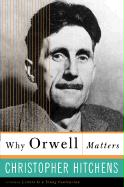
Why Orwell Matters, released in the UK as Orwell's Victory, is a book-length biographical essay by Christopher Hitchens. In it, the author relates George Orwell's thoughts on and actions in relation to: The British Empire, the Left, the Right, the United States of America, English conventions, feminism, and his controversial list for the British Foreign Office.
"The Prevention of Literature" is an essay published in 1946 by the English author George Orwell. The essay is concerned with freedom of thought and expression, particularly in an environment where the prevailing orthodoxy in left-wing intellectual circles is in favour of the communism of the Soviet Union.
"Some Thoughts on the Common Toad" is an essay published in 1946 by the English author George Orwell. It is a eulogy in favour of spring.

Nineteen Eighty-Four is a dystopian novel and cautionary tale by English writer Eric Arthur Blair, who wrote under the pen name George Orwell. It was published on 8 June 1949 by Secker & Warburg as Orwell's ninth and final book completed in his lifetime. Thematically, it centres on the consequences of totalitarianism, mass surveillance, and repressive regimentation of people and behaviours within society. Orwell, a staunch believer in democratic socialism and member of the anti-Stalinist Left, modelled the Britain under authoritarian socialism in the novel on the Soviet Union in the era of Stalinism and on the very similar practices of both censorship and propaganda in Nazi Germany. More broadly, the novel examines the role of truth and facts within societies and the ways in which they can be manipulated.
"Raffles and Miss Blandish" is an essay by the English writer George Orwell first published in Horizon in October 1944 as "The Ethics of the Detective Story from Raffles to Miss Blandish". Dwight Macdonald published the essay in politics in November 1944. It was reprinted in Critical Essays, London, 1946.
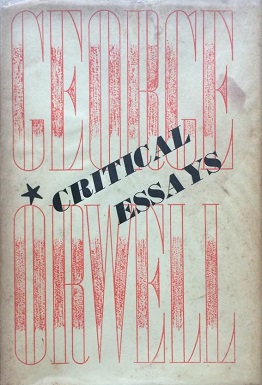
Critical Essays (1946) is a collection of wartime pieces by George Orwell. It covers a variety of topics in English literature, and also includes some pioneering studies of popular culture. It was acclaimed by critics, and Orwell himself thought it one of his most important books.
Storm over Spain is a book by Mairin Mitchell, a pacifist commentary on the Spanish Civil War published in 1937, during the war.