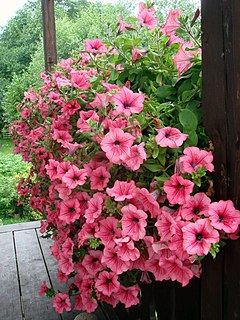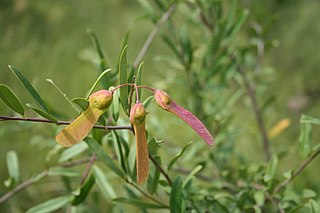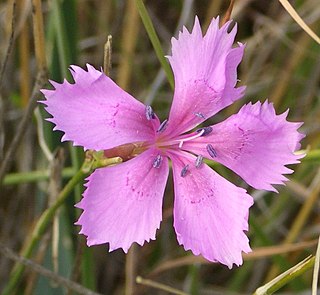
Dianthus is a genus of about 300 species of flowering plants in the family Caryophyllaceae, native mainly to Europe and Asia, with a few species extending south to north Africa, and one species in arctic North America. Common names include carnation, pink and sweet william.

Aesculus pavia, known as red buckeye or firecracker plant, is a species of deciduous flowering plant. The small tree or shrub is native to the southern and eastern parts of the United States, found from Illinois to Virginia in the north and from Texas to Florida in the south. It is hardy far to the north of its native range, with successful cultivation poleward to Arboretum Mustila in Finland.

Delonix regia is a species of flowering plant in the bean family Fabaceae, subfamily Caesalpinioideae. It is noted for its fern-like leaves and flamboyant display of flowers. In many tropical parts of the world it is grown as an ornamental tree and in English it is given the name royal poinciana, flamboyant, flame of the forest, or "flame tree".

Bellis perennis is a common European species of daisy, of the Asteraceae family, often considered the archetypal species of that name.

Prunus cerasifera is a species of plum known by the common names cherry plum and myrobalan plum. It is native to Southeast Europe and Western Asia, and is naturalised in the British Isles and scattered locations in North America.

Primula vulgaris, the common primrose, is a species of flowering plant in the family Primulaceae, native to western and southern Europe, northwest Africa, and parts of southwest Asia. The common name is primrose, or occasionally common primrose or English primrose to distinguish it from other Primula species also called primroses.

Plains coreopsis, garden tickseed, golden tickseed, or calliopsis, Coreopsis tinctoria, is an annual forb. The plant is common to Canada, northeast Mexico, and much of the United States, especially the Great Plains and Southern states where it is often called "calliopsis." The species is also widely cultivated in and naturalized in China.

Eustoma, commonly known as lisianthus or prairie gentian, is a small genus in the gentian family. They are native to warm regions of the southern United States, Mexico, Caribbean and northern South America. This genus is typically found in grasslands and in areas of disturbed ground.

Catharanthus roseus, commonly known as the Madagascar periwinkle, rose periwinkle, or rosy periwinkle, is a species of flowering plant in the dogbane family Apocynaceae. It is native and endemic to Madagascar, but grown elsewhere as an ornamental and medicinal plant, a source of the drugs vincristine and vinblastine, used to treat cancer. Other English names include '“Cape periwinkle” and "old-maid". It was formerly included in the genus Vinca as Vinca rosea.

Iris xiphium, commonly known as the Spanish iris, is an iris native to Spain and Portugal. It has also been found in Corsica, South West France, southern Italy, Algeria and Tunisia. This species is also known as the small bulbous-rooted iris.

Iris giganticaerulea is a species of iris, it is also in the subgenus of Limniris and in the Series Hexagonae. It is a rhizomatous perennial, from northern America. It has long bright green leaves, very tall stems, 1–2 musky fragrant flowers, in a range of blue shades, from pale blue, to lavender blue, to bright blue, to dark blue, and to violet blue. Rarely, there is a white form.

Argyranthemum frutescens, known as Paris daisy, marguerite or marguerite daisy, is a perennial plant known for its flowers. It is native to the Canary Islands. It is also widely cultivated as an ornamental planted in private gardens and public parks in many countries, and naturalized in Italy and southern California. The most common variety has white petals.
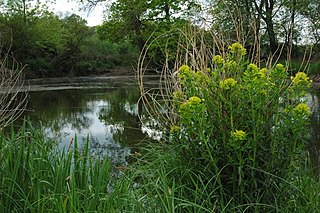
Euphorbia palustris, the marsh spurge or marsh euphorbia, is a species of flowering plant in the family Euphorbiaceae, native to marshland throughout much of mainland Europe and western Asia. It is an herbaceous perennial growing to 90 cm (35 in) tall and wide, with narrow leaves turning red and yellow in autumn, and persistent, bright acid yellow flower-heads (cyathia), 15 cm (6 in) across, in spring.

Iris bucharica is a species of flowering plant in the family Iridaceae. It is a bulbous herbaceous perennial, from temperate Asia, within Afghanistan, Tajikistan and Uzbekistan. It has long blue green leaves, many flowers in spring, in shades of yellow and white.

Narcissus bulbocodium, the petticoat daffodil or hoop-petticoat daffodil, is a species of flowering plant in the family Amaryllidaceae, native to southern and western France, Portugal, and Spain. Some sources say that the species is also native to Morocco, but this is based on populations formerly thought to be varieties of N. bulbocodium but now regarded as separate species.

Polygala calcarea, the chalk milkwort, is a species of flowering plant in the family Polygalaceae, native to western Europe. It is a delicate mat-forming evergreen perennial growing to 5 cm (2 in) tall by 20 cm (8 in) broad, with spikes of small, vivid deep blue flowers in spring, and leathery, oval leaves. The white anthers of the flowers may possibly be the source of the name milkwort.
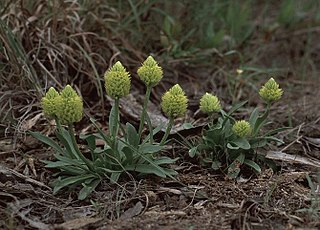
Polygala nana, commonly known as candyroot or low bachelors' buttons, is a very small herbaceous plant which is native to the southeastern United States. The root has a sweet liquorice flavor when it is chewed, but it is usually hidden underground until the plant flowers. The seeds of candyroot are dispersed by ants.

Gaillardia pinnatifida, the Hopi blanketflower or red dome blanketflower, is a perennial plant in the sunflower family (Asteraceae) found in northern Mexico and in the south-central and southwestern United States.
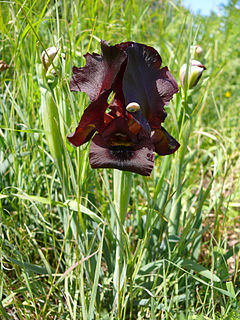
Iris atropurpurea, the coastal iris, is a species in the genus Iris, it is also in the subgenus of Iris and in the Oncocyclus section. It is a rhizomatous perennial, from Israel. It has glaucous (blue-green), linear, falcate (sickle-shaped) leaves. Between February and March, it has between 1 and 2 flowers, in darks shades from red-brown, burgundy, dark purple to blackish purple. They have a darker signal patch and yellow beard tipped with purple. It is rarely cultivated as an ornamental plant in temperate regions, due to it needing very dry conditions.