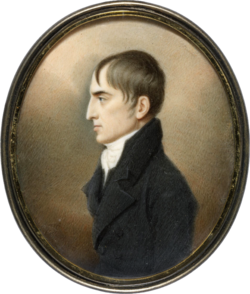
Protestant Irish Nationalists are persons of Protestant persuasion or background in Ireland who have joined their Catholic-majority fellow countrymen in campaigning for Ireland's independence and the dissolution of her union with Great Britain. Through the nineteenth century, they attained positions of leadership in a succession nationalist movements, but they did so without the support of the broader Protestant community. Content with representation in the United Kingdom parliament, Protestant opinion remained overwhelmingly unionist.
In the former, separate but subordinate, Kingdom of Ireland, in which Catholics were excluded from public office, Irish Protestants readily identified as patriots. The focus of their patriotism was the parliament in Dublin. Its high-point was the armed Volunteer movement which in 1782 secured from the British Crown recognition of the parliament's exclusive right to legislate for Ireland. The movement subsequently split on the question of Catholic emancipation. In 1798, the more radical faction, concentrated in the Presbyterian north-east, broke into open rebellion in an effort, as "United Irishmen", to abolish confessional privilege and establish a representative republic.
Following the partition settlement of 1921, in the six Ulster counties retained as Northern Ireland within the United Kingdom, Protestants in labour and socialist circles continued to be drawn to James Connolly's vision of an all-Ireland workers' republic. In the 1940s, a number of northern Protestants formed a "squad" within a reactivated Irish Republican Army. From the late 1960s, a stricter sectarian division was imposed by the onset of "the Troubles". It is reflected in the exclusively Catholic background of the present leadership in Sinn Féin, and of the SDLP, as it is in the exclusively Protestant background of unionist party leadership.
When, in 1782, the Patriot leader in the Irish House of Commons, Henry Grattan, in his Volunteer uniform, carried by acclaim a declaration of legislative independence from London, he reportedly cried: "Spirit of Swift, spirit of Molyneux, your genius has prevailed! Ireland is now a nation!"[1]William Molyneux's The Caseof Ireland stated (1696) and Jonathan Swift'sDrapier's Letters (1724–25) are sometimes cited as the first stirrings of a modern Irish nationalism.[2][3] Yet their rejection of English claims that Ireland was a colony, and insistence that the island was, in the words of Molyneux, "a Compleat Kingdom within itself",[4] was entirely circumscribed by their commitment to Ireland's Anglican ascendancy.[5]
Swift objected to extending civil and political rights to Presbyterians and other Protestant "Dissenters" from the Church of Ireland communion.[6] As for the Catholic "five sixths of the population", the English national historian Lord Macaulay proposed that, dispossessed and excluded under the Penal Laws, they were accorded no more place in the Irish nation as conceived by these "planted" Protestants than "than the swine or the poultry". The patriotism of the Anglo-Irish "squireen" was as disinterested, he suggested, as the invocation of "inalienable right" by the slave-holding "Virginiaplanter"[7] Even while pressing for further reform, Volunteer conventions did not address the "Catholic question", save in Ulster[8] where delegates concurred only in approving "the relaxation" of the civil disabilities imposed upon their "fellow subjects".[9]
The exclusively Protestant nature of the constitution was breached first, not by Protestant patriots, but by direct Catholic appeal to the British government in London then intent on engaging Catholics in both Ireland and abroad in a war with the new French Republic.[10] In 1793, with the vice-regal administration in Dublin Castle supplying the necessary inducements and pressure, Grattan piloted a relief bill through parliament that re-admitted Catholics, not to parliament itself, but to the electoral franchise.[11] The concession, votes for a small, albeit growing, number of property-qualified Catholics, could have little impact upon the conduct of government. Two thirds of the seats in the Commons remained in the gift either of landed grandees sitting in the House of Lords or of Dublin Castle, the Irish executive that continued to be appointed from London.[12][13]
Limited reform satisfied neither Catholic or Dissenter. Disaffection concentrated in Belfast where already, in 1784, Volunteer companies had been admitting Catholics to their ranks in the conviction that "a general Union of all the inhabitants of Ireland is necessary to the freedom and prosperity of this kingdom".[12] Re-animated by news of the revolutionary events in France, in October 1791 a group of Volunteer veterans among the town's Presbyterian merchants responded to an invitation from the physician William Drennan to enter into "a benevolent conspiracy — a plot for the people", its "general end real independence to Ireland".][14] Calling themselves, at the suggestion of a Protestant secretary to the Catholic Committee in Dublin, Theobald Wolfe Tone, the Society of United Irishmen, and adopting his draft resolution, they observed that in a "great era of reform ... when all government is acknowledged to originate from the people," the Irish people find themselves with "no national government" — "we are ruled by Englishmen, and the servants of Englishmen". The remedy lay in "a cordial union among all the people of Ireland" and "a complete and radical reform" of their representation in parliament.[15]
This resolve, adopted by United societies that then convened in Dublin and across the country, and which was to harden in the face of government repression into a republican conspiracy, would be invoked by later generations of nationalists. In 1913, at what he described as the "the holiest place in Ireland", the grave of Wolfe Tone in Bodenstown, Patrick Pearse declared Tone "the greatest of Irish Nationalists".[16] When proclaiming the Irish Republic in 1916, Pearse presented the Easter Rising as the sixth occasion in the past three hundred years in which the Irish people had asserted in arms their right to sovereignty. This placed the rebellion, urged by Tone in 1798, in a line succession from the Irish Rebellion of 1641 and the resistance to the Williamite invasion of 1689.[17]
Contemporary historians have taken issue with this "teleological" narrative.[18] In Tone's call to "substitute the common name of Irishmen in place of the denomination of Protestant, Catholic and Dissenter",[19] they see a political project for which the precedents were not Irish, but American and French: the realisation of an Enlightenment, legal-rational ideal of citizenship, a vindication of the Rights of Man.[20] On the principle that they should "attend those things in which we all agree, [and] to exclude those in which we differ",[21] United Irishmen had positively eschewed reference to Ireland's past. Are we "forever", asked the Dublin Society, "to walk like beasts of prey over fields which [our] ancestors stained with blood?" Better, they suggested to "think little of our ancestors [but] much of our posterity".[22]
At the same time, Tone's promised unity of creeds elicits scepticism.[23] In Dublin where, reflecting the capital's larger, more denominationally mixed middle class, the Society encompassed from the outset Protestant, Catholic and Dissenter, Drennan promoted a secret "inner Society" that was to be "Protestant but National".[24] Convinced that the object of many of the Catholic members was "selfish" (i.e. focused on emancipation rather than on reform and independence), Drennan concluded that, while the Catholics might "save themselves", it is "the Protestants who must save the nation".[25] As it was, when the society began to arm, both Drennan and the leading Catholics dropped out of its inner counsels.[26] This left Protestants in spring of 1798 — William James MacNeven, Samuel Neilson, Edward FitzGerald, Arthur O'Connor, Oliver Bond, and the brothers John and Henry Sheares — to plan and direct an insurrection from Dublin.[27]
In Ulster, the Society was strongest in the comfortably Protestant-majority districts in the east (Belfast, and immediate hinterlands) but conceded ground to the new-formed Orange Order in the west where folk memories of the massacres of 1641 sharpened the sectarian competition for tenancies and employment.[28][29] The Belfast directory did seek to mediate in the increasing sectarian disturbances through its agents both Protestant (James Hope and Thomas Russell) and Catholic.[30] For some of the Catholics displaced, they helped provide refuge on Presbyterian farms in counties Down and Antrim, and the used goodwill earned used to persuade the Catholic Defenders, more Jacobite and Jacobin in outlook, of something they had only "vaguely" considered: the necessity of a complete break with the British Crown.[31] In the aftermath of the rebellion, the Defenders in turn opened their cell-structured organisation for Protestant rebels in Antrim, enabling them to maintain (as later celebrated in Ethna Carbery's ballad "Roddy McCorley")[32] an outlaw existence until March 1800.[33] In the rebellion itself, however, there are stories of Catholics being driven from Henry Joy McCracken's ill-fated march upon Antrim Town by sectarian taunts,[34][35] and, although the accounts are disputed,[36][37] of withdrawing from the rebel camp of Henry Munro on the eve its rout in the battle of Ballynahinch.[38]
In Leinster, in counties Wexford and Wicklow, the rebels were led to their first successes, not by a United Irishman, but by a renegade Catholic priest, Fr. John Murphy.[39] Murphy did submit to the command of Bagenal Harvey, a Protestant barrister, but when their united forces were defeated at New Ross, rebels in the rear killed loyalist prisoners at Scullabogue and, after a United Irish Committee of Public Safety was swept aside in Wexford Town, at Wexford Bridge.[40][41] Notwithstanding greater military atrocities, reports of the massacres helped prompt Protestant defections from the republican cause.[42][43] Loyalists were soon able to report that "the word 'Protestant', which was becoming obsolete in the north, has regained its influence and all of that description seem drawing closer together".[44]
Protesting the "accused union" with Britain that in 1801 had stripped Ireland of her last "vestige of self government", her parliament,[45] in July 1803 Robert Emmet pressed forward with an ill-starred attempt to rekindle the United Irish rebellion with a rising in Dublin. This was despite conceding that "no leading Catholic is committed" ("we are all Protestants"),[46] and the failure of Hope and of Russell to secure pledges in what had been the Presbyterian heartlands of the movement in the north.[47]
Not only was there no appetite for a renewed resort to arms, but those whose hopes had been defeated in 1798 had begun to look for solace in the union. From exile in Hamburg, Archibald Hamilton Rowan hailed "the downfall of one of the most corrupt assembles that ever existed" and predicted that the new United Kingdom Parliament would see "the wreck" of the old Ascendancy.[48] Drennan, at first defiant, counselled patience in the hope that Westminster might in time realise the original aim of his conspiracy–"a full, free and frequent representation of the people". "What", he reasoned, "is a country justly considered, but a free constitution"?[49]
In the decades that followed the admission of Catholics to Parliament in 1829 and the first of a succession of reform acts in 1832, Protestants settled on a conciliatory consensus: had their forefathers been offered a union under the constitution as it later developed, with "equal laws for the whole Irish people", there would have been "no rebellion".[50] In the meantime, the thirty years of popular agitation that been required for the union to deliver on its original promise of emancipation had mobilised every class of Catholic in the south, an achievement in which Protestants perceived in increasingly threatening terms.[51][52]
Daniel O'Connell declared the subscribers to his penny-a-month Catholic Association to be "the people, emphatically the people" and "a nation".[53] Few Protestants who had supported Catholic emancipation were willing to join O'Connell when he repurposed the association for a campaign to give this nation a parliament through a repeal the Act of Union. In stating the new case for Irish statehood, the O'Connellite paper, the Pilot, was satisfied that "the distinction created by religion" was the one "positive and unmistakable" mark of separating the Irish people from the English people.[54]
Among the Protestants who did support repeal, was the prolific pamphleteer and correspondent to the press, George Ensor.[55] Ensor was among the first Armagh members of the Catholic Association, a notable position in a county renowned as a stronghold of the Orange Order and loyalist Brunswick Clubs.[56] On the recommendation of Jeremy Bentham, in 1828 O'Connell had considered taking on Ensor as his running mate in the by-election for the two-member Clare constituency where O'Connell's success was to prove critical in forcing the government to amend the sacramental oaths that had barred Catholics from higher office and from Parliament.[57] But Ensor was critical of O'Connell's willingness to accept "disenfranchisement project" attached to the developing Catholic relief bill.[56]
The Parliamentary Elections (Ireland) Act 1829, which received its royal assent on the same day as the Roman Catholic Relief Act, raised the freehold qualification for the county vote in Ireland fivefold to English ten-pound level. Ensor cautioned that "casting two or three million" forty-shilling freeholders, both Catholic and Protestant, "into the abyss" so that a few Catholic gentlemen might be returned to Parliament would prove "disastrous" for the country.[58] It broke the connection between Catholic inclusion and democratic reform, and projected a parliament for Ireland unlikely to address the true source of country's misfortune, the inordinate concentration of wealth.[59]
In the end O'Connell stood for the Clare seat alone.[60] He described Ensor as "a man of pure principle and excellent notions", although, "if a Christian at all, certainly not a Catholic", and a "radical" rather than (as most of O'Connell's Protestant and English friends) a Whig.[61]
In Dublin, O'Connell had a more reliable ally in John Gray, the Protestant proprietor of the Freeman's Journal. Following his assistance in promoting a series of "monster" Repeal meetings (with crowds counted in the hundreds of thousands), in 1844 Gray was sentenced with O'Connell to nine months imprisonment on a charge of sedition (remitted on appeal).[62] Later, in an alliance with the Catholic Archbishop of Dublin, Paul Cullen, a man devoted to O'Connell's memory,[63] Gray's newspaper supported the National Association of Ireland. Established in 1864 as a constitutional alternative to the physical-force republicanism of the Fenians, it called for the disestablishment of the Church of Ireland, land reform, and greater educational provision. Gray ended his career in 1875 as a Home Rule LeagueMP for Kilkenny.[64][65]
Indicted alongside O'Connell and Gray in 1844 was Charles Gavan Duffy, proprietor in Dublin of The Nation. When he had first followed O'Connell, Duffy, an Ulster Catholic, conceded that he had "burned with the desire to set up again the Celtic race and the Catholic church".[67] But, under the influence his co-editor, Thomas Davis, a Protestant from Mallow, County Cork, he dedicated the new weekly to an idea of "nationality" that would embrace as easily "the stranger who is within our gates" as "the Irishman of a hundred generations."[68]
In pursuit of this vision, and seeking an "alternative national hero" to O'Connell,[69] Davis contributed to an hagiography of the United Irishmen, centred on the figure of Wolfe Tone. In 1843, he published his elegiac poem Tone's Grave, and with the blessing Tone's widow Mathilda (in American exile), organised the first Bodenstown Tone memorial.[70]
Conscious of his family's Cromwellian roots, Davis was influenced by the ideas of the German philosopher Johann Gottfried von Herder.[71] For Herder nationality was not genetic but the product of climate, geography, history and inclination. Davis did write of an "unsaxonised" Ireland,[72] but this was not an Ireland ethnically cleansed of those of his own British ancestry and reformed religion. Rather it was an Ireland in which Catholic and Protestant alike, find sufficient unity and strength in their education and in their "recollections, ancestral, personal, national" to resist England's "unnatural", "cosmopolite" influence.[73] Davis decried the new liberal political economy, associated in England with O'Connell's friends among the Whigs rather than the tradition-bound Tories. Ireland would never attain nationhood so long as it remained in thrall to what he described as "modern Anglicanism: i.e. Utilitarianism . . ., Yankeeism, Englishism, which measures prosperity by exchangeable value, measures duty by gain, and limits desire to clothes, food and respectability".[72]
To assist in erecting a barrier to this anglicisation, Davis made The Nation a vehicle for promoting Irish,[74] a language "inseparably mingled", in his view, with the history and "soul" of the Irish people.[72] While a Gaeilgeoir himself, for O'Connell this meant little. He declared "the superior utility of the English tongue, as the medium of all modern communication" too great a consideration for him to regret the gradual abandonment of Irish.[75]
In 1845, shortly before his unexpected death, Davis clashed with O'Connell over the Emancipator's denunciation of the "Queens Colleges", a "mixed" or non-denominational scheme that the government had proposed for higher education in Ireland. When Davis pleaded that "reasons for separate education are reasons for [a] separate life", O'Connell accused him of proposing it a "crime to be a Catholic". He suggested that Davis and his colleagues were becoming "Young Irelanders"—a reference to Giuseppe Mazzini's Young Italy who in 1849 had briefly imposed a republic upon the Pope in Rome.[76] "I am", O'Connell declared, "for Old Ireland".[77][78]
Davis's place at The Nation was taken by a man whom Pearse would later venerate as a "fierce" and "sublime" apostle of Irish republicanism,[79][80]John Mitchel, a Protestant solicitor originally from Dungiven in County Londonderry. With onset in 1846 of the Great Famine, Mitchel accused the government of devising a "relief" policy to slaughter a portion of the people and pauperise of the rest. When the London journal the Standard observed that the new Irish railways could be used to transport government troops to quickly curb any unrest, Mitchel responded that the tracks could be turned into pikes and trains ambushed. O’Connell publicly distanced himself from The Nation, appearing to set Duffy, as the proprietor, up for prosecution.[81] When Mitchel successfully defended Duffy in court,[81] O'Connell and his son John pressed the issue. On the threat of their own resignations, they carried a resolution in the Repeal Association declaring that under no circumstances was a nation justified in asserting its liberties by force of arms.[82]
In January 1847, the Young Irelanders withdrew and formed the Irish Confederation. Mitchel had already antagonised his colleagues by carrying Davis's rejection of "modern Anglicanism" to the point of protesting British intervention against the Atlantic slave trade,[83][84] and he now broke with them in turn. The famine crisis, he argued, required "a more vigorous policy against the English Government" than they were willing to pursue.[85] After sixteen issues his new paper, United Irishman, was suppressed and, convicted in April 1848 of a Treason Felony, Mitchel was sentenced to be "transported beyond the seas for the term of fourteen years."[86]
In meantime, his former confederates were already advancing plans for an insurrection. Mitchel, although the first to call for action, had scoffed at the necessity for systematic preparation. The task fell to William Smith O'Brien, a former Whig MP, who, as a Protestant and a landowner, Duffy, in the effort to hold together a broad national coalition, had promoted to the leadership.[87]
In July 1848, O'Brien raised the standard of revolt in Kilkenny.[88] This was a tricolour he had brought back from Paris of the Second Republic, its colours (green for Catholics, orange for Protestants, and white for harmony between the two) intended to symbolise the United Irish republican ideal. But with "Old Ireland" and Catholic clergy against them, the Confederates had no organised support in the countryside.[89] As O'Brien proceeded into Tipperary found himself in command of only a few hundred ill-clad largely unarmed men who scattered after their first skirmish with the constabulary.[90] Following a public outpouring, O'Brien and his colleagues had their death sentences for treasons commuted to penal transportation to Van Diemen's Land, where they joined Mitchel.
Duffy alone escaped. Part of the evidence against him, an anonymous leader in The Nation, was challenged when the poet and early suffragist, Jane Elgee, confessed her authorship of what had amounted to a call to arms from the gallery of the court. Elgee, the granddaughter of a Protestant rector from Wexford,[91] and an ardent admirer of Davis, was later, as Lady Wilde (the mother of Oscar Wilde), to denounce the Fenians ("Heaven keep us from a Fenian republic!") but declare for home rule and for the Land League.[92]
Fenians
Succeeding Emmet's attempt in 1803, the Young Ireland rebellion of 1848 was Pearse's fourth precedent for the 1916 Rising. The last were the armed actions of the Irish Republican Brotherhood (IRB), formed in 1858 in Dublin, and of the sister Fenian Brotherhood (later Clan na Gael) established in the United States by Irish exiles. In 1867, the Fenians, mobilising Irish veterans of the American Civil War, raided across the northern border of the United States with a view to holding Canada hostage to the grant of Irish Independence,[93] while the IRB (who in time were also referred to as "Fenians") attempted an armed rising at home.[94] In Canada the Fenian raids were repulsed. In Ireland, British infiltration ensured that action was limited to minor skirmishes in the south-west including outside Mallow, Thomas Davis's hometown in County Cork.[95]
Two years before, David Bell, a member of the IRB executive council, had evaded a police dragnet in Dublin, fleeing first to Paris, then to the United States.[96] As a Secessionist Presbyterian minister in Ballybay, in County Monaghan,[97] Bell had shared platforms with Catholic priests to promote the all-Ireland Tenant Right League with its call for fixity of tenure at fair rent.[97] Despite the strength of the movement among Protestant tenant farmers, Bell was unable to deliver for what Gavan Duffy had optimistically hailed as the "League of North and South". In the elections of 1852, Bell found that of the one hundred Presbyterians who had signed the requisition asking John Gray (of the Freeman's Journal) to stand as the Tenant Right candidate in Monaghan, only eleven had voted for him.[96][98] The only Ulsterman among the fifty League-endorsed candidates returned from Ireland (the majority committed Repealers), was William Kirk, a liberal Protestant, who benefitted from the exceptional Catholic vote in Newry.[99][100]
Bell had been sworn into the IRB by Jeremiah O'Donovan Rossa in England where, after being forced to resigned his ministry, he was editing an Irish nationalist weekly.[96] In American exile, Bell encountered, and denounced, John Mitchel (escaped from his penal colony in Australia) who had been an uncompromising pro-slavery partisan of the Southern secessionist cause.[101] With the "Fenian poet" Michael Scanlon,[102] in 1867, Bell began publishing the Irish Republic initially in Chicago,[103] but then, at the request of the Republican presidential candidate Ulysses S. Grant, in New York City.[104] Under the masthead, "A Journal of Liberty, Literature, and Social Progress", Bell tried to associate physical-force Irish republicanism of the Fenians with the Radical Republican agenda in the United States of black enfranchisement and Reconstruction.[105]
In response to the "arrests, trials, speeches from the dock, imprisonments, sufferings, and occasional daring rescues" that followed the "Fenian rising" in Ireland, an amnesty movement formed in which moderate political figures were willing to intercede.[106] These included, as president of the Amnesty Association, Isaac Butt, who in 1848 had represented Duffy and other Young Irelanders.[107] Butt, the Liberal MP for Youghal, began, in turn, to lay the groundwork for a future political compromise. With William Shaw, another Protestant Liberal, MP for Bandon, in 1873, Butt established the Home Rule League. Rather than repeal, Ireland would accept a parliament within the United Kingdom with powers to control its domestic affairs devolved from Westminster.[106]
It was in protest against what he insisted would continue to be "foreign rule" that, in 1875, Mitchel returned to Ireland, dying at his home in Newry days after repeating O'Donovan Rossa's achievement six years before of being returned as the MP for Tipperary on an abstentionist ticket.[108][109]
When, Isaac Butt, the son of a Church of Irelandrector in County Donegal, first entered Parliament for Youghal in 1852, it was as a Conservative. But already, as a political economist, and in response to the catastrophe of the Famine, he had concluded that for Ireland the British union and its common market posed an existential threat. The prospect (outside of Ulster which, alone, seemed to attract Scottish and English capital) was of continued pressure, and poverty, on the land. At the same time, with the tenant righters, he agreed that there was an immediate question of land tenure, one that involved "the very life of the nation, the right of the Celtic race to live in their own land" and which approached "the very foundation of society and proprietary rights".[107]
In its early stages, Butt's Home-Rule association had included an "incongruous alliance" of Protestants who as conservatives still wished for "a union of Irishmen rather than a union of parliaments",[110] and upper-middle class Catholic Whigs and their clergy.[111] Following success of the Home Rule League in the 1874 general election (fifty-nine members returned to Westminster in a first-time use of the secret ballot),[112] Butt contended with a more radical coalition of former Fenians and other advanced nationalists and militant tenant farmers. The champions for these, more impatient, elements were Joseph Biggar and Charles Stewart Parnell.[107]
Parnellites and anti-Parnellites
Charles Stewart Parnell
After his election in 1874 from Cavan, Joseph Biggar, a wealthy Belfast provision merchant, converted to Catholicism.[113] He also joined the Irish Republican Brotherhood and accepted a seat on its Supreme Council, but only, he was to insist, with a view to winning Fenian support for Home Rule League's parliamentary strategy.[114] In Biggar's hands, this strategy had some appeal. Abandoning the restraint traditionally exercised in the House of Commons by oppositions who might themselves attain office,[114] Biggar led the Irish MPs in filibustering and generally frustrating the business of the government in the House in order to force the consideration of their demands.[115][116] In this obstructionism, Biggar was supported against the disapproval of Butt by Parnell.[117] When, in 1879, Butt died, Parnell succeeded him in leadership of what was to become, in 1882, the Irish Parliamentary Party (IPP).
Parnell had been born into a landed, Ascendancy, family in County Wicklow, that had celebrated its past connection to the Volunteer movement and opposition to the Act of Union. Parnell's refusal to see Ireland treated as a "geographical fragment" of England is also been attributed to the influence of his American mother.[117][118] When first elected to the House of Commons in a by-election for Meath in 1875 it was with the endorsement of the IRB's Patrick Egan. Parnell's first reported intervention in the House was a defence of the Manchester Martyrs, the three IRB men hanged in 1867 for the death of a police sergeant.[117] He consolidated his bid for leadership by securing from leading IRB and Clan na Gael figures, including, on his release from prison, Michael Davitt, endorsement for a "New Departure". This was a constitutional path to Irish self-government conditioned on energetic resistance to coercion acts and vigorous agitation on the land question.[119]
Parnell was simultaneously elected president of Davitt's newly founded Irish National Land League. On both Party and League, he sought to impose the same centralised discipline. This may have enabled them weather the waves of indignation and accusation that accompanied the escalation of the Land War and the Phoenix Park murders, so that he was still able to hold Gladstone's Liberal government to promises of land reform (1881, 1882) and, at the cost of splitting the government majority, of a Home Rule bill (1886). It also sowed dissension. Michael Davitt was later to suggest that the leader's "dictatorship" had replaced nationalism with "Parnellism".[120]
Parnell's position was abruptly undermined when, in 1890, he was when named in a divorce case, revealing his affair with Kitty O'Shea. In advancing candidates for Westminster, Parnell had favoured northern Protestants: putting Isaac Nelson into his own former seat Mayo, after the Presbyterian minister, who had refused to support the endowment of a Catholic university, was rejected in Leitrim;[121] and John Pinkerton into Galway Borough, after the founder-member of the Protestant Home Rule Association failed to top the poll in his North Antrim constituency.[122] Yet in the split within the Irish party over Parnell, which was to persist long after his death in October 1891, Pinkerton stood with the majority Anti-Parnellites, as did other senior Protestant MPs: Jeremiah Jordan, the Member for the Western division of County Clare, and later South Fermanagh;[123]J. G. Swift MacNeill, who was to represent South Donegal for over thirty years,[124] and Samuel Young MP for East Cavan.[125] Priests may have "swarmed the polling stations and kept the voters constantly in view" to ensure the defeat of Parnellites (reportedly the fate in North Meath of Parnell's close ally, Pierce Mahony, the Anglican grandson of a Repeal MP).[126][127] But the condemnation of Parnell by the Catholic bishops was not greater than that of Protestant churchmen, and while Parnellites decried clerical dictation, they continued to count on a "small but significant division" in the ranks of the priesthood.[128]
In June 1891, Parnell was seen "beaten and ashamed" at a public meeting in Dublin by Alice Milligan. Defying a "Tory and Protestant" upbringing, as she followed him in his appearances across the city she claims to have "turned into a Parnellite" while "in the tram going up O’Connell Street".[129][130]
Already a student of the Irish language, which as a child she had heard spoken by farm hands in her native Tyrone, in 1893 Milligan was among the first to join Conradh na Gaeilge, the Gaelic League.[131] Her command of Irish was never fluent, and on that basis Patrick Pearse was later to object when, in 1904, the League hired her as a travelling lecturer.[132] She proved herself by establishing new branches throughout Ireland and raising funds along the way. In Ulster, she focused on the more difficult task of recruiting Protestants. She collaborated with, among other activists, League president Douglas Hyde and the Galway MP Stephen Gwynn, both sons of Church of Ireland clergymen,[131] and with Francis Joseph Bigger, a wealthy Presbyterian solicitor, whose house on the northern shore of Belfast Lough, Ard Righ, offered a salon for the northern poets and writers of the Irish Literary Revival.[133]
In founding the League, Hyde (the future first President of Ireland) declared that "in Anglicising ourselves wholesale we have thrown away with a light heart the best claim we have to nationality".[134] While this commitment to an "Irish Ireland" was in the spirit of Thomas Davis,[135][136] , Hyde initially tried to avoid association with political nationalism and to cultivate unionist participation. The Irish language, he declared, "is neither Protestant nor Catholic, it is neither a Unionist nor a Separatist."[137] In 1895, the League's first branch in Ulster was formed in Belfast under the patronage of Orange Order Grand Master, Richard Rutledge Kane.[138] Protestants had been playing a leading role in promoting the study of Irish, not least in the service of proselytising church missions. In the Presbyterian Synod of Ulster (where his pan-Protestant unionism was opposed Isaac Nelson),[121]Henry Cooke proposed all students for the ministry learn Irish, "the tongue of your native hills".[139] But from the beginning Milligan understood the conflict between the Hyde's non-political rhetoric and the nationalism implicit in the League's revivalist project.[140]
In 1896, with Anna Johnston (writing under the name, Ethna Carbery), the daughter of local IRB man,[141] Milligan began publication in Belfast of a new, explicitly nationalist, monthly. The Shan Van Vocht (The "Poor Old Woman" in Irish, the metaphor for Ireland in a popular 1798-era ballad) followed broadly the formula pioneered by Davis in The Nation. Together with the Irish language, a unity-above-creed-and-class nationalism was promoted to an English-language readership in a mixture of poetry, serialised fiction, Irish history, political analysis and announcements.[142] Although much of the writing was her own, Milligan offered a broad political platform. Notwithstanding his argument that language and literary societies would likely achieve little, Milligan included in the first edition James Connolly's Socialist Republican manifesto, "Socialism and Nationalism".[143]
Milligan's attempt in the journal to unify nationalists across region, class, sex and religion proved untenable: no faction or party was prepared to provide enough financial support to sustain it.[144] In 1899, the IRB persuaded Milligan and Johnston to pass their subscription list on to Arthur Griffith and his new Dublin weekly, the United Irishman, organ of the original Cumann na nGaedheal, the forerunner of Sinn Féin.[145]
Other Protestant figures within the Irish literary revival ran afoul of nationalist opinion. Together with Augusta Gregory, W. B. Yeats, a poet and dramatist "determined to write himself and his people into the Irish nationalist story",[146] found himself accused by Griffith,[147] among others, of promoting, at their Abbey Theatre in Dublin, work that outraged Irish moral and national sensitivities.[148] Between 1904 and 1907, they staged three plays by John Millington Synge, a writer who had declared his wish to "work on my own for the cause of Ireland",[149] all which met with nationalist and clerical disapproval. The last of these,The Playboy of the Western World, triggered a riot.[150] Years later, the Abbey's staging in 1926 of The Plough and the Stars by Seán O'Casey, another Protestant writer who had broken with nationalist mainstream, provoked similar protests.[151]
Dissident nationalists and conciliators
William O'Brien
The son of a modest Protestant family in the birthplace of Thomas Davis, Mallow, County Cork, William O'Brien's advocacy of Irish Independence followed in the tradition of his predecessor: he acknowledged the existence of many strands of Irishness.[152] Citing "the gloom of inevitable failure" he abandoned his early involvement with the Fenian brotherhood, opting instead to work with Parnell in the Irish National Land League. As the author, in 1882, of the Land WarNo Rent Manifesto, and member of League's "the de facto military council",[153] O'Brien faced repeated imprisonment. After the 1887 ''Bloody Sunday" riots in London, he briefly went into exile in America.[154]
Following the defeat of the second Home Rule Bill in 1893, and disillusioned by the Parnell split, O'Brien retired from Parliament in 1895 and, with Michael Davitt, established a new grass-roots organisation the United Irish League (UIL). By 1900, it was the largest nationalist organisation in the country, with 1150 branches and 84,355 members.[155] The discredited IPP factions responded with a quick defensive reunion under John Redmond (a Parnellite who quickly redeemed the favour of the Catholic Church).[156]
Tensions mounted as O'Brien pursued the goal of transferring land to tenant farmers by working with those in the Irish executive who, after the Gladstonian commitment to a Dublin Parliament had run its course, called for "constructive unionism".[157] He led the tenant representation, which included T. W. Russell from Ulster, to the December 1902 Land Conference, an initiative of moderate landlords led by Lord Dunraven. Tenants' demands were conceded, and following a policy of "conference plus business", O'Brien helped secure passage of the Land Purchase (Ireland) Act 1903. This was followed in 1906, legislation – "scarcely less wonderworking", in O'Brien view, "than the abolition of landlordism itself" – that provided housing and plots of land for rural labourers.[158][159]
O'Brien was criticised by party leaders for putting resolution of the land question before Home Rule. The transfer of ownership was on terms that did not make tenants feel sufficiently beholden to the IPP.[160] In 1904, Redmond subverted O'Brien's influence within the UIL by securing the appointment of Belfast west MP, Joseph Devlin, Grandmaster of the Ancient Order of Hibernians, as its new secretary.[161]
O'Brien had opposed the IPP's involvement with "that sinister sectarian secret society". With their ethnic, exclusively Catholic, nationalism, he regarded the AOH (the "Molly Maguires") as "the most damnable fact in the history of this country" – the nationalist equivalent to the Orange Order. Compromised by the AOH, O'Brien saw the IPP set upon a path which would frustrate any All-Ireland Home Rule settlement.[161]
Following his engagement with the Irish Reform Movement 1904-5 and support of the 1907 Irish Council Bill which he viewed as a step in the right direction, or "Home Rule by instalments", in 1909 O'Brien inaugurated the All-for-Ireland League (AFIL).[162] Under the banner of the "Three Cs" – Conference, Conciliation and Consent – he hoped to obtain an All-Ireland parliament without coercing Protestant Ulster. The League was supported by many Munster Protestants, including landowners and business figures, and was joined from Ulster by Lord Rossmore, once Grandmaster of the Orange Institution, and James Sharman Crawford, a tenant-right Liberal.[163] Despite bitter opposition from the IPP and local bishops, in the 1910 general election, the Cork electorate returned eight "O'Brienite" MPs.[164]
When, after 1912, the IPP again held the balance of power at Westminster, and the Liberal government's passage of a Home Rule bill was assured, O'Brien offered a series of amendments as alternatives to IPP's "Ulster must follow" policy. In a final Commons debate in May 1914, O'Brien stated that "we are ready for almost any conceivable concession to Ulster that will have the effect of uniting Ireland, but we will struggle to our last breath against a proposal which will divide her, and divide her eternally". O'Brien and his followers abstained on the final passage of the Government of Ireland Act 1914, denouncing it as "plan for the dismemberment of Ireland".[165]
O'Brien saw the outbreak of the Great War in August as an opportunity to undertake a last crusade to preserve the unity of Ireland, by uniting the Green and Orange in a common cause, and was the first Nationalist leader to call on Irish Volunteers for the front.[166] However, by 1916, the combination of home rule's suspension until a date "as may be fixed" after the war,[167] the mounting casualties, and the impact of the Rising, persuaded O'Brien that there was no future for his conciliatory stratagems. After intoning that "it is to Sinn Féin that Ireland must now look to mould the future of her people", his paper, the Cork Free Press, was suppressed.[168] During the anti-conscription crisis in April 1918, O'Brien and his AFIL left Westminster and joined Sinn Féin in the mass protests in Dublin, and in the December 1918 general elections they put their seats in Cork at the disposal of the now republican party, whose candidates were returned unopposed.[169]
Some middle-class Dubliners of both moderate unionist and nationalist found an alternative home in the Irish Dominion League, launched in June 1919 by Sir Horace Plunkett. The League sought unsuccessfully to mediate between Sinn Féin and the Government.[170]
Opponents of "Carsonism"
Protestants protest "the Lawless Policy of Carsonism"
Returning from British consular service in Africa and in South America, where he had born witness to the savagery of European colonialism, Casement (already a teenage Parnellite) [171] was determined that Ireland should, as far practicable, distance herself from imperial Britain. With Arthur Griffith, he believed this could be, if not republican independence, something more than a devolved parliament.[174] But the immediate task was to prevent Carson's mobilisation of Protestant Ulster from derailing the final passage of the third home rule bill. In October 1913, Casement, in his first ever public speech, addressed a meeting at which the "Protestants of Ballymoney and the Route" were invited to protest "the lawless policy of Carsonism".[175]
The event was sponsored by James Armour, a Presbyterian minister who led tenant agitation in north Antrim, despite his conversion to Home Rule.[176] A sympathetic audience in Ballymoney may also have been anticipated on the strength, locally, of the Independent Orange Order.[177] The order's first Grand Master, Robert Lindsay Crawford had promoted Independent lodges as "strongly Protestant, strongly democratic" and "strongly Irish". In the order's 1904 Magheramorne Manifesto, he had invited Irish Protestants to "reconsider their position as Irish citizens and their attitude towards their Roman Catholic countrymen".[178]
With Casement on the town-hall platform was Alice Stopford Green and Captain Jack White. Stopford Green, who had supported Casement in the Congo Reform Movement, was the daughter of the Anglican Archdeacon of Meath.[179] A popular historian, she was best known for The Making of Ireland and Its Undoing, 1200–1600 (1908), a chronicle of England's systematic pillaging and disruption of an Ireland that was self-confident, internationally connected, and Gaelic-speaking.[180] Jack White, a local Boer War veteran, was fresh from addressing a motion against "the stirring up of religious rancour and intolerance in N.E. Ulster" from the platform of Pinkerton's Irish Protestant Home Rule Association in London, alongside George Bernard Shaw, Stephen Gwynn M.P. and Arthur Conan Doyle. He now proposed a Home Rule pledge to match the Carson's Ulster Covenant: "We intend to abide by the just laws of the lawful parliament of Ireland until such time as it may prove itself hostile to democracy, in sure confidence that God will stand by those who stand by the people irrespective of class or Creed."[181] Circulated at some peril across County Antrim, the alternative covenant collected some 12,000 signatures.[182]
Casement attempted, but failed, to build upon the Ballymoney meeting with further engagements.[183]The Times of London concluded that the meeting had represented but a "small pocket of dissident Protestants, the last survivors of the Old Liberals.”[184] Within a year, White was in Dublin drilling James Connolly's Irish Citizen Army,[185] and Stopford Green had extended Casement a loan to help run German guns into Howth for the Irish Volunteers.[186]
Independence era
Revolutionary republicans
Constance Markiewicz in the uniform she designed for the Irish Citizen Army.
While formed to protect picket lines and union rallies during Dublin lock-out of 1913, both Connolly and White regarded the Irish Citizen Army (ICA) as part of a broader response to the arming of unionism in the north.[187] As desertions mounted with the defeat of the Irish Transport and General Workers Union, White moved on to the more credible counterweight to the Ulster Volunteers, the Irish Volunteers. He was given command of brigades in Derry City and the northwest, but found his authority weakened by the suspicion in the ranks that, as a Protestant, he would never lead them into a fight against Orangemen.[188] After the outbreak of the Great War in August 1914, he tried to persuade the British authorities to pay and equip the Volunteers as a home guard under their own command. Of his attempt to invoke the Volunteers precedent of 1782, his comrades were no less suspicious than the government: "I was taken to be recruiting for Britain, whereas I was trying to use Britain to put Ireland into a position to enforce her own claims".[189] White was dismissed from his Volunteer commands.[190]
Connolly, meanwhile, had found a new source of ICA recruits, the nationalist youth of Fianna Éireann.[191][192] The Fianna were a link to the IRB and to the Irish Volunteers—unacceptable to Seán O'Casey who, resigned from the ICA Council rather than cooperate with those he saw as having failed in the lock-out to stand by men trying to exercise "the first principles of Trade Unionism".[193] Casey, who had been an active member of the Church of Ireland until his mid-twenties, continued as an independent republican and socialist, and as a dramatist: the first Irish playwright of note to write about the Dublin working classes.[194]
Hobson was the son in Belfast of a Protestant home-ruler.[197] At age 13 he had had his own subscription to The Shan Van Vocht, and through his English suffragist mother was introduced to Milligan and the Ard Righ set.[198] In 1904, he was inducted into the IRB, and with Ernest Blythe, who at the time had the distinction of being simultaneously a member of the Gaelic League, the IRB and the Orange Order,[199] he helped set up the Protestant-outreach Dungannon Clubs.[200] Named after the Dungannon Convention of 1782,[201] they invoked the memory not only of the old Volunteers but also of the United Irishmen, declaring that: “The Ireland we seek to build is not an Ireland for the Catholic or the Protestant, but an Ireland for every Irishman Irrespective of his creed or class."[198] Among those they persuaded that "the real Irishman is neither essentially a Celt nor essentially a Catholic" was the Belfast-born writer, literary essayist and socialist Robert Wilson Lynd.[202]
In 1911, Hobson was elevated to the IRB's Supreme Council. In July 1914, as secretary to Irish Volunteers, he organised the distribution of the German arms landed at Howth,[198] from the Asgard, a yacht owned by the English-born Volunteer Erskine Childers and his American-Irish wife Molly Childers.[203]
For IRB, the Irish Volunteers and the ICA, like the Gaelic League (a regular source of recruits from as early as 1903),[204] the Dungannon Clubs and the Fianna Éireann, were "open fronts". They sustained a republican network that the Supreme Council believed they could spring into action when they judged the moment opportune. But in planning the 1916 Easter Rising, Pearse, whom Hobson had sworn into the IRB in December 1913,[205] was engaged in an internal IRB conspiracy (with Connolly included only at the last possible moment).[206] When he learned of Pearse's mobilisation orders, Hobson alerted the Volunteers' chief-of-staff Eoin MacNeill, but was kidnapped to stop him from spreading news of the countermanding order that followed.[207] During the Rising, which he later described as having "no plans.....which could seriously be called military",[208] Hobson went into hiding, re-emerging after the June amnesty, largely to scorn.[209]
Had the British not captured him on his return by U-boat from Germany, Casement might also have advised the Volunteers to stand down. He had concluded from his negotiations for further arms, that the Germans were toying with him,[210] and hoped to convince MacNeill (who he believed was still in control) to call any plans for a rising off.[211] After a highly publicised trial for treason Casement went to the gallows at Pentonville Prison, 3 August 1916, three months after the summary court-martials of the rebel "ringleaders" in Dublin.
Two of the leaders, who had had positions of command in Dublin during the Rising, escaped execution: Éamon de Valera, it was widely thought because of his American birth;[212] and Constance Markievicz. Markievicz had supervised the setting-up of barricades on Easter Monday and was in the middle of the fighting all around St. Stephen's Green, wounding a British army sniper.[213] She was sentenced to death, but the court recommended mercy "solely and only on account of her sex".[214]
Markievicz, née Gore-Booth, the daughter of an Anglo-Irish family with an estate in County Sligo, had associated in Dublin with the leading figures in the literary revival, the Gaelic League and, in time, the IRB.[215] In 1908, she joined Sinn Féin and Inghinidhe na hÉireann ("Daughters of Ireland"), a revolutionary women's movement founded by Maud Gonne, like herself the daughter of Anglo-Irish gentry, and a muse of their mutual friend, W.B. Yeats. After helping found Fianna Éireann in 1909, in which teenage boys were instructed in the paramilitary style of Robert Baden-Powell's Scouts, she had had to rely on the support of Bulmer Hobson to avoid being excluded on the grounds that women did not belong in a physical force movement.[216]
In 1913, while working with the Inghinidhe na hÉireann to assist the locked-out workers and their children, Markievicz joined James Connolly's Irish Citizen Army which, in contrast to the Irish Volunteers, gave women "rank and duty just as if they were men".[217] Her biographer, Seán Ó Faoláin, suggests that, devoted as she was to Connolly, Markievicz "did not understand, and did not try to understand" his socialism.[218] Seizing on Connolly's portrait of Gaelic society in The Reconquest of Ireland, (1914), she was content to summarise his revolutionary syndicalism as the "application of the social principle which underlay the Brehon laws of our ancestors".[219] After being released, with de Valera, under the general amnesty 1917 (and, following Casement's eve-of-execution conversion, taking Catholic communion),[220] she stood for Sinn Féin in the 1918 general election. Returned from Dublin St Patrick's, she was one of the 73 Sinn Féin MPs who constituted themselves as the revolutionary Dáil Éireann with de Valera as President.[221]
Also court-martialed in 1916, having fought under Éamonn Ceannt at the South Dublin Union, was George Irvine from Enniskillen. Until his death a devout Anglican, with Ernest Blythe and Sean O’Casey he had formed what became Irish [language] Guild of the Church of Ireland, and, as an IRB man, led its republican takeover. After being amnestied, Irvine was selected in 1918 as the Sinn Féin candidate for North Fermanagh but his nomination was successfully blocked by local Ancient Order of Hibernians. He was imprisoned for his opposition to the Anglo-Irish Treaty, and was to protest the Catholic ethos of the dominion-status, twenty-six county, Irish Free State it created. In a letter to the press in 1940, Irvine insisted that, given the loyalty of generations of Catholic leaders to the Crown, the struggle of Irish independence "owes a lot to protestants, and the spirit of protestantism".[222]
Combined with the conscription crisis that followed, the Rising and the execution of its leaders had a profound effect upon initially hostile public opinion.[223] Among those personally affected were Erskine Childer's cousins, Robert Childers Barton and David Lubbock Robinson. As a British officer on duty in Dublin, Barton had contact with many of the imprisoned leaders.[224] He resigned his commission, joined the IRB, and in the 1918 general election was returned as the Sinn Féin member for Wicklow West.[225] After imprisonment during the War of Independence, he was a signatory in London to the Treaty.[226]
Robinson, who in the trenches won the Croix de Guerre, opposed the Treaty and fought on the Republican side in the Civil War.[227] He was present in Annamoe, County Wicklow when Childers was arrested by Free State Troops and taken to Dublin which would result in his court-martial and execution.[228] As publicity director for the Dáil, Childers had helped bring the British to the negotiating table in 1921 by advertising the growing strength of pro-nationalist opinion in the United States, but, with de Valera, he had rejected the final compromise.[229] Robinson was himself arrested in 1922 and spent forty days on hunger strike during his eighteen months' internment in Mountjoy Prison.[230]
The Treaty was also opposed by Dr. Kathleen Lynn, daughter of a Church of Ireland clergyman in County Mayo. Deeply affected by the poverty and disease she had witnessed as a child, she trained as a doctor and, working alongside James Connolly during the Dublin lock-out, became the chief medical officer of the Irish Citizen Army. In 1916, following the loss of their officer in charge, Sean Connolly, with Helena Maloney she had assumed command of the insurgents at Dublin's City Hall. In 1923, Lynn was elected an abstentionist TD for North Dublin, but the failure of republicans to embrace social reform drove her from politics. She devoted herself to St. Ultans, the children's hospital she had established in 1919.[231]
After his pursuit of reconciliation with nationalist Ireland forced him out of the Independent Orange Order in 1908, Robert Lindsay Crawford emigrated to North America where, in 1918, he was among the Protestant Friends of Irish Freedom in New York.[234][235] Introduced as "a stout-hearted son of Ulster", in April 1920 he appeared on a Clan-na-Gael platform in the city with de Valera, and he subsequently toured Canada as the president of the Self Determination for Ireland League.[236] Encountering sometimes violent Orange Order opposition, he insisted that the fight for Irish self-determination was neither "racial nor religious in its origin" and he avoided declaring publicly for the republic.[237] From 1922, Crawford served the Irish Free State as New York consul.[238]
In 1920, de Valera was also joined on platforms in New York, and on an Irish bond drive through the American south, by James Alexander Hamilton Irwi n, the Presbyterian minister for Killead, Country Antrim. Irwin had endorsed the liberal home-rule resolutions of Rev. Armour's Ballymoney meeting, but in the wake the 1916 Rising embraced the republican cause. He assured American audiences that "if Britain would withdraw her present army of occupation not one hair upon the head of a man, woman or child would be injured in any part of Ireland,”[239]
On his return to Northern Ireland, Irwin was detained two weeks on a weapons charge (reportedly, possession of a 1798 blunderbuss).[240] In 1926 he left for a ministry in Scotland. From 1935, he ministered in Lucan, County Dublin, and from 1945 until his death in 1954 served on Fianna Fail's National Executive. He declined an offer from the party to stand for the Presidency of Ireland. [239]
Post-partition
Belfast Socialists walking behind "Break the Connection with Capitalism" banner, Tone Memorial, Bodenstown, 1934. Mural, Northumberland Street, Belfast, 2024
Shankill Road Connellyites
In addition to Markievicz, Sinn Féin nominated one other woman in the 1918 election. With no prospect of topping the poll, Winifred Carney, supported by Alice Milligan,[241] stood in Belfast Victoria.[242] Carney, the Catholic daughter of a mixed marriage, had been Connolly's personal, as well as union-branch, secretary, in Belfast, and had been his adjutant throughout the Easter week fighting in Dublin.[243] In 1924, she joined the militant Court branch of the Northern Ireland Labour Party (NILP).[244] The party acknowledged the reality of partition and of a Belfast parliament but without any profession of loyalty. It was an equivocation on the national question—a "pragmatic silence"[245]— that allowed for an uneasy co-operation between Connellyites and those who, despite its refusal to organise in Northern Ireland, continued to look to the Labour Party in Britain.[246]
In the NILP, Carney met, and eventually married, George McBride. A working-class Protestant from the Shankill Road, McBride was Ulster Volunteer veteran, who had emerged from the experience of the western trenches as an internationalist and atheist. Carney was never able to persuade him that the deaths of Easter week "had been worth it",[247] but he shared her respect for Connolly's socialism. The couple were part of the organising committee for the Outdoor Relief protests that brought thousands of Protestant and Catholic working people out onto the streets in 1932. The following year, they joined the NILP affiliate, the Socialist Party of Northern Ireland,[243] a mainly Protestant organisation, with around 150 members in the Shankill Road and Ballymacarrett districts of Belfast.[248]
In 1934, with other party members, and with Jack White, Carney and McBride joined a contingent of 200 Belfast Protestants, organised in James Connolly Worker's Republican Clubs, at the annual Wolfe Tone commemoration at Bodenstown.[249] The clubs were an initiative of the popular frontRepublican Congress, promoted by, among others, the Anti-Treaty veteranGeorge Gilmore, a Dublin Protestant, and within the NILP by Victor Halley and William McMullen.[250] On the approach to Tone's graveside, the visitors were blocked by members of Tipperary IRA who seized and ripped their "red", "Break The Connection with Capitalism", banner.[251][252] The banner was carried later that day to the graveside of James Connolly at Arbour Hill in Dublin. The 36 members of the Shankill Road James Connolly Republican Club attending described themselves as "the vanguard of Protestant workers entering into active participation in the fight for an Irish Workers' Republic".[253]
The "experiment of Protestant working men taking art in a pilgrimage to Tone's grave was not repeated".[254] The following year, Twelfth celebrations triggered deadly riots and workplace expulsions in Belfast that targeted not only Catholics but "rotten Prods" – Protestants whose labour/left politics disregarded sectarian distinctions. It was a sectarian logic that extended itself to the interpretation of darkening events in Europe.[255] Contesting the Dock constituency in 1938, NILP leader Harry Midgley, who had sided with Connolly in his debates with unionist labour before the war,[256] and on the eve of partition had continued to press for all-Ireland home rule,[257] found his support for the anti-clerical Spanish Republic regarded as another instance of "No Popery!" Catholic crowds disrupted his rallies with chants of "Remember Spain" and "We want Franco."[258] Unable to accept Irish neutrality in the face of "Nazi-Fascist totalitarianism", he formed the Commonwealth Labour Party, which proved to a path to his entry into the wartime Unionist government.[259]
The Limerick born, lead writer for the Freeman's Journal (until the anti-Treaty IRA destroyed its presses), James Winder Good reluctantly accepted the 26-county settlement. Like others, he believed that "hard" economic facts would "open the eyes" of northern unionists to "the drawbacks of Partition".[264] Criticising Irish economic policy from a Keynesian perspective, Bulmer Hobson spent his last years arguing that the hard facts did not favour unity.[265]Denis Ireland, the Belfast son of a Protestant mill owner, drew broadly the same conclusion. De Valera, he wrote, had failed "to see [independence] through". In his otherwise assertive 1937 constitution, the Fianna Fáil leader had made no provision or commitment to exercise "the power to control National Credit and Currency." The Irish pound, and consequently the monetary policy effective within the state, continued to be regulated to Ireland's detriment by the Bank of England ("the witch-doctors of Threadneedle Street") and the City of London.[266]
Denis Ireland was clear that his advocacy of greater "economic democracy" did not define him as a socialist (like Maud Gonne, he was a disciple, rather, of the social credit philosophy of C. H. Douglas) and that it did not bring him into line with the post-war Labour-majority in Westminster.[267] He was an active member of the Anti-Partition League, which in 1941 he had sought to assist with the creation in Belfast of the Ulster Union Club. Intended (like the Dungannon Clubs) to "recapture for Ulster Protestants their true tradition as Irishmen,"[268] it advertised a range of activities including discussions and lectures on current affairs, economics, history and the Irish language, and it published number of pamphlets.[269][270]
The Ulster Union Club was discovered to be a source of recruits to the Irish Republican Army. Meetings were being attended by John Graham, a Church of Ireland devout who at the time of his arrest in 1942 (following a gun battle with the RUC) was leading a "Protestant squad", an intelligence unit, that was preparing the armed organisation for a new "northern campaign."[271] Along with George Gilmore and George Plant (executed by the Irish government in 1942 for the murder of a suspected informer),[272] Graham had been amongst a handful of Protestants who had come to the IRA through a split in the Republican Congress.[273] In 1944, under Northern Ireland Special Powers Act, the club was suppressed. Its premises, and the homes of Ireland and other prominent members (among them Presbyterian clergymen, teachers and university lecturers) were raided by RUC Special Branch.[274]
In 1948, with Victor Halley, Ireland organised a 150th-year commemoration in Belfast of the 1798 Rebellion. Barred from the city centre, the commemoration crowd of 30,000 gathered in nationalist west Belfast where they heard Halley declare: "The people who destroyed Tone in Ireland were those who feared the Protestant tradition of association with America, French Republicanism, Freedom and Democracy".[275]
In 1948 Denis Ireland entered the Seanad Éireann, the Irish Senate, for Clann na Poblachta. As a senator, Ireland was the first member of the Oireachtas, the Irish Parliament, to be resident in Northern Ireland.[276] From his home in south Belfast, he lived to witness the onset of the Northern Ireland Troubles. Listening in 1972 to intermittent rifle-fire from the Falls Road in republican west Belfast, he wrote: "The shots did not begin in Belfast; they reached Belfast from the background of Irish history, all the way back to the battle of Kinsale".[277]
During, and after, the Troubles
Constitutional nationalists
Arising out of the bi-centenary celebrations of Wolfe Tone's birth in 1963, left-leaning elements of the IRA formed the Wolfe Tone Societies.[278] A key figure, with a Presbyterian background in Tyrone,[279] was Roy Johnston. A Marxist, he argued for a national liberation strategy to unite the Catholic and Protestant working class, using democratic means, in the first instance, to challenge the Unionist regime in Northern Ireland.[280][281]
In August 1966, a Wolfe Tone Society conference in Maghera, County Londonderry, proposed a civil rights campaign.[282] The IRA's Chief of Staff Cathal Goulding was present and pledged support. A further meeting in Belfast in January 1967 saw the formation of the Northern Ireland Civil Rights Association.[283] Its executive council included to trade unionists, communists, liberals, socialists, and republicans, and a Young Unionist Robin Cole.[284] It was chaired by Betty Sinclair, a Communist Party veteran of the 1932 Outdoor Relief protests. As paramilitary, and state security-force, violence escalated, Sinclair and other non-republicans withdrew, conceding direction to Goulding's Official IRA-aligned faction until, in the wake of Bloody Sunday, the association ceased its work.[285]
In August 1970, with John Hume, who as an independent had defeated the Nationalist leader Eddie McAteer in Foyle, and four other Stormont MPs—Gerry Fitt, (Republican Labour), Austin Currie (Nationalist), Paddy Devlin (Northern Ireland Labour), and Paddy O’Hanlon (Independent) —Cooper co-founded the Social Democratic and Labour Party (SDLP).[288][289] While committed to "eventual" Irish unification—to a new all-Ireland constitution that would provide "the framework for the emergence of a just, egalitarian and secular society"[290]—this would be on the basis of "the consent of the majority of the people in the North and in the South" .[291] As a Protestant, Cooper was presented by Hume as evidence of the party's non-sectarian bona fides, proof that "the important issue" for the party was "human rights not religion".[292]
After an election in June 1973 of a new Northern Ireland Assembly, in which the SDLP emerged as the sole representatives of the nationalist community, Cooper and his colleagues agreed to enter into a "power-sharing" government with Unionists. With former Prime Minister, Brian Faulkner, as chief executive, Gerry Fitt as his deputy, and Cooper as minister for community relations, the coalition took office on 1 January 1974. By the end of May it had collapsed and the Assembly was dissolved in face of a paramilitary-supported loyalist general strike.[293]
By the end of the 1970s, Devlin and Fitt had resigned from the SDLP, both arguing that in the executive the party had sacrificed the trust necessary to imbed power-sharing in the reckless pursuit of a cross-border Council of Ireland.[294][295] According to Fitt, it had gone "too green",[296] and become simply a "Catholic nationalist party".[297] Cooper remained, until 1983 boundary changes for the new Foyle constituency persuaded him to step aside in favour of Hume.[298]
Ronnie Bunting, son of Ronald Bunting, a close associate of Ian Paisley, became a member of the Official IRA in the early 1970s and was also a founder-member of the INLA. Like Turnley, he was assassinated by the UDA in 1980.[305][306] Noel Jenkinson, a Protestant from a County Meath, emigrated to London in the 1950s and became involved in communist and Maoist politics. In 1969 he joined the Official IRA in London and in 1972 he was sentenced to thirty years in prison for the bombing of the headquarters of the 16th Parachute Brigade in retaliation for Bloody Sunday.[307] In 1974, David Russell, a Presbyterian from Ramelton in Donegal, was accidentally killed in Derry by the premature explosion of a bomb he was placing for the Provisional IRA.[308] Tom Berry, an Official IRA volunteer from Protestant east Belfast was killed by the Provisionals during the intra-republican feud in 1975.[309][310] Harry Murray, who was shunned by his Tiger's Bay community after marrying a Catholic, volunteered with the Provisionals, assassinated a policeman in 1978 and was later involved hunger strikes and prison breaks.[311] Ronald Spence, whose father Edward Spence had joined the Communist Party and married a Catholic, in the mid-1970s served a sentence on the INLA wing of the Maze prison while his uncle, Gusty Spence, was OC on the Ulster Volunteer Force wing.[312]
Since the 1998 Belfast Agreement
Accompanied by paramilitary ceasefires and a withdrawal of British troops to barracks, the 1998 Belfast, or Good Friday, Agreement re-established a devolved Northern Ireland Assembly and Executive. Its principles of compulsory coalition, and of privileging unionist and nationalist blocs by requiring their parallel consent, has been criticised for reinforcing, rather than unwinding, sectarian political division.[313][314] All the current representatives of the unionist parties appear to be Protestant, all those of the SDLP and Sinn Féin, and of People Before Profit (a party that supports the reunification of Ireland[315] while rejecting the designation of "unionist" and "nationalist" in the Assembly)[316] appear to be of Catholic background.
There was the anomalous case of Billy Leonard, a former Seventh-day Adventist lay-preacher and Royal Ulster Constabulary reservist, whose wife and children are Catholics. He was elected in 2001 to Coleraine Borough Council as an SDLP representative for the Skerries area.[317] Citing insufficient emphasis on Irish unity, he switched to Sinn Féin in 2004. The party nominated him as an MLA for East Londonderry in 2010. But among other disagreements, he complained that "the tentacles of the [IRA] Army Council still run throughout" the republican party, and resigned.[318]
When he claimed, in 2021, that Sinn Féin had no Protestants representing the party either north or south, Tánaiste, Leo Varadkar, was corrected by Violet-Anne Wynne, Sinn Féin TD (member of the Dáil for Clare): "I am a Protestant and I am proud to be a Sinn Féin TD."[319] The following year, citing "psychological warfare" conducted against her within the local party organisation, Wynne resigned from Sinn Féin and served as an independent.[320]
In 2025, Heather Humphreys, a Presbyterian from Drum, a border village in County Monaghan,[323] was the Fine Gael nominee for President of Ireland. She recalled being taken to local Orange parades by her father,[324] and of being impacted by the death of Billy Fox, a Protestant Fine Gael politician from nearby Ballybay, killed by the Provisional IRA in 1974.[325] While her successful rival, Catherine Connolly, the candidate of a broad alliance including Sinn Féin, called on the Irish government to "prepare" for unity, Humphreys spoke rather of the need to "build trust".[326]
↑McBride, Ian (2009). Eighteenth-Century Ireland (New Gill History of Ireland 4): The Isle of Slaves – The Protestant Ascendancy in Ireland. Gill & Macmillan Ltd. p.275. ISBN978-0-7171-5927-7.
↑Macaulay, Lord (1864). The History of England from the Accession of James II. London: Longman, Green & Co. pp.IV 231–232, III 287.
↑Smyth, Peter (1974). "Introduction". The Volunteers, 1778-84, Education Facsimiles 141-160. Public Record Office of Northern Ireland. p.14. ISBN0337231222.
↑Bardon, Jonathan (1992). A History of Ulster. Belfast: Blackstaff Press. pp.214–217. ISBN0856404764.
↑Elliott, Marianne (2000). The Catholics of Ulster, a History. London: Allen Lane, Penguin Press. pp.236–237. ISBN0-7139-9464-9.
↑Bardon, Jonathan (2008). A History of Ireland in 250 Episodes. Dublin: Gill & Macmillan. p.296. ISBN9780717146499.
↑Cullen, Louis. (1993), "The internal politics of the United Irishmen", in D. Dickson, D. Keogh and K. Whelan eds., The United Irishmen: Republicanism, Radicalism and Rebellion, Dublin: Lilliput Press, ISBN0-946640-95-5, (pp. 176–196) pp. 95–96
↑Stewart, A. T. Q. (1977). The Narrow Ground: Aspects of Ulster 1609–1969. London: Faber & Faber. pp.107–108.
↑Bardon, Jonathan (2011). The Plantation of Ulster. Dublin: Gill and Macmillan. pp.333–334. ISBN978-0-7171-4738-0.
↑Patterson, James G. (2008). In the Wake of the Great Rebellion: Republicanism, Agrarianism and Banditry in Ireland after 1798. Manchester: Manchester University Press. pp.38–44. ISBN978-0719076930.
↑McSkimmin, Samuel (1906). Annals of Ulster from 1790 to 1798. Belfast: E. J. McCrum. pp.74–75.
↑Elliott, Marianne (2003), "Religious polarization and sectarianism in the Ulster rebellion", in Thomas Bartlett et al. (eds.), 1798: A Bicentenary Perspective, Dublin, Four Courts Press, ISBN 1851824308, (pp. 279-297), p. 289.
↑Elliott, Marianne (2000). The Catholics of Ulster: A History. Allen Lane. pp.254–256. ISBN0713994649.
↑Fergus Whelan (2014). God-Provoking Democrat: The Remarkable Life of Archibald Hamilton Rowan. Stillorgan, Dublin: New Island Books. p.201. ISBN978-1-84840-460-1.
↑Wright, Jonathan Jeffrey (2013), The 'Natural Leaders' and their World: Politics, Culture and Society in Belfast c. 1801–1832, University of Liverpool Press ( ISBN978-1-84631-848-1), p. 75
↑Fergus, O'Farrrell (1985). Catholic emancipation: Daniel O'Connell and the birth of Irish democracy, 1820–1830. Dublin: Gill & Macmillan. p.123. ISBN9780717115174.
↑Beckett, J.C. (1966). The Making of Modern Ireland 1603–1923. London: Faber and Faber. p.332. ISBN0571092675.
↑Crimmins, James E.(1997), "Jeremy Bentham and Daniel O'Connell: their correspondence and radical alliance 1828–1831", Historical Journal, xl (1997), pp. (359-387) 373.
↑Oxford Dictionary of National Biography. Vol.23. Oxford University Press. 2004. pp.436–7. Steele, David, Grey, Sir John (1816–1875), newspaper proprietor and politician
↑Boylan, John (1998). Dictionary of Irish Biography. Vol.3rd.ed. pp.153–4. ISBN0-7171-2507-6.
↑Roger Courtney (2013), Dissenting Voices: Rediscovering the Irish Progressive Presbyterian Tradition, Ulster Historical Foundation, Belfast, p. 156
↑Woods, C. J. (2018). Bodenstown Revisited: the grave of Theobald Wolfe Tone, its monuments and pilgrimages. Dublin: Four Courts Press. pp.18–19. ISBN9781846827389.
↑Gray, Peter (1994). "Rethinking Irish Nationalism". Studies. 83: 9.
123Boyce, D. George (1990). Nineteenth-Century Ireland, The Search for Stability. Dublin: Gill and Macmillan. p.81. ISBN0717116212.
↑Quoted in MacDonagh, Oliver (1977). Ireland: The Union and its Aftermath. London. p.58. ISBN978-1-900621-81-6.{{cite book}}: CS1 maint: location missing publisher (link)
↑Hoppen, K. Theodore (1999). Ireland since 1800: conflict and conformity (Seconded.). London: Longman. pp.22, 24. ISBN9780582322547.
↑Ó Tuathaigh, Gearóid (1975). "Gaelic Ireland, Popular Politics and Daniel O'Connell". Journal of the Galway Archaeological and Historical Society. 34: 21–34. JSTOR25535454.
↑Dennis Gwynn, O'Connell, Davis and the Colleges Bill, Cork University Press, 1948, p. 68
↑Macken, Ultan (2008). The Story of Daniel O'Connell. Cork: Mercier Press. p.120. ISBN9781856355964.
12McCullagh, John (8 November 2010). "Irish Confederation formed". newryjournal.co.uk/. Newry Journal. Archived from the original on 25 September 2020. Retrieved 27 August 2020.
↑O'Sullivan (1945). Young Ireland. The Kerryman Ltd. pp. 195-6
↑Duffy, Charles Gavan (1898). My Life in Two Hemispheres. London: Macmillan. p.70. Archived from the original on 9 June 2021. Retrieved 28 December 2020.
↑Eamon, Phoenix (2005). Feis Na Ngleann: Gaelic Culture in Antrim Glens. Belfast: Ulster Historical Association. p.73. ISBN9781903688496.
↑Hyde, Douglas (1894). "The necessity for de-Anglicising Ireland". In Duffy, C.G. (ed.). The Revival of Irish Literature. London: T.E.Unwin. p.116.
↑Ó Conchubhair, Brian (2018). "The Culture War: The Gaelic League and Irish Ireland". In Bartlett, Thomas (ed.). The Cambridge History of Ireland: Volume 4: 1880 to the Present. Cambridge: Cambridge University Press. ISBN978-1-107-11354-1.
↑Ó Tuathaigh, Gearóid. "The Irish Ireland Idea: Rationale and Relevance". In Longley, Edna (ed.). Culture in Ireland: Division or Diversity. Institute of Irish Studies, Q.U.B. pp.54–71. ISBN0853894132.
↑Mac Póilin, Aodán (2018). Our Tangled Speech: Essays on Language and Culture. Belfast: Ulster Historical Foundation. pp.83, 119, 134–137. ISBN9781909556676.
↑McGuire, James; Quinn, James (2009). Dictionary of Irish Biography. Vol.II. Dublin: Royal Irish Academy-Cambridge University Press. ISBN978-0-521-63331-4.
↑Hogan, Robert; Kilroy, James (1975). The Irish Literary Theatre: 1899–1900. Dublin: Dolmen Press. p.152 n.19. ISBN9780851052748.
↑O’Donovan, John: The All-for-Ireland League and the Home Rule debate, 1910–14 Ch.7 p.157, in Doherty, Gabriel (Ed.): The Home Rule crisis 1912–14 , Mercier Press Cork (2014) ISBN978-1-78117-245-2
↑Dungan, Myles (2024). Land is All That Matters: the Struggle that Shaped Irish History. p.384. ISBN9781801108157.
↑Hudson, David R. C. (2003). The Ireland That We Made: Arthur & Gerald Balfour's Contribution to the Origins of Modern Ireland. Akron, OH: The University of Akron Press. ISBN1884836976.
↑Bromage, Mary (1964). Churchill and Ireland. Notre Dame, Illinois: University of Notre Dame Press. p.54.
↑O'Brien, Joseph V.: William O'Brien and the course of Irish Politics, 1881–1918, The All-for-Ireland League p.223, University of California Press (1976) ISBN0-520-02886-4
↑Pearse, Pádraic (1924) [1913]. "To the Boys of Ireland". Political Writings and Speeches. Hosted online at CELT: The Corpus of Electronic Texts. Dublin: Phoenix Publishing Co. pp.110–116. Archived from the original on 7 August 2020. Retrieved 31 December 2020.
↑Casement, Roger (1913). "Chivalry". Fianna Handbook. pp.75ff. Archived from the original on 25 September 2021. Retrieved 31 December 2020.
↑Cronin, Seán (2020). James Connolly: Irish Revolutionary. Jefferson, North Carolina: McFarland. p.168. ISBN978-1-4766-3997-0.
↑Clavin, Terry (2009). "Séamus O'Doherty In O'Doherty, (Michael) Kevin". In McGuire, James; Quinn, James (eds.). Dictionary of Irish Biography. Cambridge: Cambridge University Press.
↑Hay, Marnie (2019), Na Fianna Éireann and the Irish Revolution, 1909–23: Scouting for rebels, Manchester University Press, p.71, ISBN978-1-5261-2775-4
↑Tierney, Mark (1972). Modern Ireland: 1850-1950. Gill and Macmillan. pp.172–182. ISBN978-0-7171-0640-0.
↑Dempsey, Pauric; Boylan, Shaun. "Crawford, (Robert) Lindsay". Dictionary of Irish Biography. Cambridge University Press. Retrieved 14 December 2020.
↑Boyle, J. W. (1971). "A Fenian Protestant in Canada: Robert Lindsay Crawford 1910–1922". Canadian Historical Review. LVII (2): 165–176. doi:10.3138/CHR-052-02-03. S2CID162210866.
↑Ryan, Louise; Ward, Margaret (2007). Irish Women and The Vote: Becoming Citizens. Wales: Irish Academic Press. pp.195–200, 202–205. ISBN978-0-7165-3393-1.
↑Woods, C. J. (2018). Bodenstown Revisited: the grave of Theobald Wolfe Tone, its monuments and pilgrimages. Dublin: Four Courts Press. p.130. ISBN9781846827389.
↑Bardon, Jonathan (1982). Belfast, An Illustrated History. Belfast: The Balckstaff Press. pp.226–233. ISBN0-85640-272-9.
↑Ireland, Denis (1944). The Age of Unreason: a Short History of Democracy in our Times. Dublin: Abbey Publications. p.2..
↑Norton, Christopher (2016). The politics of constitutional nationalism in Northern Ireland, 1932–70: Between grievance and reconciliation. Manchester: Manchester University Press. pp.57–58. ISBN978-0-7190-5903-2.
↑"Ulster Union Club. A new Protestant movement." Irish Times. 19 February 1941
↑Ulster Union Club. What is the Ulster Union Club? Belfast, Ulster Union Club. 1941).
↑Guy Woodward (2015), Culture, Northern Ireland and the Second World War. Oxford University Press. p.221
↑Coogan, Tim Pat (2002). The IRA. London: Macmillan. p.178..
↑Purdie, Bob (1990). Politics in the Streets: the origins of the civil rights movement in Northern Ireland. The Blackstaff Press. p.133. ISBN0-85640-437-3.
↑The Lost Revolution: The Story of the Official IRA and the Workers Party, Brian Hanley and Scott Millar, pp. 22–70, ISBN1-84488-120-2
This page is based on this Wikipedia article Text is available under the CC BY-SA 4.0 license; additional terms may apply. Images, videos and audio are available under their respective licenses.